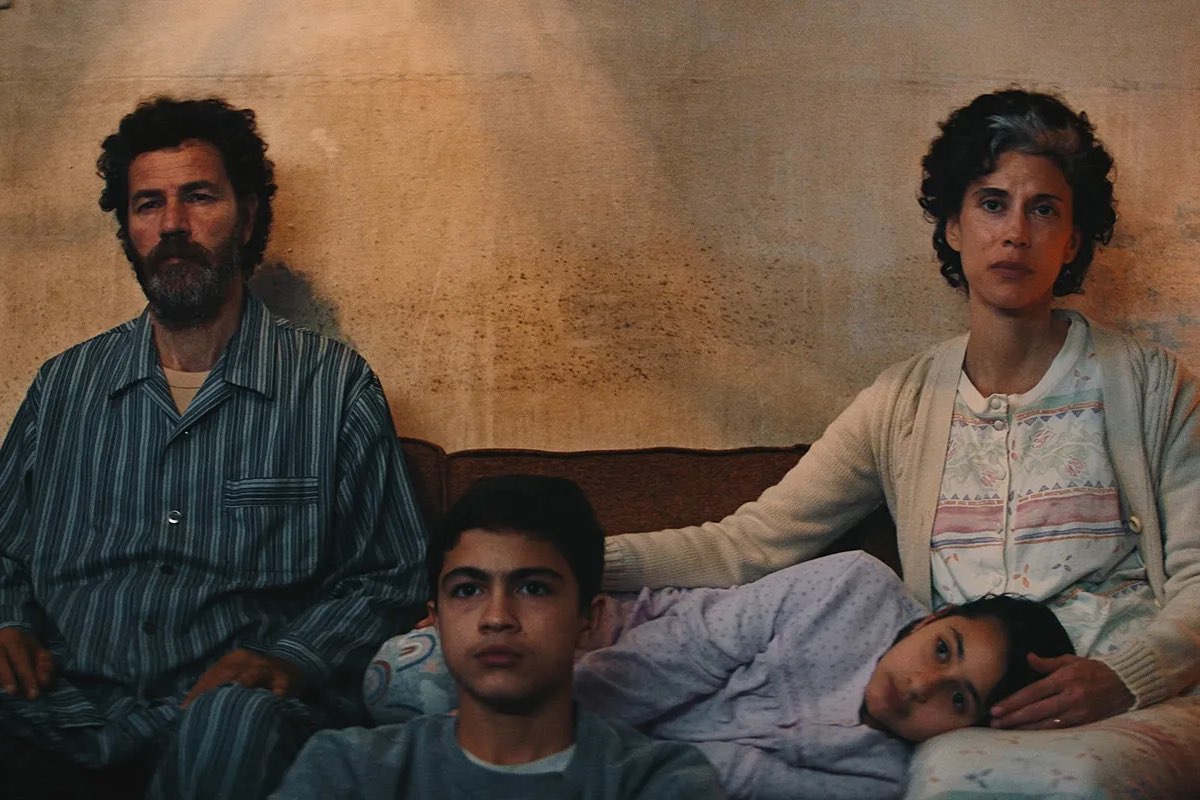
Watching All That’s Left of You, the painful but tender family portrait of a film, we can’t help but sense a “what if?” scenario. Specifically, what if the piece had been conceived and realized after the Gaza atrocity, instead of just prior? That timing might have entailed more rage and angst in a film that, despite its indignant treatment of Palestine over many decades, maintains a pilot light of humanity and family values.
The film, Jordan’s Oscar Submission this year, is the brainchild of Cherien Dabis as writer, director, producer, and also a star (as the mother). Dabis, who has worked extensively in television, including Only Murders in the Building, had this passion project waylaid by October 7 and Israel’s obliterating war on Gaza. It was delayed and forced to move locations to Jordan, Greece, and Cyprus.
Ultimately, the film succeeds in humanizing the people of the oppressed and battered nation, while going deep into the complex history of its struggles, through phases of what has been reasonably labeled apartheid and genocide. It also provides a valuable framework and chronology of the Israeli-Palestinian conflict, going back to the establishment of the Israeli state in 1948 and genocidal waves to the present.
To tell that battle-scarred story, combined with the empathetic narrative of a familial lineage through the years, expands its dimensions as a film both moving and informative. Rather than wade through the paces of a three-generation family epic, Dabis has wisely pared down to a lean and propulsive structure. Framing the almost 60-year span of the story, she bookends the telling with her mother character relaying the family — and, by association, national — saga in a conversation with a Jewish man. “I’ve never met people from the West,’ he tells her. “We are aliens,” she retorts, speaking a mouthful with the pithy comment.
The story logically begins with her son’s grandfather, who lost the family home in Orange Grove to Israeli occupiers in 1948. We progress through eras, protagonists, to 1988, with the seeds of young rage appearing in young Salim, and then to his more volatile, rage-filled late adolescence in 1990.
While it would make sense to portray the Palestinian tragedy in terms of waves of violence — on both sides — Dabis exercises admirable restraint. There are key scenes in which callously brutal young Israeli soldiers impose their sadistic will, but larger aspects of bellicose destruction are strategically avoided.
Dabis even poses questions about sovereignty and humanity throughout the story. For instance, if a Jew is the recipient of a Palestinian’s heart, are racial and religious lines crossed? That’s one of the many tacit pleas for peace and recognition of common humanity tucked into the folds of this engrossing film.
Another pressing question: Could there be an angrier sequel in the works, post-Gazan nightmare?