
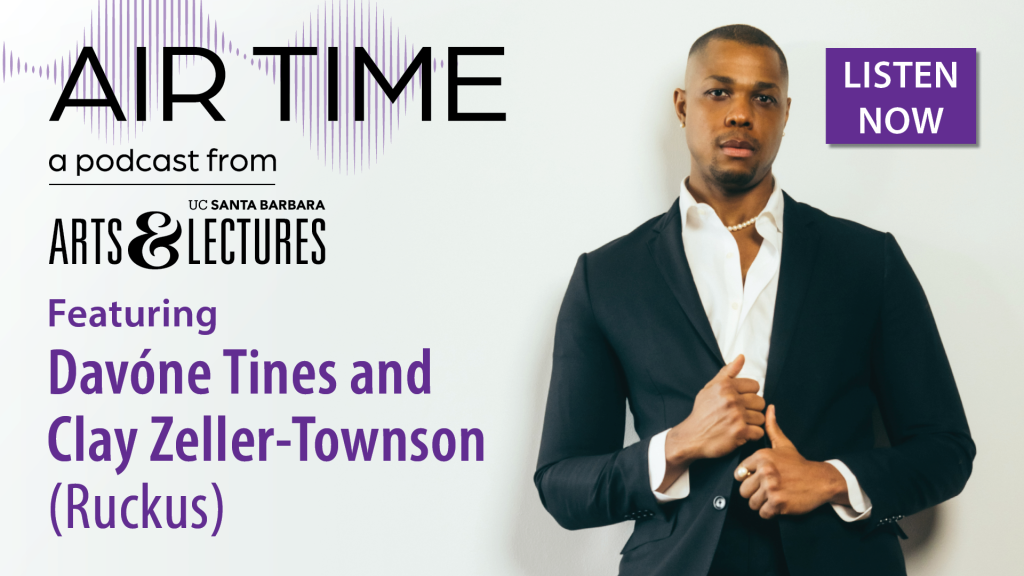
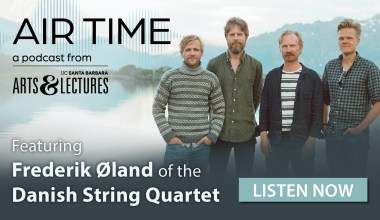
Bass-baritone Davóne Tines and bassoonist Clay Zeller-Townson of the early-music ensemble Ruckus join Air Time host Charles Donelan to discuss What Is Your Hand in This?, a powerful program exploring voice, history and American identity.
In this episode, Tines and Zeller-Townson reflect on collaboration, research and performance as acts of inquiry, tracing how early music, Black expressive traditions and contemporary questions intersect onstage.
🎧 Listen to the episode above or read the full transcript below.
About the Artists and Event
What Is Your Hand in This? will be performed on Tuesday, February 3, at 7 p.m. at Hahn Hall. Tickets and information are available at artsandlectures.ucsb.edu.
Charles Donelan
Welcome to UCSB Arts & Lectures’ Air Time podcast. I’m with Davóne Tines and Clay Zeller-Townson today, and they will be in Santa Barbara for a performance on February 3 at the Music Academy’s Hahn Hall of a program called What Is Your Hand in This?, and this program is in part a recognition of the 250th anniversary of the signing of the Declaration of Independence. Good morning or good afternoon, depending on where we are. Thank you both for being here. And I’m going to start. I’d like to do a little bit with each of you about what it was like at the beginning. I’ll start with Clay. Before Ruckus, before what you’re doing now, what was it about early instruments that pulled you in, and how did the sound or the experience speak to you from the beginning?
Clay Zeller-Townson
Thank you. Thank you, Charles and yeah, we’re really looking forward to coming to Santa Barbara very soon. I was drawn to early music because it was clear that there was a community of people working with those instruments, who were working in a way that felt very alive and that was for me, and my experience was sort of in opposition to an experience in an orchestra where, like, there’s a there’s a very one-sided conversation with conductors and ensembles. And the music of the Baroque people, I think it’s always about the people who are doing it. It’s where I felt my community was. These were like-minded individuals. It’s funny, because I’m not, like, obsessed with the Baroque period per se. I didn’t come out of that music directly as a kid. I found my community there, and that’s what Ruckus is, it’s a community. It’s a small team of like-minded individuals who approach music from a similar background, and who get all of our life force from being together and making things together, excellent.
Charles Donelan
So you were drawn to this group, this community that you saw forming around this particular set of practices, not necessarily an individual practice, but a few different things, probably.
Clay Zeller-Townson
And there’s like, if I can just expand on this, Baroque music has this dance-fueled joyous rock and roll sort of thing, and that really appealed to me, coming out of the big band tradition as a kid, that was my context as a kid. I loved playing in big bands, and I loved playing saxophone. I love being surrounded by a killer band, and I never played in an orchestra until I got to college. So that was like, it’s just that music was not really for me. I just love the bassoon. I love the sound that this thing makes. So I ended up playing that. And I didn’t need to play Brahms or Bruckner or whatever, like I wanted to be with a band. And then I found my way to that through Brooklyn, sick, great.
Charles Donelan
Davóne, when you first started training your voice, where did you imagine that it would live? Did you see yourself in an opera context, or did you from the beginning imagine something more?
Davóne Tines
Hello, thank you so much for having me here. It’s so lovely to talk to you. And also, no, I had no idea as a singer. Quite honestly, I started taking voice lessons because I was in the high school musical. I played, I think, Coalhouse Walker in Ragtime and. And I was always encouraged to sing. It wasn’t something I was gunning for. You know, my grandfather realized when I was in middle school that I had kind of a unique, bolder voice when I tried to do it that way or let it happen. And he’s the one who said, “Oh, you should audition for choir, and you should do these things,” and singing became kind of a path of least resistance. So I thought, Oh, if people keep asking me to do this, I should figure out what that is and why it’s happening, and also maybe continue the study or the grounding of skill to deliver that as consistently and healthfully as possible.
But no, I had no conception. I didn’t say, “Oh, I’m going to go to the opera stage. I want to be a Broadway star.” I just liked making sound. I’ve been doing that ever since I was little. You know, singing in church choir as soon as I could stand up and playing piano at six and playing violin for over 15 years. So I just love being in all kinds of music making, and also to what Clay is saying, which kind of like touched me a certain way, because it reminds me of my love and interest in the kind of historical performance world in a specific way. But all of my early music making was communal. All of it was about a group of people, not individuals. You know, a choir is, was my literal family and extended church family coming together to sing the most incredible, forceful triadic closed position, which to this day I am obsessed with, and then playing in an orchestra, you know, just my little stringed instrument, but like sounding like an ocean when it’s in the midst of everything else, to singing in musicals and giving the force of an entire narrative, but with a lot of other voices.
So no, I didn’t have a vision for it, but I knew I liked doing it. And I think I realized early on that I thought I would have something to say that was always something that felt odd, because at the time, I didn’t know what it was, but I thought I had this feeling, you know, okay, people tend to pay attention to me when I make these kinds of sounds. So if I make, if I do something necessary while making those sounds, maybe something positive or necessary even could occur. But I just wanted to get to what Clay was saying in terms of finding a kind of saving grace or some of your people, you know, in Baroque or early music practice, that really was true for me at Juilliard, I had worked in arts administration and done, you know, played violin for a long time, and then realized I wanted to figure out my singing for real.
And so, you know, happenstance, I just happened to go to Juilliard, or maybe the path kind of led me there, but when I got there, it was really odd, because I hadn’t been in a formal conservatory setting, you know, I’d taken private lessons, and I’d played in ensembles, but to be in this kind of structured machine of how you are to be turned into a viable player out in the world, that was really shocking to me, because it took away the agency I had experienced as a mature young adult, even in the working world. And I realized there were so many assumptions and conclusions on how I wanted to Train My Voice. You know, you go through your paces of French, chanson, German lieder and so on. But there was never a more open-ended question of, “Why are these the training tools?” Why are these the building blocks, and what else is there that’s being left out? You know, I wasn’t asked to sing a negro spiritual until my final year of my graduate program, and then that began an entire journey I continue 15 years later.
But I was once assigned to sing a remote piece with Robert Mealy, who was heading the historical performance department then, and I was asked to sing that because my voice has always been a little, quote, unquote, odd. I have a very kind of low bass-baritone foundation, and then a very high upper extension. Basso cantante is kind of an older nomenclature for that type of singing. And it’s useful for Baroque music, because parts were less standardized then there was a certain flexibility and freedom amongst all voice parts. And so they said, we don’t really know what to do with you in the opera world. Go hang out with those historical performance people and sing this weird, remote thing. And I will always remember the first rehearsal. You know, walking into a medium-sized classroom, everyone is sitting in a circle, you know, not some more, you know, formalized conductor, orchestral structure, but a circle. And you know, even the band leader, Robert. And I sat next to him, and we sang through the first aria. And then Robert asked me, “Well, how did that feel?” That blew my head off, because that doesn’t happen in the standard orchestral context. You know, the idea of your own personhood as an instrumentalist doesn’t come into play. And then the person playing the second violin. Said, “Oh, we have a phrase here together. Do you want to shape it?” And I looked at Robert as if looking for permission to speak, and he says, “Oh my gosh, yeah.” And so we, like, we found something together as a community of people. And that was one of my favorite, favorite things I’ve ever done. It was the first time I sang an Alice Tully Hall, and it was great to do it in this free way that I didn’t know existed before.
Charles Donelan
I love it. This is so helpful, because you’ve taken to these questions. Here’s the thing I wanted from this bit, this opening, because I feel like you both talked about what I see happening here, which is early music in both instances, it sounds like, is a way that you found your people, but it was also an open door for beginning to understand and appreciate the fact that no musical context is neutral, that there’s no standard or ordinary, or, you know, unmarked form, and so it’s not like you came to music with some sort of political idea. Instead, you came to music with a sound and a feeling and an appetite for community, and then that led to an understanding of the way things work and where you might want to potentially change things, right? I mean, because this is – I’m really Davóne relying a lot on these notes I have back from 2022 from Everything Rises, you know, because that was eye opening for me to hear how you two, you and Jennifer Koh connected. And you know what your thoughts were, and I was there for that performance. So I’m going to continue with you, Davóne, because I want to connect to something that you just mentioned, which was that when you began singing spirituals you’ve already been singing for a long time, and I want to ask you, was there a first moment when you realized that certain songs don’t let you simply perform them, but that they, they ask for something back, or that they, they demand a certain commitment or understanding? I don’t know, I’m not doing a good job of articulating this, but please.
Davóne Tines
Sure, I mean, it wasn’t like late grad school was the first time I had ever sung a spiritual; it was the first time I’d sung one in an academic context, or in the thrust of, you know, trying to grow into being a professional musician, you know, doing a backwards taxonomy, I’d sang negro spirituals growing up my entire life, they’re just woven into the gospel repertoire, and in my church tradition, not considered separate. They’re not considered a separate repertoire. It’s just a continuation of what’s in the hymnal. You know, spirituals in the hymnals alongside things that were composed in the 1950s and so on. You know, it’s just the larger compendium of sacred music of black, African American or Baptist tradition.
So singing it in the academic context. What I mean was it wasn’t asked of me as something to put into my quote, unquote, formal training until the very end of it, you know. And that idea of adding yourself as an individual to the training at the end is very much in practice too. I mean, it happens in classical voice recitals all the time. The standard format is, you know, you check all the boxes of, you know, French, German, Italian, or what have you. And then at the end you might sing something a little more close to your own culture, whether that be Irish folk song or whatsoever, or, you know, or spirituals. It’s always this thing that’s kind of said, Okay, you have these certain standards in place, and now you can kind of show us some of your personal flavor. We can have a whole podcast about why the self is subjugated to the very end of things.
But suffice to say, when I did, you know, explore a spiritual in the conservatory context, it was this odd separation from self. It was like taking something that was, you know, always beating in my body and putting it on a slab and trying to dissect in order to understand it. When you know, I think I already inherently had a connection to it, and further to, you know, realizing or not that certain songs require more of you. I realized that my stepping stone was not having a connection, or my stumbling block was not having a connection to the song. I realized quite early on in my professional music making that if I didn’t have a known, felt, emotional connection to what I was singing. It simply wouldn’t work in any way, you know, on the technical level, the emotional level. So then it became my work to find those emotional connections. You know, of course, singing German lieder, singing all kinds of Latin Church music and so on.
The task was to say, here are these words as some sort of story, which can also be thought of as sort of a metaphor. And how does my own lived experience pour into the contours of that story or metaphor? When I could do that, then there’s a clear psychological and emotional connection between my own lived experience and the notes that are being said, and thus they can be alive with some sort of truth of interpretation, and as I continue – not to go on too much – but I also find in master classes, you know, when I’m working with students, just getting them to actually say what they’re singing while they’re singing it, you know what I mean, not just say the words, but to actually treat the language as as an expression from their own body, as opposed to a mechanic that’s being placed on top of it. Everything just lines up. The breath works, the tone spins because we are communicative creatures. It’s what we’re literally here to try to do for our own propagation and survival. So when we just rely on that very base unit of trying to communicate, you know, the singing part of it just works, but you have to be intentional and conscious and present with what you’re doing.
Charles Donelan
Clay is there a way to connect the work that you do in Ruckus to this sense of connecting the body, the individual and the music in a way that’s not structured by an academic curriculum.
Clay Zeller-Towson
Totally. I mean, I think in the early music study, the technique you learn is, you know, you’re getting to a new instrument that’s new, like this, like, baroque bassoon was, like, pretty fresh. So I’m like, in Juilliard, and I’m like, I’ve been playing this thing for like, you know, a year and a half, and it’s different than, you know, there’s that, and you’re learning how to make music sound, yeah, the dirty word is “authentic.” And how do you know, what are these practices that are appropriate to this piece and and I think what was next, the not discussed technique that became the reason for existence for Ruckus is like, well, what’s authentic to us?
And that’s exactly what Davóne is talking about. It’s like, what range of technique, what range of style it is, it comes out of yourself and your cohort, your peers, your collaborators, and what is unique to you as a group. And let’s dig in there. Let’s excavate that archeology of history, of musical history. And then I think that’s what audiences are craving; they want to feel, they want to know you as a person and and for me, I’m usually not talking too much in shows. I’m all in. What I can do is express myself through my instrument. And so, like, you know what? What’s the range of sounds that you can get out of any instrument that you’re using? Hopefully conservatory music education can help you learn to access a range. And then, like, what is yourself like, we’re and it’s for me, like I’ve mentioned, it’s like, I just, I came out of this big band thing. I came out of the saxophone world. I love mid-century pop, and so do a lot of the people in Ruckus and that’s like this Venn diagram thing with our collaborators that is really important. We just try and find the overlap as much as possible, and I think with the show that we’re doing in Santa Barbara, like with every Ruckus show, a new Venn diagram comes out of working with a new collaborator, and it brings out certain parts of us, individually in new ways.
Charles Donelan
Let’s go with that. When did this collaboration, Davóne Tines and Ruckus, feel necessary, and was it connected to the topic, the 250th anniversary?
Clay Zeller-Townson
Well, it was natural. I mean, we’ve known each other since. I mean, Davóne, you met Doug in like, 2008 or something,
Davóne Tines
2005, Yeah.
Clay Zeller-Townson
And I met my husband at Davóne’s birthday party in 2010, years ago this week. And we did things, you know? We did things at Juilliard together. We did things after school together, and we did Ruckus. We did our first ever performance with Davóne, like we go deep, and we hadn’t, like devised a program together yet, and when we saw this historical moment approaching, we knew this was going to be the thing.
Charles Donelan
Okay, so now we’re at the moment. In terms of the conception of this piece. In the short description I have here, it says “The Quest for a Better World Continues Through the Present Moment.” And the title, What Is Your Hand in This?, that’s a really interesting title. That’s not like, let’s celebrate American values, that feels confrontational and that “your hand,” is that the listener? Or is that from a lyric? How did you get that? How did that come about? Because I’m fascinated by it. I want to know more.
Davóne Tines
Yeah, it comes from a song that I wrote. And the song is called, “What is my hand in this?” And it’s, if I can be completely frank, it’s a song I wrote for a Christmas party of billionaires. Because, you know, a lot of my work tries to be – or hopefully all of it – is very respective of the context in which it happens. I’m very personally averse to the idea of entertaining. I think I do it sometimes, but mostly, if I’m singing something, I want it to be for a reason, you know, some sort of prescribed intention that this interaction could portend. And in this time of, you know, Christmas or celebration, especially in a time of real complexity, of course, in America, specifically in the past years, I didn’t want to just, you know, put another candle on the tree. I wanted to say, Okay, this is some sort of time of self reflection in the midst of change, if not celebration. And can’t we use that space to question how we’re connected to things? You know, people read things all kinds of ways based on how they are feeling or on how they find themselves.
The question “what is your hand in this?” doesn’t necessarily have to be a confrontation. It could be an invitation, you know, how are you connected to this? What is your part? You know, not saying you must contribute. Or, interestingly, maybe that comes out of, you know, a capitalistic way of thinking. Generally, you have, I have, what do we each give or put in? That’s also community. But the song is, “What is my Hand in This?” In the piece, because some of the words are as you, as you fret upon your woes and cast the blame upon your foes. Please ask, what is my hand in this? Meaning, trying to think of one, how you’re connected to something, two, your own culpability, potentially, but most importantly, your own agency. What are you actually able to affect based on what you’re able to externalize about your own experiences? You know, it goes quite beyond just naming that something is not the way you’d like it to be, but to actually walk through the the taxonomy, a word I love, of how we got there, and how anything for even your own comfortability, might change, and that can only change through reflection. So the song at the core of the piece is, “What is my hand in this?” that then changes into the title of the program. “What is your hand in this?” Meaning, how are you connected to everything? If something is existing the way you don’t want it to be, how do you have agency in changing that? And if it is going to where you wanted to be, how are you contributing, right?
Charles Donelan
Oh, man, this really gets to the heart of something that we have actually had quite a few conversations about here in the Arts & Lectures organization, as we think about this anniversary and about the ways in which different organizations that we are related to, Carnegie Hall, you know, they’ve got something. And all of us, I think, are concerned that, you know, a patriotic celebration right now feels complicated. You know, this is not just sort of “we’re so good. We got where we are because we’ve always been right.” I mean, far from it, right? And it feels almost like a little bit of a stress test, the 250th anniversary. But this is why this program has such resonance and is so exciting for us to be presenting, because I get the feeling that these are open questions for you still. I mean, what are the questions that you’re kind of sitting with as you work through this material? What is still kind of ongoing for you when you’re performing and rehearsing the music that you’re going to play for us.
Clay Zeller-Townson
You know, if I can jump in, the things that feel important, there’s two things. One, I like to think that it’s a patriotic gesture at the heart of this, in that we are like this country, was founded on dissent, and that is what we’re celebrating, the ability to ask questions, right? So that’s like, what we’re showing, you know, 400 years of music that asks questions to people about power. So you know, yeah, we’re not releasing 250 red and white and blue balloons.
Davóne Tines
We should, we should.
Charles Donelan
We could get to work on that for you.
Clay Zeller-Townson
And then, within that, can you hold compassion and empathy for people who you disagree with? I think that’s been, like, one of the things we’ve been trying to hold on to, and is a challenge, right? We know we encounter people in this piece that we’re making. They’re authors who are difficult to sort of reckon with, and can we like them? Can we do the work of loving, you know, people who we really like have some issue with? That’s not easy, period. And I hope that there’s this warmth at the center of this show, you know, I think that’s a really important thing. This compassion is really at the core of what we’re doing.
Charles Donelan
That’s great. And Davóne, as you pointed out, it doesn’t have to be a confrontational question. It can be an invitation. What is your hand in this can be an opening to a bigger, more interesting, more inclusive conversation. And I know it’s a question we’re going to keep asking after you guys have been here and for a while, because let’s hope we get another 250 years of something good. Thank you both. So much. Anything else that you want to say? I’ve already kept you a little longer than I asked for initially, but I could talk to you all day,
Clay Zeller-Townson
I’m very excited for people to experience this program. You know, we put a lot of love and thought into it over two years, and it’s just really exciting for all of us to share this potential for reflection, you know, with as many people as we can at a time when it’s important for us to slow down and actually be introspective so that we can look out and perhaps be of use.
Charles Donelan
I love it. Thank you so much, both of you. Clay Zeller-Townsend. Davóne Tines, thank you for participating in Air Time with UCSB Arts & Lectures, and we will see you on Tuesday, February 3 in Santa Barbara, thank you.





You must be logged in to post a comment.