Be Kind to Little Animals

A favorite poem from my childhood reads as follows: “Be kind to little animals / Whatever sort they be. / And give to stranded jellyfish / A shove into the sea.” The Santa Barbara Wildlife Care Network doesn’t take care of jellyfish, but it will take care of just about every kind of vertebrate creature to be found in the Santa Barbara area.
This week, I visited Julie Parker, director of animal care, at the Care Center in the Fairview Shopping Center in Goleta, which had just three humming birds, a cedar waxwing, and some doves in residence. Spring is here, however, and with it comes a multitude of baby birds, rabbits, raccoons, possums, skunks, small mammals, deer, snakes, and other reptiles. Some of those living in Santa Barbara County may one day be helped by the almost entirely volunteer-operated Wildlife Care Network. While Fairview’s center cares primarily for birds, satellite centers across the county help out seabirds, possums, raptors, reptiles, and even skunks. Around 3,000-4,000 animals are treated at Fairview’s center and the satellites annually, with more than half being successfully rehabilitated and returned to the wild, within a three-mile radius of where they were found.

The goal is to get most of these satellites-currently in people’s homes and backyards-consolidated on a property the Care Center owns on North Fairview Avenue and to have a resident caretaker onsite. This will give relief to the many volunteers whose homes have become virtual animal hospitals over the years. First to be constructed will be a seabird facility. This will be welcomed by the volunteer who has been lovingly treating seabirds in her back yard for the past 10 years!
If you find an injured or orphaned animal, you can call 966-9005 to arrange for a pick up. Or you can take the animal directly to the Care Center, which is open from 9 a.m. to dusk. They can also advise you on what to do to help the animal in the meantime. Sometimes it is better to leave baby animals where they are so their parents can come back to them. (The one group of animals the center does not work with is marine mammals. Calls about seals, dolphins, and whales are referred to the Marine Mammal Center at 687-3255.)
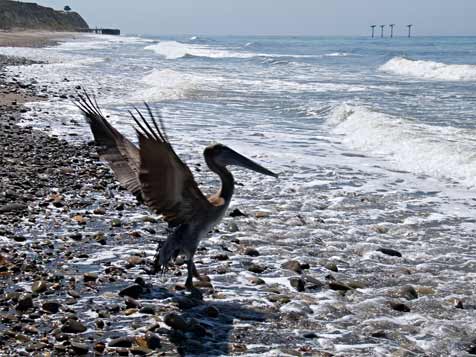
Most of the animals brought into the Wildlife Care Network are juveniles. Seabirds are an exception. Adult seabirds may be incapacitated by oil, caught on fishhooks, or entangled in fishing line. Diving birds like pelicans, cormorants, and grebes are especially vulnerable. Oiled birds are sometimes sent to a treatment center in San Pedro. Once they are cleaned and healthy again, they are taken to Haskell’s Beach and released back into the wild.
Parker explained that just because a young bird is on the ground does not necessarily mean it is in distress, however. A fledgling bird making its first flight may end up on the ground. The parent will continue to feed it there, and it should be left alone unless it is in danger. A younger nestling without feathers on the ground has probably fallen out of its nest. If you can see and reach the nest, you can pick the bird up and put it back. If its nest is damaged or destroyed, then the baby bird should be brought in to the center. Nests often get damaged during pruning. If possible, pruning should be done in January or February, before the nesting season begins.
These services would not be possible without volunteers. They are needed for office work and answering phones, transportation of animals, making up diets, feeding animals and cleaning cages, and sometimes 24-hour care at home. Baby birds and mammals-like human babies-need frequent feeding, so this can be a full-time commitment in the early weeks. As the nesting season gets in full swing, the center is seeking more volunteers. Call 966-9005 or visit sbwcn.org for more information on how you can “be kind to little animals” this spring.
Goleta Grapevine appears every Monday morning online at independent.com/goleta. To contact the author, who helped craft the original General Plan during her time as a councilmember and as mayor, email margaretconnell@earthlink.net.