• CREATE AN ACCOUNT
  • LOG.IN
  • CONTENTS
  • CLASSIFIEDS
  • ARCHIVE
  • INFO | ADVERTISING | CONTACT US

  • Home
  • News
    • Business
    • NewsFlash
  • Arts & Entertainment
    • Movie Times
    • TV Listings
    • A&E Blog
    • Art Galleries
    • Best Bets
  • Opinion
    • Columns
    • Voices
    • Letters
    • In Memoriam
    • Obituaries
  • Events
    • Today
    • Search
    • Submit
    • Best Bets
  • Living
    • Outdoors
    • Travel
    • Sports
    • Peeps
  • Food & Drink
    • All Restaurants
    • Delivery
    • All Bars & Clubs
    • Drink Specials
    • Open Now
  • Classifieds
    • Real Estate
    • Jobs
    • Autos
  • Personals

Photo: Ray Ford

The Hidden Costs of Mountain Biking

A Trip Up Romero Canyon With Native Plant Enthusiast Frank Sovich


Thursday, May 8, 2008
By Ray Ford (Contact)
Article Tools
Print friendly
E-mail story
Tip Us Off
iPod friendly
Comments
Bookmark This
del.icio.us. del.icio.us.
Digg! Digg!
furl furl
google google
newsvine newsvine
reddit reddit
technorati technorati
Facebook Facebook
Yahoo! My Web 2.0 Yahoo!

Frank Sovich loves hiking Romero Canyon and you can tell it as we walk up the trail. We stop at one point to check out a cluster lupine along the edge of the trail, perfectly placed to provide a dash of color to the overwhelmingly green canopy that covers most of the skyline. The joy on his face as he tells me about them says it all.

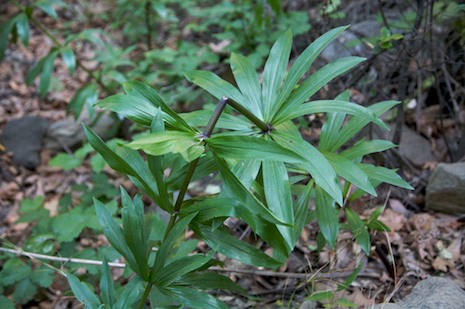
Frank is from Carpinteria but with no trail access there he spends much of his time hiking Romero — often once or twice a week. “I’ve got a thing for native plants,” Frank explains, “and the canyon is a great place to enjoy them. Over the course of the next hour we check out a dozen or more other plant species including one of my favorites, the Humboldt lily (Lilium humboldtii), a tall thin reed-like perennial that grows to heights of 8 feet and produce clusters of the most intensely brilliant orangish-yellow flowers, jewels of the canyon if only for the few weeks when they are in blossom.

“I’m not quite sure why this year,” Frank tells me, “but they’ve come up in much larger number than I’ve seen in quite a while.” At one point just above one of the many creek crossings there is a small pool, perfectly located about halfway up the canyon trail. We stop to splash a bit of water on our faces, sit back enjoy the sound of a nearby canyon wren and the small waterfall that cascades into the pool. It is an idyllic moment, the kind that makes having such places so close to Santa Barbara such a special treat.
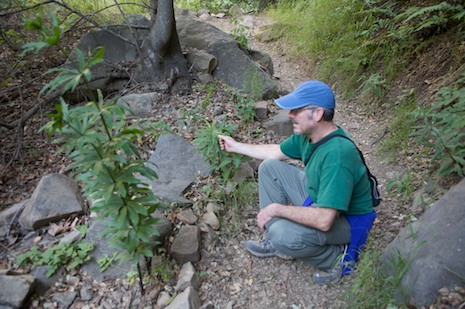
Trailside plants are especially susceptible to damage by users. Frank has added rocks along the edges of the lillies to discourage bikers from hitting the plants.
Click to enlarge photo

Photo: Ray Ford

Trailside plants are especially susceptible to damage by users. Frank has added rocks along the edges of the lillies to discourage bikers from hitting the plants.

Then we are back on the trail again. A few minutes later Frank points a long section by the side of the trail that is filled with several dozen of the lilies. “Look closely,” Frank shows me, “many of the stems are broken in half. A few others are just plain crushed.” It becomes evident after a bit of looking about that the reason for the damage is the increased use of the trail by mountain bikers who aren't always good at staying on the trail.

Photo: Ray Ford

As we continue up the trail Frank points out numerous places where the trail is being widened as the bikers seek out new lines to follow. “I’ve been hiking Romero since the early 1990s and regularly for the past 4-5 years and I’m seeing more and more damage,” Frank adds. “It isn’t just the impacts from the mountain biking but the rapidity of the damage they are causing.”

It has gotten to such a point that Sovich is now placing small rocks along the sides of the trail where the lupine lilies and other fragile canyon vegetation grows to help keep them from being run over. That may save a few plants but he wonders what the canyon will look like another ten years from now if the use increases.

Mountain bikes cause the trail to become grooved when they speed down the trail and brake hard into the corners.
Click to enlarge photo

Photo: Ray Ford

Mountain bikes cause the trail to become grooved when they speed down the trail and brake hard into the corners.

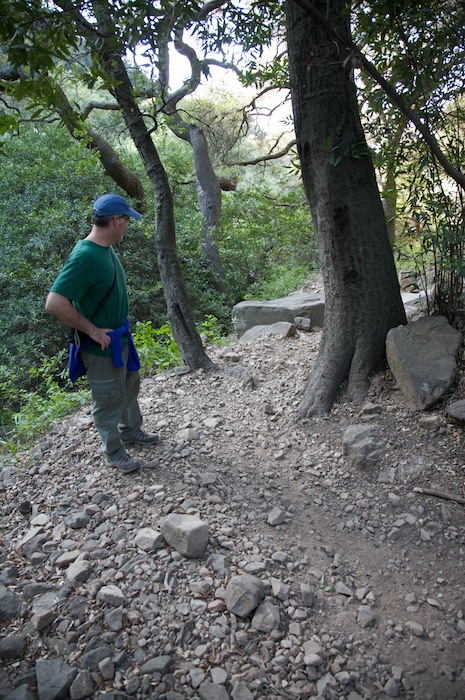
The damage is especially evident where the trail gets steeper and particularly where it is both steep and rocky — which is about 80% of the trail. “Not only are some parts of the trail now 5-6 feet wide, in many places the bikes are riding up on the side of the hills above the trail, widening them even further,” Frank adds. “Then there are the impacts caused by over use of the brakes when the riders go so fast down the trails. The trail getting more grooved and the tires are knocking rocks down on the trail, making it especially difficult to hike back down the trail without slipping all over the place.”

This past March 22 marked the day Sovich decided he couldn’t take it anymore. Over the forty-five minutes that it usually takes him to hike up the canyon with his dogs, 17 mountain bikers came by. “They were all polite,” he remembers, “and there wasn’t a question of either me or the dogs being in danger. It was what this kind of use was going to do to the canyon over time.
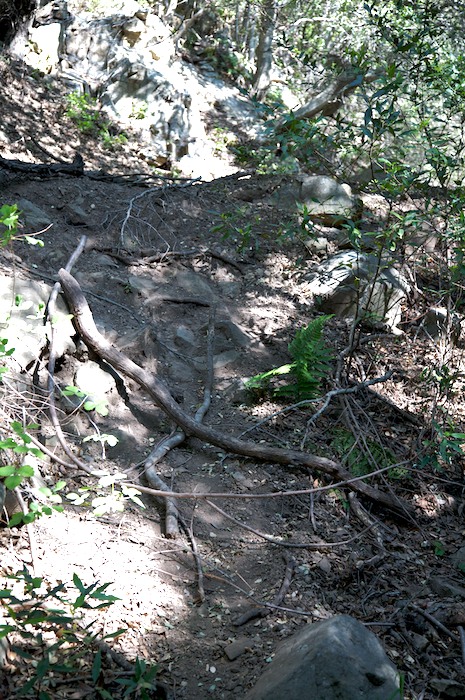
Photo: Ray Ford

This is an example of a spot along the trail where mountain bikes have cut a new shortcut down a steep section. The branches have been put in place to discourage continued use by bikers.

“I’m not normally very aggressive when it comes to standing up and saying enough is enough, but that day that many mountain bikers coming down the trail was a few too many. When I got home I took out a list I’d gotten from one of the local trail groups of newspapers, agencies and organizations and started writing to anyone and everyone.”

While many trail user organizations, especially those committed to keeping the trails open to mountain biking, were busy defending their rights at the Task Force meetings set up to study user conflict issues on the trails, Sovich was taking a different point of tack, choosing to speak out for the protection of the trails themselves and the canyon ecosystems rather than the users themselves.
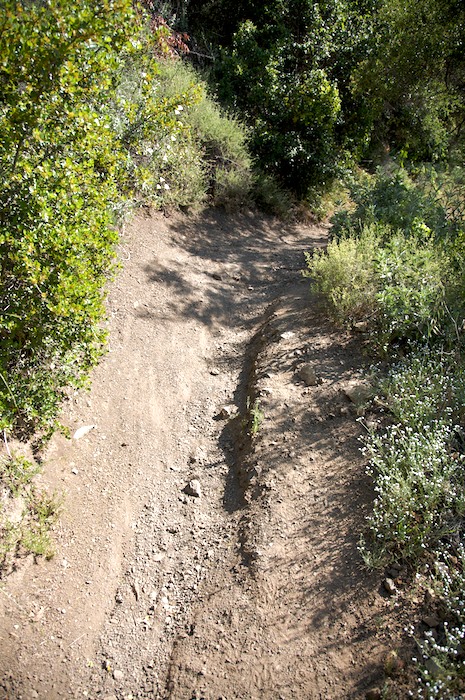
Once the grooves begin developing the trail can break down quite rapidly.
Click to enlarge photo

Photo: Ray Ford

Once the grooves begin developing the trail can break down quite rapidly.

“Is anyone out there talking about what the costs are for allowing downhill use of the trails by mountain bikers?” he asked. “It isn’t just the damage to the plants or the trails, it’s the increased cost of maintenance, the added trail signage, the money we’ll need to come up with to rebuild the trails to accommodate mountain biking, the impacts on other trail users rights, the difference it makes psychologically when you add mechanized vehicles on the trail — these are big costs.

“Does the community really understand how much it will really cost and what the impacts will be if we don’t close at least some of the trails to mountain biking? If I were king for a day, I’d close the Romero Canyon Trail for sure, especially since the old road provides a perfectly great route for them to get up to the top of the mountains.
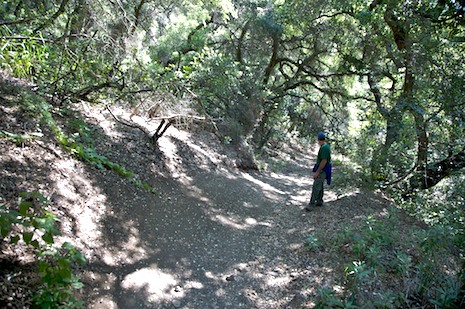
Photo: Ray Ford

Mountain bikers have the capability of going off the two-foot wide tread and often do as shown here where they've scarred the hillside above the trail.

“Then I’d take a new look at how we define multi-use. For mechanized uses such as mountain biking, generally the trails are open until someone proves they shouldn’t be. It ought to be the other way around: the trails should be closed to those uses until it’s proved they’re not only safe but the damage they cause can be dealt with.”
Story Help (Click-ability)
Double-clicking on any word or phrase in this story will open a reference window with definitions and links to other reference material.

Comments

Discussion Guidelines

I see you are on an anti bike campaign. What are the ethics of using your position as a member of the press to reinforce your personal agenda? Your arguments against bikes on the trail have a couple of holes and are misleading. Studies have shown that bikes, hikers and horses do about the same amount of damage, so it is just as valid to suggest eliminating hikers instead of bikes. I think the picture showing the illegal cut back is from hikers not bikers. ( I will have to investigate, but I have never seen this cut back on my bike). The trail maintenance cost you declare to be prohibitive is more than covered. There are now many volunteers maintaining the trails and many are mountain bikers. Mother nature will cause way more damage than any user group. Are you going to regulate Mother Nature next? If the plants you are showing are that endangered the trails should be shut down. Otherwise they are unfortunate victims of all users. Are you sure no dogs or people or horses have ever toppled over any vegetation? Once again I must point out that you are causing problems for multi use not solving them. Don't make me go out documenting hikers and the damage they do, or start finding the hikers that have sabotaged the trail attempting to hurt and maim people on bikes. Please figure out a more productive approach.

toadalee (anonymous profile)
May 7, 2008 at 8:31 p.m. (Suggest removal)

I haven't seen this week's hardcopy edition yet, but the main problem I have with this online article is as of Thu nite, I can't tell whether this is a news piece, a part of the opinion section, Voices, or Ray's column (it doesn't seem to be accesible from any of those links, I got here from an e-mail link).

If this is an opinion piece, then I'd ask the editors to identify it as such and leave it at that. But if this is a news article, then I think its rather one-sided. It fails my test when I ask ... "Does it help me understand all sides of an issue?".

EastBeach (anonymous profile)
May 9, 2008 at 1 a.m. (Suggest removal)

Right on Ray!

Goletaman (anonymous profile)
May 9, 2008 at 7:13 a.m. (Suggest removal)

Agree that Ray is on an obvious campaign to eliminate mountain bikes - from the front country trails at least. How can we keep trails available to responsible users, and restrict the abusers (whether on bike, foot, horse, etc)?? I recall that on Mt. Tam in Marin County they would give out painful traffic tickets to abusers. I love the front country trails - and use them responsibly and politely on horseback, foot, and bike. Many of us are neighbors, taxpayers, and MTF donors/volunteers who do! There are ways to share them, and ways to use them responsibly. The answer is to find ways to deal with the abusers (whether on foot, horseback or bike), not discriminate against a whole class of valid users. I am offended by Ford's use of the Independent's news pages to push a one-sided agenda without giving equal time to the other side of the opinion "fence". Signed, ex-Ford fan.

jvillan (anonymous profile)
May 9, 2008 at 8:50 a.m. (Suggest removal)

To Ray and others, I should clarify my concern is a journalistic one. The power of the pen is well known and I don't doubt their are some Indy fans who might read a non-opinion article and be swayed to one side (sub-consciously or not) if multiple voices aren't heard in the article. After all, isn't fairness one of the things that differentiates a community newspaper from a blog?

This is not to say that there isn't any value in the article or that it shouldn't have been written. On the contrary, I thought it was interesting to read Sovich views. It helps me understand the spectrum of trail users concerns. And I'm very glad someone is writing about them. Nevertheless, the presentation concerns me.

At a minimum, I would have preferred to see a short introduction that states the article looks at a unique viewpoint among many different and strongly held opinions before diving in. Pedantic? I believe its needed for a non-opinion piece.

An interesting alternative would be a series where each article focuses on a particular viewpoint. The first article could be an introduction/primer to trail use issues followed by the viewpoint articles (the article on Sovich would easily fit in). Obviously this would be a tricky series to write and I'd hope it would be written in a way that could bring sides together rather than factionalizing them further. But this would be a great vehicle because it implies there was consideration by the author for analysis and even-handedness prior to the articles appearing.

However, if one claims that this has all been done before, and/or Sovich's opinions are so unique that they deserve its own article, then I would say fine, print it, but put it in the opinion area. The same goes for any other particular trail use viewpoint.

EastBeach (anonymous profile)
May 10, 2008 at 2 p.m. (Suggest removal)

For a well rounded perspective on the issue of trail usage in the frontcountry, it would be good to hear from one or more of the above commentary sources in an article in defense of their point of view, philosophy, and findings to their proposed studies. I don't necessarily think that Ray needs to publish a myriad of articles simultaneously, but rather develop the issue over time...which is what one would assuming is going to happen.
anxious to read more on this topic...

humanimalhybrid (anonymous profile)
May 11, 2008 at 11:15 a.m. (Suggest removal)

I'm glad the story provoked a lot of discussion on issues that for want of a forum, have really been ignored. Almost all of the conversation regarding user conflicts has been done more or less under the banner of trail safety, with one side blasting mountain bikers for making the trails unsafe and bikers on the other side defending their rights to use the trails.

As you can see from some of the comments above, the issue is very emotional — and unfortunately some of it takes on the tone of current politics — which is to defend one's point of view at all costs and to admit nothing that might strengthen the hand of the other side.

Well first, no one seems to be talking about what the impacts are of use of the front country trails. There are costs, and in some cases it appears major costs, especially given the paucity of resources we have to deal with the impacts.

Frank brings up a number of good points and we should be discussing those rather than ganging up on whoever brings them to the table, whether Frank or me. I'm not out to get mountain bikes off the trails but I do believe we need to have honest discussion regarding their impacts and to how their use affects other trail users.

Getting a handle on how we feel about mechanized use of the trails is one of those points of discussion as is what damage they cause to the trails. As technology develops there will be other forms of trail travel that could lead to issues we haven't yet thought about. It is fair to talk about these kind of issues and to make sure we are clear about what purposes we want our trails to serve, how we will go about making sure they can be maintained to a standard that is sustainable and that both the natural environment and its inhabitants are protected along the way.

So, yes, let's have the discussion. What Frank saw over the last 4-5 years is a trail that he has seen change. Perhaps not so much that it would bother some but it did him. The trail is widening in places, there is more loose rock and gravel on the trail, there are ruts on some of the steeper sections and several of the switchbacks are being damaged. I walked up the trail with him.

These aren't figments of the imagination — they are real impacts — ones we need to look at from a variety of perspectives: one of them is whether it is worth having bikes on the trails given these impacts. I would suggest that isn't a practical option. Another is whether or not the impacts can be mitigated and what the cost of doing so is. Still another is working out what types of educational programs might be put in place to change attitudes and habits. Another might be looking at a monitoring program that assesses use and regulates it according to impacts.

The bottom line from my point of view is that we cannot afford to ignore the fact that there are impacts and costs associated with them. How we deal with them is up for discussion.

So let's continue the dialogue but please can we tone down the emotions?

riveray (Ray Ford)
May 11, 2008 at 1:05 p.m. (Suggest removal)

If you don't want people to be emotional you need to be much more responsible about how you write things. You have attacked a user group and then play it off like you were just trying to explore issues to get people to talk to resolve issues. If you don't want fire don't light the match.

The switch backs that you referred to are not primarily from bikes. From what I saw they are from foot travel. That would not be a good alternative path for a bike. For one it is just as easy to continue down the trail, and two if you did not take the first one the second one would be impossible to turn into. So how did it get there? The ironic thing is that you did not include a picture of the switch back a little further down the trail or discuss why it is there. I witnessed a dog come down the cut back and slide dirt down it. It is not a cut that a bike would take as it would jam you into the wall. Did Frank have his dog on a 6 foot leash and keep it on the trail? My guess is the dog ran free on and off the trail and used the cut back that you are blaming solely on bikes. It might have even toppled the lily too. If a bike hit those lilies it must have been from a crash. Bikes don't just wonder around off trail like a dog, horse or hiker can and do.Can you do an article on the costs of dogs on the trails.

In general the trail is in amazing condition. If it is a little wider because of bikes that is a good thing as it gives room to safely pass other users and keeps the vegetation back so we do not have to spend money grooming the trail as much. I am not seeing you or Frank point out all the broken poison oak twigs.

My concern with any user pushing against other users is that it then becomes more tedious and annoying and expensive to manage the users than to maintain the trails. If you really don't want to chase bikes off the trails then stop pushing. Do you really want trail cops? Right now it is a great place for many people. Let's leave it at that and use our energy for maintenance and education. And let the Front Country Task Force do their thing.

toadalee (anonymous profile)
May 13, 2008 at 4:21 p.m. (Suggest removal)

Post a comment

Username:
Password: (Forgotten your password?)

Comment:

EVENT CALENDAR

Previous Month | Next Month

Today's Events Best Bets Submit an Event

Local Weather

Currently:
Clear Sky
Temperature:
54.0°
Wind:
8 SE

Surf Report
  • Specials
  • InPrint
  • Top Emails
  • Summer Camp Guide 2008
  • Wedding Guide 2008
  • SBIFF 2008 All Access
  • 2008 Election Info
  • Best of Reader's Poll 2007
  • Local Bands
  • Kid's Mother's Day Issue
  • Blue & Green Guide 2007
  • Made in Santa Barbara
  • Zaca Fire 2007
  • Five Candidates Vie for the County’s Hottest Supervisorial Seat
  • An Interview with Willie Brown
  • Judge Joe Lodge Dies
  • U.S. Military Measures Climate Change
  • A Taste of Hotel Café Helps Bid SOhO’s Anna Zamir a Fond Farewell
  • Wheels of Hope
  1. Nuns Leaving Town
  2. Judge Joe Lodge Dies
  3. The Hidden Costs of Mountain Biking
  4. Montecito Debates Rick Caruso’s Miramar Remodel
  5. Crispin Leather Closes
  • CREATE AN ACCOUNT
  • LOG.IN
  • CONTENTS
  • CLASSIFIEDS
  • ARCHIVE
  • INFO | ADVERTISING | CONTACT US
Google
 
Independent.com Web
Copyright ©2008 Santa Barbara Independent, Inc. Reproduction of material from any Independent.com pages without written permission is strictly prohibited. If you believe an Independent.com user or any material appearing on Independent.com is copyrighted material used without proper permission, please click here.
This is our Privacy Policy.