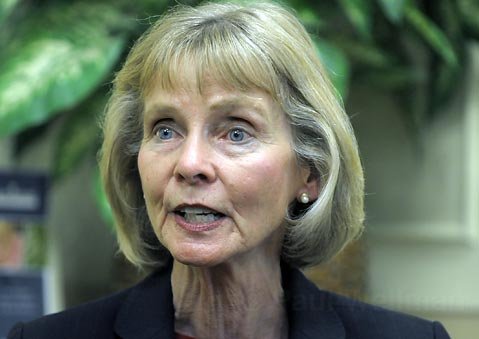
During an Energy and Environment Subcommittee hearing on Tuesday, June 15, Representative Lois Capps wasn’t shy about calling out BP America Chairman Lamar McKay and Shell Oil President Marvin Odum on their companies’ perceived failure to invest significant time or money in developing new ways to mop up spilled oil. Comparing Santa Barbara’s 1969 spill to the current Gulf disaster, Capps took the two to task for using the same cleanup methods today that were employed more than 40 years ago, especially, she said, when their companies have sunk countless dollars into exploration, extraction, and lobbying. Here’s a transcript of her questions and the oil execs’ responses.
Capps: Mr. McKay, last year you testified before the Natural Resources Committee. You had this to say about the role of technology and the oil and gas industry: “The energy industry isn’t usually classified as a high tech business, but it truly is. This technology has been instrumental is protecting the environment. Today’s offshore oil drilling technology bears about as much resemblance to what was available in the 1960s as a rotary dial telephone does to an iPhone.”
That was a very interesting comparison. Let’s look at it, to get the picture of the contrast.
First we have a picture of a rotary dial telephone. Then, an iPhone. Clearly there’s a difference in technology. And we certainly all benefit from those remarkable advances.
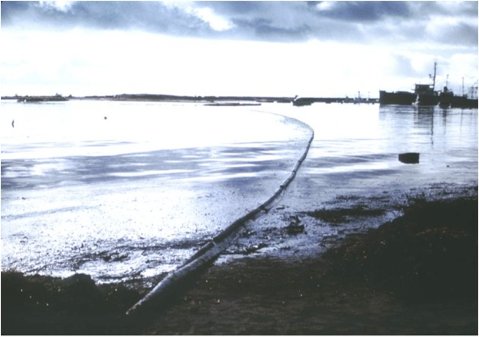
Now, here’s a picture I’m very familiar with, a picture of the boom used in the Santa Barbara oil spill in 1969. That was about the era of the rotary telephone. Now here’s a picture of the boom used in the Gulf today, 40 years later.
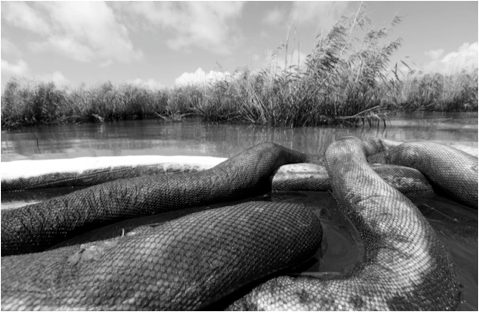
Do you see a big difference between the boom technologies used in these two pictures?
McKay: I don’t see a big change in boom technology. There have been tremendous changes in how boom is deployed and how satellite imagery helps deploy resources into the best possible places.
Capps:Yes we do have satellite imagery now, but that was the era of the rotary telephone. We now live in the era of the iPhone. And it looks a lot, on the shoreline of the Gulf, as it looked to me in 1969. The two cleanup booms however they are deployed look and act pretty much the same. Would you agree?
McKay: That’s true …
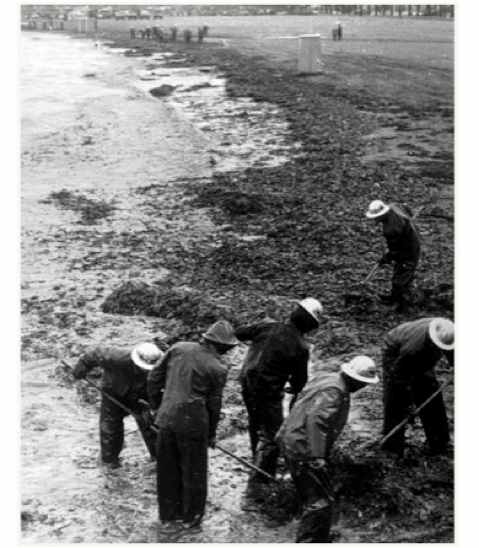
Capps: Now let’s look at another set of pictures. Here’s a picture of workers cleaning up the oil in Santa Barbara. Again, 1969. Now, here’s a picture of a worker mopping up — with his own two hands, bare hands I should add — oil that reached the Gulf’s shore. Again, I don’t see a huge difference in technology between the clean up in Santa Barbara and the clean up now underway in the Gulf.
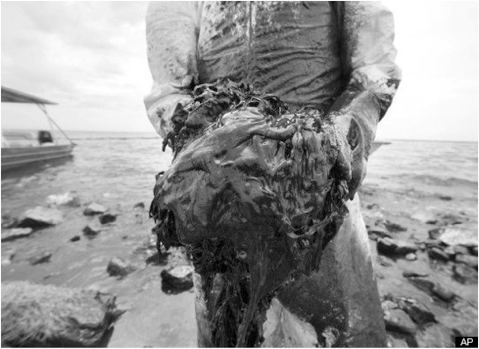
If fact, I don’t see much difference at all — booms, workers mopping up by hand thousands of barrels of spilled oil. So, Mr. McKay, I get that the industry spends a lot of time and effort on exploration and extraction and lobbying. But my problem is that you don’t seem to spend very much on accident prevention and you seem to have made few, if any, real developments on oil spill cleanup. We’re talking about 40 years later!
So, here’s my question: What’s BP’s plan on containing the inevitable accidents from your offshore rigs, which are drilling in harsher and more difficult conditions?
What is it going to look like, 10 or 20 or 40 years from now, when there is another huge spill — to see booms being the big line of defense for our coasts? Will we still be relying on thousands of cleanup workers mopping up the beaches by hand?
Will that be considered state-of-the-art cleanup technology and response, like it is today and like it was 40 years ago?
McKay: We’ve talked a lot about prevention today so I won’t go into that, but in terms of spill response I think one area that we will learn from this incident will be the ability to do more subsea intervention …
Capps: Well okay, but I’m talking about the oil that comes to the surface. Let me switch to the May 12 Oversight and Investigations Subcommittee hearing: a Transocean document was revealed that discussed the strategy of using floating boom to contain oil.
This document warns, quote, “The recovery rate of oil under the best circumstances rarely exceeds 15 percent.” And that’s 15 percent of the oil that reaches the oil’s surface. It’s not a very impressive rate of recovery and what’s more disturbing is the fact that the rest of the proposed techniques are not particularly effective either.
For instance, Chevron’s and BP’s plans that the Chairman held up earlier caution that some marsh cleanup techniques “destroy much wildlife” and “destroy marsh areas.” And Shell’s oil spill response plan describes an approach that stands out from the rest. Section 13 of the Shell plan states that oil will accumulate on places like sand bars and barrier islands. The plan states that this can be, quote, “very helpful” and “cost effective” for collecting the oil. Mr. Odum, does Shell really believe that it is “very helpful” when oil washes up on the barrier islands?”
Odum: Clearly not, and I think the statement is just meant to go to the fact that the ability to stop further encroachment and cleanup, and that’s what’s intended by the statement.
Capps: Do you have any other information? If I had time, I would ask each of you: Is this the state of affairs for cleanup today?
Odum: The answer is yes, you’re seeing the deployment of the technology today to respond to the spill.
Capps: So that’s the best we can do?

Print friendly
E-mail story
Tip Us Off
Comments
Share Article
Myspace


Previous Month


Comments
Why is she asking oil executives? Lois Capps needs to ask me why oil spill clean up technology has lagged, because I can give an intellectually honest answer.
The federal government capped liability for oil companies to pay for oil spills at $75 million. That is a ridiculously meager amount compared to their profits.
Let's brighten this up with an analogy. If the government capped the amount drivers were responsible for damages they do to other people's cars in an accident at $1,000, would anybody buy car insurance? Maybe, but the car insurance would only pay out a maximum of $1,000 so it would only cost probably $10 a month. This might sound fantastic to those who have high car insurance premiums, but what about everybody else? How do they benefit? Now they have to pay additional taxes to come up with all of the extra damages. Beyond that, the bigger problem would be that the government would be creating a moral hazard. Getting in an accident wouldn't be as big of a deal, although nobody wants to end up in the hospital so it wouldn't drastically change driving habits, most people would still drive relatively safe. So the oil companies are 'relatively safe' when they pump wells and transport oil.. but they don't have full responsibility for what happens, so there is no incentive to develop clean-up technology. Does Lois Capps honestly expect the oil executives to develop this stuff out of the goodness of their heart? Sorry Lois, that isn't happening. Now you give them a business reason to develop clean up technologies, full liability in oil spills, and you will see technology develop.
Lois Capps needs to learn about the magic of the free market. The same thing happened to our financial system in the recent collapse, government gave too many guarantees on loans and the Federal Reserve artificially lowered interest rates and single handedly created the housing bubble. A free market never would have allowed the housing bubble to occur in the first place, and there would actually be much less fraud.. although EVEN IN THE FREE MARKET fraud is still illegal, many people seem to think that free market means no rules. Contracts, theft and property damage are still prosecuted by the state in the free market.
loonpt (anonymous profile)
June 18, 2010 at 5:01 p.m. (Suggest removal)
"The federal government capped liability for oil companies to pay for oil spills at $75 million. That is a ridiculously meager amount compared to their profits."
Uh that doesn't apply if there is negligence. And there was a lot of negligence here.
"Contracts, theft and property damage are still prosecuted by the state in the free market."
Agreed, but it has its limits when it comes to tragedy of the commons, google it.
I am happy that Capps made this guy squirm, thanks, keep it up and I'll vote for you again Lois! These oil booms are meant for PR only. Reality is, oil cleanup is still haphazard and it's all PR. Oil booms don't work, cleaning up birds doesn't work since best case is they die of oil toxicity. BP doesn't allow the media to see the bird cleanup. So far BP has only offered PR campaigns. Chew up these execs and spit 'em out... don't hold back, they deserve it.
sbpuppet (anonymous profile)
June 19, 2010 at 1:16 a.m. (Suggest removal)
And the magic of the "Free Market" is? The Free Market owns government! What part of that escapes the "Free Market" proponents who on the one hand blame government for ineptitude and then foster that government ineptitude with the revolving door of lobbyists, congress and corporate executives who are put in charge of regulatory bodies who then, write the regulations for their industries. Dear Lord when will the brainwashing stop!
contactjohn (anonymous profile)
June 19, 2010 at 3 a.m. (Suggest removal)
Example: Congressman Joe Barton, apologist for the oil companies worked for Atlantic Richfield for 18 years before becoming a congressman. BP bought Arco and they are the ones funding Joe Barton's retirement. As far as the Financial Meltdown it was all done by and for private industry, Summers, Geitner, Paulson, Greenspan, who by the way all have worked for Goldman Sachs corrupted policy by eliminating the Glass Steagel Act and set government policies to profit from the housing bubble, credit default swap fiasco. You need to read up outside of talking points and study little things like reality!
contactjohn (anonymous profile)
June 19, 2010 at 3:10 a.m. (Suggest removal)
LOL, contactjohn, the "Free Market" does not own government, big corporations own government. However, government is precisely what destroys the free market by doing anything other than upholding contracts, prosecuting fraud, injury, theft and ensuring repayment for damages done to property. The government is supposed to provide justice. So when big corporations go to lobby the government and create regulations that favor big corporations, they are actually destroying the free market in that process. A free market is a market without government intervention. Big corporations lobbying government to protect them, subsidize them and increase their profits are what is destroying the free market and creating all of our problems.
loonpt (anonymous profile)
June 21, 2010 at 12:46 a.m. (Suggest removal)
"Uh that doesn't apply if there is negligence. And there was a lot of negligence here."
sbpuppet, perhaps you would like to explain how that diminishes the intellectual value of the post I made. It seems to me that you are attempting to find a petty difference that is irrelevant to the broader underlying point being made regarding the economic concept of moral hazard. I was attempting to explain why investment in the area of oil clean-up hasn't been minimal in the last few decades and you are talking about a detail regarding a current event.
loonpt (anonymous profile)
June 21, 2010 at 12:54 a.m. (Suggest removal)
"Unfortunately, a large sum of taxpayer money has been slipped into the upcoming supplemental bill for Gulf cleanup costs that should fall on BP. Taxpayers should not have to bail out a major oil company that has caused this horrible damage to our shores.
It should be noted that BP is not exactly a bastion of free market capitalism. Rather, they are very vested in acquiring government subsidies, favorably slanted policies, and competition-hobbling regulation. BP has even been a major lobbying proponent of cap-and-trade because of certain provisions in the legislation it could profit from. Considering who lobbies for them and what they lobby for, my concern is that attempts to hold them strictly and fully accountable could end up being nothing more than a shell game, with taxpayers ultimately holding the bag.
If the government’s idea of action in crisis is to punish the innocent, bail out the guilty, and raise prices at the pump on everybody, we should want them to do less, not more."
From "Too Much Government in the Gulf"
http://www.house.gov/apps/blog/tx14_p...
loonpt (anonymous profile)
June 21, 2010 at 1:19 p.m. (Suggest removal)
How did this story disappear off the front page in less than 2 days, then disappear completely off the News section after 3 days??
loonpt (anonymous profile)
June 22, 2010 at 12:51 p.m. (Suggest removal)