Fess Parker Dies
Transformed Santa Barbara Waterfront as Well as ‘50s Headgear

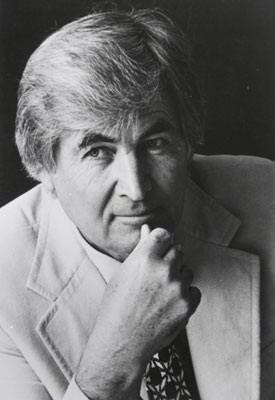
Fess Parker, the onetime Disney sensation who sparked a brief but intense craze for coonskin caps playing frontiersmen Davy Crockett and later Daniel Boone, has died at age 85 in Santa Ynez. He’d been in failing health the past several years. In Santa Barbara County, Parker is most recently known for his Santa Ynez winery.
But closer to home, Parker transformed the City of Santa Barbara’s waterfront in ways profound and still ongoing. It was Parker who built the Red Lion Inn — now the Doubletree — along Cabrillo Boulevard in 1985, but only after a prolonged knockdown drag-out with South Coast environmentalists that culminated with a citywide referendum on the project in the early 1980s.
In that case, it was a small cadre of his environmental critics who put the Parker project on the ballot. But Parker and his plans won and won big. Then, in the 1990s, Parker, frustrated with the city’s design review process, took a play out of the environmentalists’ handbook. He appealed directly to city voters by placing his plans to build a second waterfront property on the ballot. This time, Parker and his plans were decisively shot down.
Eventually, Parker would win permission to build another hotel — one that he promised would deliver five-star accommodations — though construction has yet to begin in earnest.
In between these battles, however, Parker agreed to yield six acres of his waterfront property to the City of Santa Barbara, with which he was then locked in battle. Without this property, City Hall could have never built what has since become Chase Palm Park on the mountain side of Cabrillo Boulevard, the site of a carousel, an extensive kids’ playground, and weekly outdoor concerts. The park has been intensively used ever since its inception.
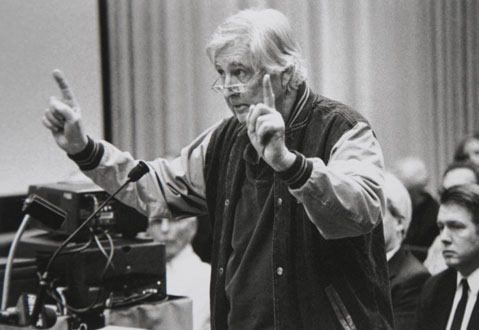
In person, Parker radiated a graciousness, decency, and sincerity that made him all but irresistible. As an advocate for his own projects, he was endowed with an uncanny ability to synthesize complex land use controversies into simple but compelling political equations. But behind that Texas twang and unassuming demeanor, Parker was both shrewd and stubborn beyond measure. That stubborn streak probably helped Parker become a serious player in the land development game when it would have been tempting to dismiss him as another pretty face wearing buckskin leggings. Over time, though, Parker’s bullheadedness caused headaches not just for his adversaries but for himself.
Parker first made his mark on Santa Barbara in the 1970s, when, as a recently retired television actor, he got one over on the cream of the corporate land sharks who were working for the Hyatt Corporation real estate division — which was then devising plans of staggering magnitude for the city’s waterfront. (One such plan called for relocating Highway 101.) The real estate was owned by the Southern Pacific Railroad. Somehow Parker managed to persuade railroad executives not to renew their long-term leases with Hyatt and to give him the option instead.
According to land-use legend, Hyatt never forgave Parker for his successful impertinence, and refused to have anything to do with the actor-turned-developer when he finally managed to win permission to build a 360-room hotel. Nor, it seems, would any of the other top-tier hotel operators. So instead, Parker went into business with the Red Lion Inn, which ran a successful chain of business-oriented hotels. (Eventually, Parker would run afoul of his Red Lion partners, and the two sides would spend years in arbitration hashing out their differences.)
But before Parker won permission to build his hotel, he had to endure City Hall’s endless and painstaking deliberations over what the whole stretch of waterfront from Garden to Milpas streets should look like. In the process, his plans for a 500-room hotel with hundreds of condos was whittled down to a 360-room hotel and no condos, graced by sweeping swaths of passive open space that mirrored the park on the ocean side of the beach and allowed uninterrupted views of the mountains. Ultimately, the Coastal Commission would sign off on these plans. But not before Fred Eissler, an ardent environmentalist with Scenic Shoreline Preservation, began collecting signatures to place the matter on a citywide ballot.
City attorneys argued that Parker’s approvals were not subject to the ballot box because they were administrative in nature, rather than legislative. The state Supreme Court saw it differently, finding in favor of Eissler and his attorneys. By the time Parker’s hotel made it onto the ballot, the environmental movement was split. Many organizations and activists argued that Parker had undergone a thorough environmental analysis and had made major concessions. They wound up campaigning for Parker, arguing that the process had worked. Eissler conjured up alarming images of fez-wearing conventioneers running amok along the city’s waterfront in search of high-class hookers, which, he claimed, would be the inevitable by-product of Parker’s hotel.
Dave Davis, the former City Hall planning czar, recalled that Parker was the first person in his office when he started to work for the city in 1978 and the last one he saw before retiring in 2002. Although much of their relationship was adversarial and contentious, the two developed a grudging, if exasperated, admiration for one another. “We disagreed over almost everything — process, content, vision. But he was a real gentleman,” said Davis. “He was honest, he was scrupulous. He was straight up. He never lied. He never tried to sneak around you. Instead, he’d tell you straight to your face, ‘I’m going to run over you.’ And then he’d proceed to try.”
After Parker’s hotel was built in 1985—and it was always Fess Parker’s Red Lion Inn, never merely the Red Lion Inn—there was considerable confusion as to what the “open space” requirements of his permit approval actually meant. For Parker and City Hall, it meant that Parker had to maintain a large swath of lawn between the sidewalk and the hotel entrance. Many in the environmental community, however, thought Parker had to provide something more rustic and inviting than mere lawn. One group of guerilla planners and activists sought to claim the public open space for the public by holding annual picnics, accompanied by croquet tournaments and liquid libations. The police were never called.
There has always been significant public confusion over what additional amenities Parker was required to provide in exchange for permission to build the Doubletree. The agreement stipulated, for example, that Parker would build a youth hostel to accommodate low-income visitors as well as those with deep pockets. Parker’s critics have consistently asked when Parker would build the hostel, charging he was not living up to the agreement. But the deal never said when the hostel had to be built, only that it be open for business before Parker could open a second hotel, located on the Milpas side of the property. The permit process for this second hotel — begun in the early ’90s — has set land speed records for slowness; after Parker secured the necessary permits, he sought extension after extension, to make change after change. Then the recession hit, and no financing was available. As a result, Parker’s second hotel is now a big hole in the ground. The youth hostel, though, is almost finished, but more financing is necessary to complete the job. In the current market, such financing is not available. At one point, Parker suggested that he not be required to build the hostel at all. Instead of building the hostel, he said he’d donate a large chunk of money to an anti-gang, anti-drug program. Critics charged he was reneging on his deal. Parker never pursued the idea through official channels, and it died a quick and not-so-quiet death.
The new hotel — Fess Parker’s Red Lion Inn — added to the city’s bed tax and provided desperately needed meeting space for large professional gatherings. But the hotel’s construction had at least one major unintended consequence. For years, that area of the waterfront had served as an official “hobo jungle” and was home to dozens, if not hundreds, of homeless. One resident even created a two-story shack. What frequent police raids failed to accomplish, the onset of the bulldozers did. And once the hobo jungle was no more, the number of street people and homeless making their presence felt on State Street skyrocketed. The political fallout was as intense as it was predictable and remains the subject of heated controversy.
If the Red Lion was not quite the five-star facility Parker envisioned, he hoped to rectify that deficiency by building a second hotel on a 3.4-acre chunk of land by Cabrillo and Milpas streets. This project became the focus of endless wrangling, lasting years and years. By the early ’90s, just as Parker had his plans finally approved, he asked to add 50 more rooms, bringing the total number to 200. Local land-use watchdogs, like the Citizens Planning Association, objected that Parker’s new plans were too big and claimed that they’d block the mountain views. They took their case to the City Council demanding supplemental environmental analysis. The council agreed to an exceptionally modest level of new review. This so infuriated Parker, that he withdrew his plans from consideration. It was then that he took his proposal directly to city voters. In this case, Parker found little support even from conservatives and Republicans. The opposition campaigned on the sanctity of the city’s review process; Parker got smeared.
Eventually, Parker would come back, go through environmental review, and secure the permits needed to build his five-star hotel. That he never actually built the hotel remains the subject of intense speculation. He was given at least 12 years to get the hotel built, far longer than most construction permits. For a host of reasons, known and inexplicable, Parker never managed to get beyond the excavation site now in the ground.
Some have blamed the economy; others contend his stubborn insistence on being in control stymied his ability to find suitable partners, others have blamed City Hall. But today, the project remains one of several vast holes-in-the-ground that may not soon be filled. Parker’s hotel — like the unbuilt La Entrada development at the bottom of State Street — has given pause to many regarding the adequacy of the city’s existing planning process. One school of thought holds that developers need to show they have the cash to finish the job before they’re allowed to start digging and demolishing.
In the ’90s, Parker embraced the Santa Ynez lifestyle, bought land in the valley and started growing grapes. He opened a successful winery that bears his name and was a well-respected member of that community. But Parker’s itch to build wouldn’t go away. He proposed building a hotel and condos on property he owned by Highways 154 and 246. That didn’t fly with the valley’s well-heeled no-growthers and slow-growthers. When he suggested later that the Chumash running the Santa Ynez casino go into partnership with him, the valley’s slow-growthers — hostile to anything associated with the casino — came unglued.
Parker’s standing in the community suffered in the process, and the plans were quietly shelved. “That was a trial balloon,” said Bob Field, a valley resident, activist, and watchdog. “It never flew. It died quickly. It was hard on everybody.” Field said Parker was very popular in the valley and lamented his loss. “We met a few years ago. He wanted to talk about his plans for a hotel and a few hundred condos. I wanted to talk about putting his land into a conservation easement. It was the most civil conversation I’ve ever had with someone where there was such disagreement. He was the real McCoy.”
Parker’s death was announced two days after that of his longtime business partner, Fred Rice — also of Santa Ynez — with whom the former actor had built several mobile home parks in the early days of his development career. He is survived by his wife of 50 years, Marcella Parker, his son, Eli, and his daughter, Ashley.