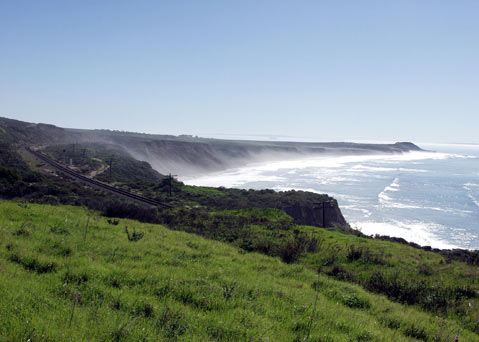
The distance between Point Conception and Eastern Canada may have just gotten a little closer. While armchair environmentalists throughout the South Coast continue to speculate about what exactly the new owners of Cojo-Jalama Ranch, commonly known as Bixby Ranch, have in store for the historic and sprawling 25,000-acre agricultural compound, word is making its way from Canada about a highly controversial mega-quarry project being proposed on an equally stunning expanse of beloved farmland north of Toronto.
What does one have to do with the other, you ask? Well, the folks looking to build the quarry, Highland Companies, and Coastal Management Resources (CMR), the people who have owned Bixby since 2007, are subsidiaries of the same Boston-based $23-billion hedge fund, the Baupost Group. Interesting but not necessarily damning in and of itself, the trouble about the commonality, according to Gaviota Coast Conservancy head Mike Lunsford, who has been following the story of Highland’s proposed Melancthon Quarry since last summer, is in the details. “I think the deceptive practices demonstrated [in Canada] show that Baupost is all about profit and doesn’t really care about community. [Based on what we have seen already with Coastal Management], I fear that that culture has been brought here.”
At first blush, the connection seems to be little more than a passing formality. After all, Baupost is a massive hedge fund, the 11th largest in the world, and it throws its money around in all variety of ventures. Then, of course, there is the fact that the high-quality limestone that Highland hopes to harvest in Canada likely doesn’t exist around these parts. However, once you start talking to people who stand to be most immediately impacted by Melancthon’s mega-quarry — most of whom are small- to medium-scale lifelong potato farmers — and get the background on what has happened in the time since Baupost first came to their neck of the woods five years ago and this past spring when Highland announced its plans to tear up some 2,300 acres of prime ag land and build the largest quarry in Canadian history, you begin to get an idea about what has Lunsford worried.
In short, to hear folks like Carl Cosack tell it (a cattle rancher in the area near the proposed quarry and one of the driving forces behind the group trying to stop it, the North Dufferin Agricultural and Community Task Force), what was initially sold to neighbors and prospective land-sellers as a fairly straightforward and fiscally enticing effort by an outside company to buy up old farms and continue their operations has turned into a potential environmental nightmare. As per the application, the quarry would require Highland to drill down roughly 200 feet beneath an aquifer (and pump 600 million liters from it a day) that not only feeds five separate river systems in southern Ontario but also provides drinking water every day for more than 2 million greater Toronto residents.“When they started out here, in all their interviews and dealings with local folks, they just went with the story that was easiest to swallow: that they wanted to be potato farmers,” recalls Cosack. “That deception has not served them well. It was all a master plan, and we are onto them.”
According to Cosack, starting in 2006, Highland eventually bought some 8,300 acres of farmland and, in the process, became Ontario’s largest potato grower and distributor. However, along the way, it also worked to demolish dozens of old homes and barns on its newly acquired lands and began drilling test wells throughout the potato fields — two things that set off alarm bells for Cosack and others about the company’s claimed commitment to a future in farming. That doubt was confirmed in the worst way possible in March, when Highland dropped a 3,000-page application for the monstrous Melancthon project, which, if it becomes a reality, would be dwarfed in size by only one other quarry on the entire continent, a facility in Michigan. (It is worth noting that the community-at-large in Ontario has rallied against the plan in recent months, including a 25,000-person-strong demonstration festival in October, and as a result, the project is up for an unprecedented round of environmental review.)
It is this type of bait-and-switch tactic that has Lunsford concerned. Ever since paying some $136 million for Cojo-Jalama back in 2007, various spokespeople for CMR have publicly pledged allegiance to maintaining the ranch’s historic cattle operations and dry farming. However, there have also been ample instances of behavior to the contrary. Things such as a quiet effort to secure large amounts of state water rights from the Carpinteria Valley Water District and alleged illegal landscaping of a coastal terrace on the property about a year ago that resulted in the destruction of federally designated critical habitat for the endangered Gaviota tarplant only work to fuel skepticism by those who fear development dreams will soon replace the ranching realities at Cojo-Jalama. (The tarplant remains under investigation by both the California Coastal Commission and by the U.S. Fish and Wildlife Department.)
For their part, CMR Executive Vice President Carl Steinberg explained this week that his company knows little about the situation in Canada, adding that “to [their] knowledge there is no limestone in the area of Point Conception.” As for the landscaping allegations and associated investigation, Steinberg said simply that talks with the Coastal Commission were “ongoing” and that he was “hopeful for a mutually acceptable resolution that supports ranch and farm operations and the protection of coastal resources.”



Print friendly
E-mail story
Tip Us Off
Comments
Share Article
Myspace


Previous Month


Comments
Thanks from Canada, to the Independent and Ethan Stewart for connecting the dots and exposing the Highland Co's/Baupost Group for their unethical business practices.
We, in Canada, have become painfully aware through our efforts to stop their proposal, that hundreds of millions of litres of our purest water could be at risk, DAILY.
Above all, watch and protect your WATER rights. It is universally our most precious commodity, for which the Baupost Group has demonstrated little regard, in either of your community or ours.
coalminecanary (anonymous profile)
December 15, 2011 at 6:33 a.m. (Suggest removal)
You have your Gaviota tarplant -- Ontarians have our bobolink blackbird. Under the guise of "normal farming practice" Highland Companies has effectively cut grass in all the wrong places, erased fencerows, and hollowed out woodlots leaving the outer fringe only as a facade. Bye bye blackbird.
NoMegaQuarry (anonymous profile)
December 15, 2011 at 8:01 a.m. (Suggest removal)
Thanks for this article which exposes the risks involved in both of these proposals. Hedge fund investors may have short term benefits from such proposed projects, but the negative impacts for water quality for millions of people are a long term risk . These projects should be stopped.
rethinktheseproposals (anonymous profile)
December 15, 2011 at 1:58 p.m. (Suggest removal)
As one of the 25,000 Canadians who protested against the Baupost Group in a farmer's field last October, I am very familiar with this hedge fund and its tactics. From the moment Baupost showed up in Ontario under the guise of the Highland Companies it has misled the community and caused great distress.
Our prime farmland and the aquifer beneath its fields are vitally important to southern Ontario. Yet, Baupost -- which said it was interested only in farming -- now wants to blow it up. Thousands of Canadians are fighting them. We hope those of you who cherish the Bixby Ranch will do the same. Our precious agricultural lands and our water should not be destroyed, especially to satisfy the greed of a Boston hedge fund.
Cityfarmgal (anonymous profile)
December 15, 2011 at 5:30 p.m. (Suggest removal)
Bixby got a really good deal on both the Cojo and Jalama ranches because of bad weather and taxes. Bixby owned a lot of land, with a lot of people all over California. Some of which he paid nothing for. Read your history books not Wikipedia.
I have a problem with the government and PACS giving our heritage away. I also have a problem with the government and people who can’t afford land telling land owners of that land what they can do with it. The government is not great on farming; farmers are having regulations and laws by the government that is stupid and expensive. Foreign farmers do not have the same standards. Yet people want good food at a reasonable price. It is a shame that no rancher in Santa Barbara could afford to buy that property. Buying a 27,000 acre ranch for $136 million, it would require a real working ranch to support that monthly payment. Face it, Santa Barbara is not friendly to coastal ranching. So who would buy it? If they did buy it, what would support it, to pay the interest on the loan and property taxes? It seems that digging it up and selling it in pieces might work, sadly. Look at history. Who are the crooks? How did Bixby get all this land?
The San Justo land Grant that Flint and Bixby bought with Col. Hollister’s who’s down payment of $12,000 from his sister Annie, only the $12,000 was ever paid, that was a 34,620 acre land grant in San Benito County. Not a penny of the rest of the loan was ever paid back. Hollister eventually became a millionaire raising sheep there. A millionaire in the late 1800’s from a loan from his sister and profits from his sister’s sheep kept on range there.
So later Bixby bought the Cojo and Jalama ranches south of the San Justo because of 2 things, over taxed Spanish landowners who had to sell because of severe droughts and they could not pay their taxes; like now, they had taxes and global warming, no, a huge El Nino event in 1912, then La Nina kicked their asses into the poor house with a drought (the same weather event took place Nov 1861 to Jan. 1862 then a drought followed – no taxes but land was sold to pay debts). So Bixby bought two distressed ranches, 20 years apart, and made them one huge ranch, price, overdue tax money. Sounds like modern times. Those rich people! Plus they were white and not from Spain.
Bummer, so now we are complaining about the billionaire hedge fund guys from the great white north doing the same thing as Col. Hollister, Flint, Bixby, Bishop, More, Ellwood Cooper, Den (who owned almost all of Goleta), and all our local heroes, men and women, who have streets and a Wharf, named after them, who all got a Spanish Land Grant one way or another. Mostly they were not Spanish or Mexican; they were Irish, Scottish, German, Italian, and other Europeans from the east coast. I am not for destroying the coast, buy we learn from history that we learn nothing from history.
jw (anonymous profile)
December 15, 2011 at 6:34 p.m. (Suggest removal)
Wow, cool story jw.. My only question is what kind of face do you make when you see some kid wearing a Hollister sweatshirt?
loonpt (anonymous profile)
December 16, 2011 at 10:21 a.m. (Suggest removal)
I make a scrunchy face when I see someone wearing a Hollister shirt myself!
This is probably one of the most important articles in this week's issue.
One of the ways we can preserve places like the Bixby ranch is to grow up not out, and preserve what agro land we have left.
Maybe we should Occupy Jalama and get some good surf as well.
Did you know a Boston firm also owns KEYT?
Ken_Volok (anonymous profile)
December 16, 2011 at 11:33 a.m. (Suggest removal)
Preserving farmland means resisting the growth that the smart-growth crowd is for. Increased densitys and population growth only put farmland and open space under more pressure of getting developed. Don't be fooled by the false smart-growth planners, Noleta is already trying to change ag-zoning to build more smart-growth density apartments.
Georgy (anonymous profile)
December 16, 2011 at 3:23 p.m. (Suggest removal)
I live in Ontario, and I have gone to a meeting put on by this company regarding the proposed quarry. They weren't prepared to answer any hard questions, as they clearly thought that they were dealing with a bunch of hicks. However, they were not able to pull the wool over anyone's eyes. The reality of their plans was all too clear. In their literature it stated that once operational, 100 large tractor trailors full of "aggregrate" would leave their facility every hour. Another 100 would return in the same time. Of course this would totally clog, and destroy all of the roads into and out of Shelburne, the nearest town. Blasting was to go on continuously all day, every day. They expected the quarry operation to last for at least 30 years, afterwhich they would refurbish the land and make it "even better than it had been in the beginning". This kind of operation would turn the beautiful and productive farmlands in the area, as well as the lovely little surronding towns into Hell on Earth. They bought the land under false pretences, and they continue to lie and insult the local people. We in Ontario are determined to stop this project. Maybe our protests will stop them, and if so they could turn their sights on California. Beware of this company. All they care about is profit.
wvalhoff (anonymous profile)
December 16, 2011 at 6:13 p.m. (Suggest removal)
I smile. I like it. I see capitalism working; specifically Abercrombie & Fitch their stock trades for about $45 dollars a share. They’re definitely not a local shop. So capitalism should continue it makes money from good ideas. However it is being impeded by entitlement types that can’t afford anything but the shirt.
As far as saving the land for agriculture, dry farming hay won’t pay the bills Ken_Volok. The ranch has to be a working agricultural facility to qualify for the Williamson act; to reduce paying property tax on $136 million dollars the CPR is 1.5% otherwise do the math. That’s over $ 2 million a year in property tax to let it sit and that goes up 1.5% every year afterward. Who can afford that except a billionaire? The ranch was proposition 13; so the taxes were not an issue. I don’t think the LA Times did a great job in their story of how Bixby got the Cojo and Jalama Spanish land grants. They are usually very good and less sentimental. His heirs don’t care that the government gets 50% of the sale in inheritance taxes. It’s still a $68 million dollar lottery ticket to them. They never could have afforded to keep the land; even though it was left to them. You understand that you would have to earn about $300,000 to qualify for a 30 year loan on 2 million dollars right?
jw (anonymous profile)
December 16, 2011 at 7:30 p.m. (Suggest removal)
Most humans don't eat hay JW.
Ken_Volok (anonymous profile)
December 17, 2011 at 9 p.m. (Suggest removal)
What can you dry farm on the coast that won't cause a problem with the coastal environmentalists? I would like to hear a diversified plan that will make money to pay off the debt to make the ranch a ranch instead of this quarry? Make a profit too. I’m looking at the deal that was made with the USAF; that’s a stumbling block I think. Who has the water rights for irrigation and what is going to power that system? Vegetables need water, cattle need water, and not all of the ranch can be farmed so it should be grazed to keep it clear from fire. What would you do?
jw (anonymous profile)
December 18, 2011 at 1:48 p.m. (Suggest removal)
Mr. Ken_Volok,
You may be sardonic but you are bright. So, no we eat the seeds on the top. I just want to hear an alternative plan, form you, which will pass the Santa Barbara Costal Commission, all the PAC groups and environmentalists that want to keep it wild. To make it a working profitable ranch.
jw (anonymous profile)
December 18, 2011 at 3:35 p.m. (Suggest removal)
Well, the Bixbys had to sell because too many heirs lost their connection to the land and money talks. I confess I fantasized about buying the land if I had won the lottery and what I would do with it all... create a low key but high end dude ranch with small rustic cabins scattered about that folks could ride out to and spend a few nights playing cowboy/cowgirl, have a central ranch house for base operations, raise quality organic beef, charge an arm and leg to guests for the right to walk out of your rustic beach cabin and surf, try some dry farming, use wind and solar energy, and lobby the government to give me a break for keeping it pretty much "undeveloped" and a working/profitable ranch. Yeah, call me a dreamer.
maybeso (anonymous profile)
December 18, 2011 at 5:36 p.m. (Suggest removal)
Well Ken,
Since its zoned AG 360 you could only put a cabin per 360 acres, then there is the USAF zone that would not allow that on the whole property, plus not everything is geologically conducive to buildings; plumbing and septic tanks. Even if you could build 750 yurts on the property after winning the lottery you would waste all your money fighting to be able to get the permits. However, I like the dude ranch theme. The Bacara resort model says it could work? But the wind turbines would kill your low key business because of the noise.
jw (anonymous profile)
December 18, 2011 at 6:51 p.m. (Suggest removal)
Maybe the Chumash should buy it. They could build a beachfront mega casino with oceanfront golf course and backwoods hunting, and nobody in Santa Barbara County could stop them.
I'm not serious about wanting such a monstrosity. But I am serious in pointing out the dangers presented.
Murdoch (anonymous profile)
December 19, 2011 at 7:54 a.m. (Suggest removal)
Hey maybeso is not Ken!
So if the zoning is AG 360, will they try to change it?
maybeso (anonymous profile)
December 19, 2011 at 10:27 a.m. (Suggest removal)
Can we surf it???
805RunningCrew (anonymous profile)
December 19, 2011 at 4:13 p.m. (Suggest removal)
Bacara? You'te proposing another Bacara JW? Wow you must be a developer when you're not a s"cientist"! You know so much about the zoning eft.. Do you know how unpopular Bacara is to locals? I wish that place would shut down and their goons who harass beachgoers dragged into court. And nope I am not Maybeso, a reading error which is an even bigger red flag to the validity of the "science" you've presented in other columns.
Ken_Volok (anonymous profile)
December 20, 2011 at 9:54 a.m. (Suggest removal)
Dear Ken_Volok
"The Bacara resort model says it could work?” When you build a business you look at other business models for guidelines and legal procedures for the demographic business client you seek. I did not say build a Bacara. I suggested that there are wealthy people who may support a high class dude ranch as demonstrated by the Bacara’s ability to not only draw them to Goleta but charge their clients very high prices for food and lodging. You did not see the question mark at the end of my sentence? I said could not would, therefore there is a question as to whether or not it would indeed be a viable and sustainable business and not a fad. I sure hope that clears that up for you. The real question that exists is who, other than a multi-billion dollar resource, could hold onto such an enormous piece of land and pay the property taxes on $136 million dollars as the property stands now? As far as reading errors go, I I read the text correctly and addressed the message to you and you took offense. This demonstrated your emotional frequency well; as it caused your dander to rise to insult me. I take no offense. I do not write in spite. There are many problems and few people looking for solutions, just looking for another problem to point out. I am a science fiction writer that has not credibility according to you. That is fine; I suggest only that you search for facts that give qualitative and qualitative analysis to show the actual problem and a solution. Or, you may discover that the problem is perceived, after the qualitative and qualitative analysis of the subject matter is complete. Either way, you can subjugate and undermine me with your facts.
jw (anonymous profile)
December 28, 2011 at 2:58 p.m. (Suggest removal)
For my part I did the researh on The San Justo land Grant that Flint and Bixby bought with Col. Hollister’s $12,000 down payment. They were supposed to pay $65,000 for it. But only the $12,000 was ever collected.
jw (anonymous profile)
January 6, 2012 at 2:22 p.m. (Suggest removal)
This is late, and where to start...
True, the base zoning is AG-II-360, but the ranch also has its very own overlay specifically crafted by Bixby that allows about 100-200 units to be built in a "clustered" development. Public coastal access is required under the zoning overlay; however, since Bixby received millions of federal dollars for a safety easement to mitigate hazards from missile mishaps, in the waning days of the Bush I reign late in1992, public coastal access could prove to be even more difficult than originally imagined in 1980, when the zoning was applied.
However, there's a wild card here that's held by the public: the county accepted a grant of coastal access in the later '80s, connected with the approval of the (then) Chevron Gaviota plant and onshore pipeline. This grant has its own stipulations to develop a plan for public access that respects privacy, conserves resources, etc. That plan was drafted in the early 1990s but never was adopted for what can be described politely as "political" reasons, or impolitely as the longstanding actions by the Hollister and Bixby Ranches to spend big bucks to thwart any and all attempts to provide public access to "their" coastlines.
There's another wild card held by the public: as part of the Chevron approvals, a million dollars was set aside in the Coastal Resource Enhancement Fund (CREF) to help fund the provision of public coastal access through the Hollister and Bixby Ranches. Again, all efforts by the CA Coastal Conservancy and the county to negotiate and provide such access have been thwarted by the money and concomitant political power of the Hollister and Bixby Ranches.
The bottom line is that we, the people, hold two wild cards in our hand against the money and power of the landowners. That should be a pretty good equalizer. You'd think.
GregMohr (anonymous profile)
January 7, 2012 at 9:55 a.m. (Suggest removal)
Greg,
Where do we get the money to fight the billions? Litigation will bleed us dry.
jw (anonymous profile)
January 26, 2012 at 9:11 p.m. (Suggest removal)