The John Birch Society had been founded in 1958 by Robert Welch, a retired prosperous candy manufacturer. He named his new organization after a Baptist missionary who had been killed by the Chinese Communists in 1945.
Starting out with only 11 members, the John Birch Society grew during the tense years of the Cold War. By the early 1960s, the Society claimed membership at close to 100,000 nationwide. The primary purpose of the organization in this period was to expose and root out what members perceived to be the pervasive and dangerous influences of communism in all aspects of American life. Welch had labeled President Dwight D. Eisenhower a “dedicated, conscious agent of the Communist conspiracy.” Other officials who had come under attack included Supreme Court Chief Justice Earl Warren and CIA director Allen Dulles.
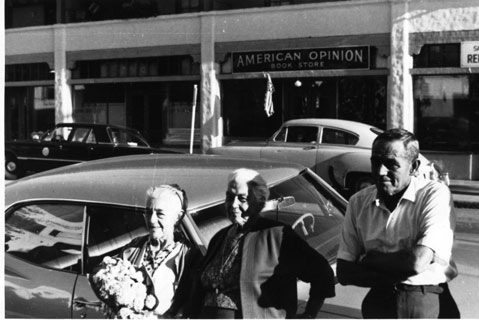
A Santa Barbara branch of the society had formed early in 1960. Groups met in private homes for discussion and study. Within a year, the society had opened the American Opinion Book Store at 132 East Canon Perdido Street where society and supporting literature was made available to the public. Exact membership numbers were never made public; at its height S.B. society membership probably numbered a few hundred.
On May 7, 1962, Thomas M. Storke, editor and publisher of the Santa Barbara News-Press, received a telegram from Grayson Kirk, the president of Columbia University. It read, “I have the honor to advise that Columbia University Trustees have awarded you Pulitzer Prize for editorial writing.” The award was the culmination of the newspaper’s campaign against the John Birch Society.
Storke had been a newspaperman for virtually his entire adult life, starting out as a cub reporter for the area Morning Press at the turn of the century. By the early 1960s, he was arguably the most powerful and influential figure on the Santa Barbara scene, aptly dubbed, “Mr. Santa Barbara.”
In January 1961, the News-Press ran a two-part story by reporter Han Engh that portrayed the society in a less than flattering light, highlighting Welch’s Eisenhower comment, noting that the society’s literature called for the “takeover” of PTAs, and calling the society a “semi-secret” organization.
The Santa Barbara Society branch responded with newspaper ads and letters to the editor, objecting to the rather sinister tone of Engh’s pieces, and portrayed the society as a largely educational organization. At the same time, members in the area distanced themselves from some of Welch’s more inflammatory comments, especially the latter’s views on Eisenhower.
On February 26, 1961, Storke published the first in the series of editorials, which garnered the Pulitzer for the paper. It read, in part, “Every American must be alert for Red infiltration. But that does not lead logically to the conclusion that to fight Communism at home we must throw democratic principles and methods into the ashcan and adopt the techniques of the Communists themselves, as the John Birch leaders would have us do.” The editorial went on to denounce the society’s charges against leaders in government and education “and even ministers of the Gospel.” Storke followed up with a piece in a similar vein in the New York Times Sunday Magazine in December 1961.
When informed of the award the following spring, the 85-year-old publisher said the John Birch Society had a place in “our political spectrum” as long as “our political give-and-take be carried out in the open, with honor and integrity.” The John Birch Society, never a major force on Santa Barbara’s political scene, soon after faded away.
Related Links
- More History 101 columns
- Campaigns of Vilification (T.M. Storke & the John Birch Society) [ April 26, 2007 ]
Michael Redmon, director of research at the Santa Barbara Historical Society, will answer your questions about Santa Barbara’s history. Write him c/o The Independent, 122 W. Figueroa St., Santa Barbara, CA 93101.


Print friendly
E-mail story
Tip Us Off
Comments
Share Article
Myspace


Previous Month


Comments
Sounds like an early version of the Tea Party
joerak (anonymous profile)
May 23, 2011 at 6:49 a.m. (Suggest removal)
very much like the wacko tea baggers, yes.
these are nutjobs, too.
sbnative08 (anonymous profile)
May 23, 2011 at 8:03 a.m. (Suggest removal)
That address for their book store is now a car parking lot.
Draw your own conclusions.
John_Adams (anonymous profile)
May 23, 2011 at 10:18 a.m. (Suggest removal)
The claim in this article that by "the early 1960's" the JBS had 100,000 members is an utter falsehood. In reality, the JBS had approximately 13,250 members.
In September 1960, Robert Welch told his National Council that the JBS had 324 chapters and 5300 members.
In the December 1960 JBS Bulletin, page 4, Robert Welch declared that "we have been doubling in size approximately once every four months" (i.e. 25% per month).
If one uses the formula stated by Welch (i.e. 100% every 4 months), then actual JBS membership would be approximately as follows starting from the baseline specified by Welch in September 1960:
9/60.......5300
01/61......10,600
Thus, the JBS was increasing its membership by about 1325 per month between September 1960 and January 1961 -- which would produce the following membership numbers:
9/60......5300
10/60.....6625
11/60.....7950
12/60.....9275
01/61.....10,600
02/61.....11,925
03/61.....13,250
Interestingly, the 1960 financial statement of the JBS declares that it received $198,719 in member dues during all of 1960. At that time, annual dues were $24 for men and $12 for women. If one uses an average of $18 that would mean there should be about 11,039 members by the end of December 1960 -- which is very close to the 10,600 extrapolation shown above for 1/61.
ernie1241 (anonymous profile)
May 23, 2011 at 10:48 a.m. (Suggest removal)
Funny line, John_Adams, but incorrect; it looks like 132 East Canon Perdido is part of the Post Office building.
When I visited the American Opinion bookstore back in the day, I believe it was where the yoga clothing store is at 154 (Drishi?) or it might have been where the Three Pickles deli was/is, right next door.
It was empty but for me and the counter-worker, and had little in the way of books I was interested in.
binky (anonymous profile)
May 23, 2011 at 10:51 a.m. (Suggest removal)
I forgot to mention in my previous message that the Birch Society's 1962 dues income was $296,326.
Consequently, using an $18 average, there were approximately 16,462 JBS members by the end of 1962.
The JBS did not approximate 100,000 members until sometime after the 1964 election.
FBI FILES ON BIRCH SOCIETY:
This 105-page report explains why J. Edgar Hoover and senior FBI officials within the Bureau’s Domestic Intelligence Division concluded in FBI memos that the JBS was “extremist”, “irrational” and “irresponsible”
http://ernie1241.googlepages.com/jbs-1
ernie1241 (anonymous profile)
May 23, 2011 at 10:54 a.m. (Suggest removal)
Good riddance.
EZK (anonymous profile)
May 23, 2011 at 2:09 p.m. (Suggest removal)
"The claim in this article that by "the early 1960's" the JBS had 100,000 members is an utter falsehood."
-- ernie1241
You have to sharpen your reading skills, ernie1241. The article does NOT make the claim that the JBS had 100,000 members, it merely reports that the JBS itself made that claim. Big difference.
SezMe (anonymous profile)
May 25, 2011 at 3:07 a.m. (Suggest removal)
I believe 132 E. Canon Perdido is part of where the Sojourner is now. Soj address is 134. When I first went there with a friend 19 years ago, he told me it was where the John Birch Society used to be.
Nitz (anonymous profile)
May 25, 2011 at 3:47 p.m. (Suggest removal)
I think you are right about that NItz;
I took the Google map address to be accurate (it's not) and it pictured the part of the Post Office on Canon Perdido as '134.' They also had Drishti at 154.
But the address for Drishti is 130 E. Canon Perdido, and I recall when The Soj expanded into the space next to their original, core location (I'm guessing it was late '80s?).
So I would agree that's the best guess as to where I visited the American Opinion bookstore back in the late '60s.
binky (anonymous profile)
May 25, 2011 at 5:12 p.m. (Suggest removal)
Back in the day my class took a field trip down to the JBS in Pasadena and then to the American Communist Party in downtown LA. The theme was the same from political opposites. Far right or left, both crazy as the Mad Hatter.
howgreenwasmyvalley (anonymous profile)
May 27, 2011 at 8:17 a.m. (Suggest removal)
EZK: If YOU think that the JBS claimed to have 100,000 members by the early 1960's -- then please cite what source you think substantiates that.
The JBS never made that claim. First of all, JBS officials always refused to discuss specific membership numbers.
My larger point remains the same: the Birch Society did not have 100,000 members in the early 1960's. Based upon private internal documents and financial reports which reveal income received from member dues, it could be speculated that they may have had 75,000 members in 1965 or 1966.
ernie1241 (anonymous profile)
May 31, 2011 at 6:42 p.m. (Suggest removal)