Tag, You’re It
Inside Santa Barbara’s Back-and-Forth Battles Over Graffiti

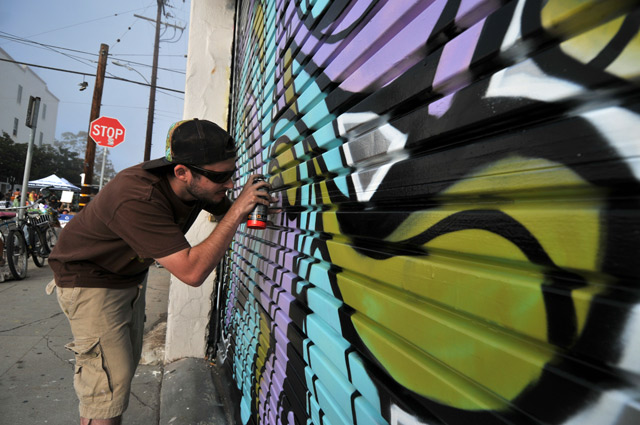
It’s as obvious as someone’s nickname scrawled in bright-green spray-paint on the side of a white-washed adobe wall: Graffiti in Santa Barbara is at an all-time high. From elaborate displays on freeway overpasses and railroad under-crossings to the hastily sketched monikers on sidewalks and simple “ES” or “WS” gang provocations on each side of town, it’s hard to walk down almost any street in Santa Barbara without spotting signs of a tagger’s late-night handiwork. And despite combined efforts from the police, city workers, and volunteers all over town, the costly and constant trend only seems to be on the rise.
“It’s a nuisance problem,” explained Charles Katsapis, an officer with the Santa Barbara Police Department who deals with graffiti on a regular basis. “We live in a beautiful city, and no one likes to see it.” And like more traditional nuisances such as litter, dilapidated buildings, and abandoned vehicles, the explosion of graffiti threatens to harm Santa Barbara’s profitable reputation as a quaint tourist destination and, most critically to residents, to lower property values.
Confronting the graffiti tide has become a daily race in painting over paint, a back-and-forth, nearly Sisyphean task for the City of Santa Barbara’s streets maintenance team, who go out early every morning to clean up as much as they can before the sun rises, only to see their efforts tagged up as soon as the next night. “The amount of cleanup we’ve done has almost quadrupled,” said city Streets Manager Rick Fulmer, who said the graffiti-abatement program costs his department alone about $200,000 annually. “We’re tired of being hit all the time with people demanding that the city and police do something about it. We are constantly doing stuff about it.”
Santa Barbara is not alone, as graffiti — considered to be one of the “four pillars” of the hip-hop movement that began in New York City nearly 35 years ago — is exploding worldwide as an art form and going mainstream, whether the authorities like it or not. Two of the West Coast’s most popular art exhibits this summer, Street Cred at the Pasadena Museum of California Art and Art in the Streets at the Museum of Contemporary Art in Los Angeles, were all about graffiti; the documentary Exit Through the Gift Shop, by notorious British street artist Banksy, nearly won the 2011 Academy Award; and major brands such as Coca-Cola, Nike, and Sony have hired “aerosol artists” in recent years for advertising campaigns. Though much of what’s seen every day in Santa Barbara doesn’t rise to this quality, there are some hidden spots that aren’t regularly painted over where the spray paint does shine.
Some communities have chosen to embrace the trend rather than fight it, most notably Venice Beach, where public art walls were erected in 2007 to allow graffiti and have resulted in a drop of illegal tagging nearby. In Santa Barbara, there is only about a block of wall space in the Funk Zone where aerosol art is tolerated (and only then with written permission), leaving plenty of kids with cans of green spray paint eyeing your white-washed adobe walls as their next canvas.
Cops and Taggers
“It’s extremely frustrating for us,” said Detective Andy Feller, who’s in charge of the SBPD’s youth services sector, which covers everything from missing persons to attempted gang homicides. And that’s in part because, as Officer Katsapis explained, “There’s a mentality amongst taggers that it’s not vandalism, that it’s art.” That notion is supported by the popularity of graffiti in mainstream culture as well as the rise of a multimillion-dollar online aerosol-art retail market that’s accessible to anyone with a credit-card number. Altogether, the combination leads to repeat offenses, little fear of the probation, fines, and even jail time that constitutes punishment, and a bravado that’s both dangerous (because they might go to jail) and stupid (because they aren’t afraid to show off). “One kid we arrested showed us everywhere he had tagged,” said Feller. “It was like 15 locations. He had a sense of pride.”
Graffiti crimes have always been on the department’s radar, but the spike in recent years has led to more actual prosecutions of taggers. And Feller fears more trouble down the road, as he’s noticed a rise in conflicts between tagging crews, as well as between crews and gangs. Katsapis and his partner, Christopher Martinez, run into taggers on a regular basis, and report that they come from “all walks of life, all socioeconomic statuses.” There was one kid from San Roque who lived in a beautiful house, said Katsapis, explaining, “[Taggers] party together, they know each other from school, and they share a common interest in graffiti.” (Repeated attempts to contact taggers for this story were entirely unsuccessful.)
And it isn’t just teenagers. Some taggers are in their mid twenties, though they tend to follow an ethical code of sorts that includes only painting on city or abandoned property and not engaging in the “bombing” practice of scrawling as many little tags on as many places as possible or using “slaps,” stickers that taggers put their names on and then post around town. “There used to be a different code,” said Martinez of the older taggers’ mentality, “but it’s changing now,” and that means that private residences and even people’s vehicles have become fair game for this next generation.
Regardless of its beauty, however, in the eyes of law enforcement, graffiti is graffiti, and Martinez and Katsapis frequently stop suspected or known taggers and look for paint marks on their hands and spray cans in their bags. “It’s pretty rare for us to catch them in the act,” said Martinez, noting that taggers use lookouts and special whistle calls to warn each other, making even complicated sting attempts difficult. “It’s more common to catch them with stuff.”
One of the recent tools used by the police, as well as the city streets team and the Downtown Parking department, is the Graffiti Tracker, a camera equipped with a GPS tracking system that logs tags. When a tagger is caught, additional images of his moniker can be searched in the system, which is in use in jurisdictions throughout California and beyond, and then more serious charges can be brought against him. It’s only been in use for one year in Santa Barbara, but it’s already had an impact. “We’ve made some pretty big arrests, and it helps us put together a bigger case,” said Feller, but he reminded that the program costs money and the department could use donations to keep it alive into the future.
Power Washing at Dawn
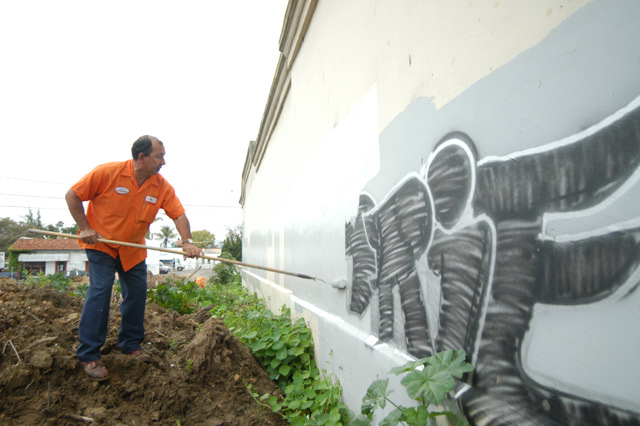
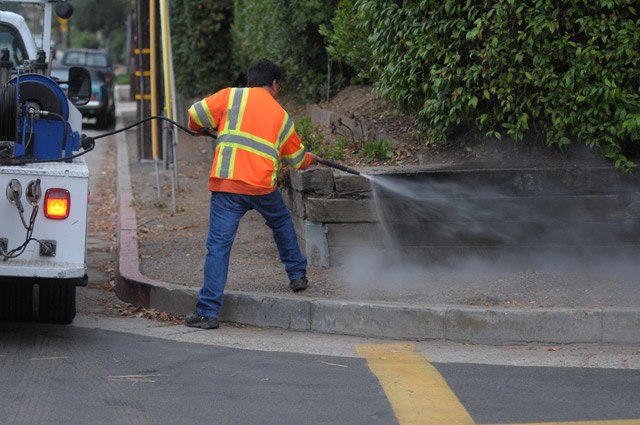
If you happen to spot a guy blasting the sidewalk with a high-powered water gun just after dawn on any given weekday morning, you’re seeing the city’s top graffiti fighter, Mike Borrayo, in action, and he’s already been at work for a few hours. As the lone full-time employee focused on cleaning up graffiti, Borrayo — a native Santa Barbaran and former manager at Moby Dick Restaurant — gets into the office at 3:30 a.m., checks the hotline for calls, and then hits the road to clean up those new tags and scan the neighborhoods, such as the Lower Westside, that get hit most frequently. “Anything that’s a gray or brown wall,” said Borrayo, whose early-morning efficiency means the biggest tags are never seen by most residents, “we paint them.”
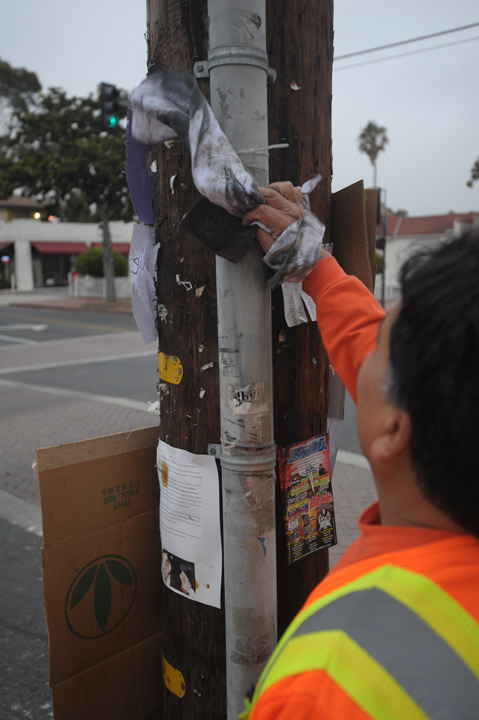
To do so, he drives a special $85,000 truck that the city purchased a few years ago, outfitted with the water blaster as well as various paints and nontoxic chemicals that Borrayo and the occasional part-timers use to wipe walls clean. From July 2010 to June 2011, he did that for more than 300,000 square feet of public property (including the railroad, which contracts the city for cleanup). He’s also responsible for posting notices on private properties that get tagged, as they have three days to clean up the mess or have the city do so before accruing fines; both residential and business owners complete such cleanups 99 percent of the time, and no one has yet had the city do it for them, despite more than 500 such notices going out last fiscal year alone. (To avoid tagging, Streets Manager Fulmer advised, “Don’t make it easy for people to access your building. Make it bright. Make it unfriendly.”)
“The thrill is getting away with it, I guess,” said Borrayo, shaking his head and explaining that, as a lifelong surfer, he’s always got his “guts and glory” in the ocean. “I see these kids tagging. You call that guts and glory? Try riding a 10-foot wave.”
Technically, Borrayo and his spitfire boss Georgia Lopez — who started graffiti-abatement work before it was a program and today gives out her cell-phone number to repeat hotline callers — are only in charge of cleaning up tagging in the city right-of-way, save for their additional work on the railroad corridors. So the Parks Department is in charge of trees, County Flood Control does the Mission Creek culverts (“It’s kind of an endless job,” said Water Resources Deputy Director Tom Fayram), utility companies handle their boxes, Caltrans does specific highway work, and so forth. A more centralized strategy might make sense, but in the meantime, Lopez and Borrayo have become the de facto clearinghouse, and regularly alert other agencies when their work is needed. But Fulmer, their supervisor, also admitted, “We’ll sometimes go over our jurisdiction. We’ll clean up extra areas.”
Despite the fact that Borrayo often visits the same graffiti spot multiple times in a week, painting the same color paint over yet another familiar moniker, he remains upbeat about his work. “It’s job security,” he said. “I love my job. I love making Santa Barbara look good.” Plus, he’s happy to see the support of the community volunteers. “I’m proud of this city,” he explained, before showing off a particularly thick but hidden wall of graffiti in the Las Positas area that’s only cleaned up once or twice a year. “That’s what Santa Barbara would look like if you didn’t have concerned citizens.”
All Hands on Deck
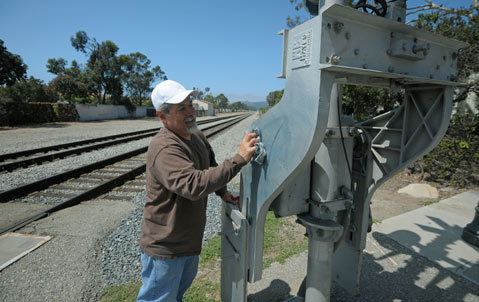
On a recent morning down at the corner of Milpas and Indio Muerto streets near the railroad tracks and freeway off-ramp, Sebastian Aldana Jr. and a couple associates were pulling weeds, picking up trash, and wiping graffiti off of utility boxes and power poles. It’s something Aldana, a former-painter-turned-caterer-turned-City-Council-candidate, does almost every week around the Eastside, where he lives on East Cota Street (though he was raised on the Westside). He’s part of Looking Good Santa Barbara’s Adopt-A-Block program, in which the city gives volunteers the tools they need to remove graffiti and pick up litter around their neighborhoods.
“I just got tired of seeing my neighborhood filthy. It’s okay to live in an old part of town, but it doesn’t have to be dirty,” said Aldana, who’s seen his work spark others to do the same. “If I keep my block clean, and the next guy keeps his block clean … It’s one block at a time.”
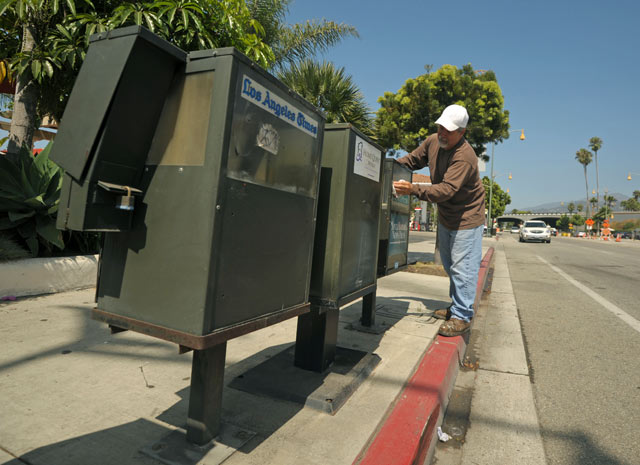
Looking Good is run by the city’s Lorraine Cruz Carpenter, who reports that 180 Santa Barbara residents and business owners have signed up for the program so far and received the bucketful of supplies in return. “It’s a battle,” she explained. “We feel that quick cleanup is one of the ways to resolve the issue or at least work toward getting rid of graffiti, and that’s what our volunteers do. A lot of them stay right on top of it.”
That includes neighborhoods from the Lower Westside (where resident Jaime Limon leads the work) and West Downtown (home to another Adopt-A-Block-leader-turned-City-Council-candidate Sharon Byrne) to the Upper Eastside, where Santa Barbara City College trustee Joan Livingston hopes to enlist one member per block. “Volunteers have enthusiastically stepped forward, and we now have close to 50 percent of our blocks covered,” said Livingston, who said the tools provided by the city are effective and easy to use. “This activity encourages us to be the eyes and ears of our neighborhood.”
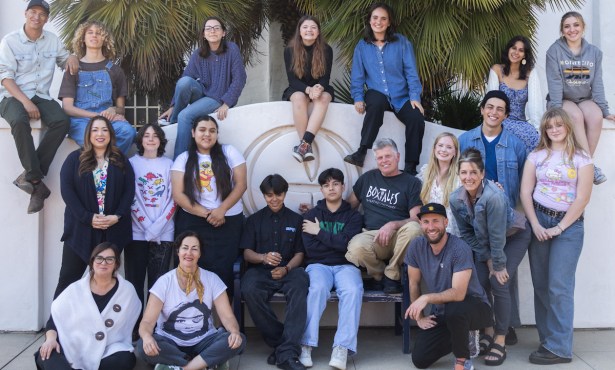
Enhancing the fight against graffiti is the Santa Barbara Youth Art Alliance, which began about five years ago as a mentoring program to work on murals around town, including the ones at Ortega Park and other former graffiti hotspots on the Eastside. “Since the murals were installed, there have been no incidents of graffiti vandalism at those locations, saving the city hundreds of dollars in repairs,” said program director Ricardo Venegas.
Then, in October 2010, the alliance kicked off the Milpas Graffiti Abatement Project to even more effect and applause. “Many business owners reported up to an 80-percent reduction in graffiti along Milpas from Canon Perdido to Cabrillo Boulevard,” explained Venegas, who said the project ended in June but will likely be rekindled this month. “Our program makes an economic impact across the board because it takes youth off the streets and very effectively engages them in an art mentoring program that is both creative and relevant to their experience. … The alliance helps to reduce and minimize all forms of vandalism, violence, and youth delinquency.”
With school back in session, everyone expects graffiti in Santa Barbara to start rising once again, but people like Aldana aren’t willing to give up in this endless war. “We’re gonna win,” said Aldana. “You just can’t throw in the towel.”
Missing an Opportunity?
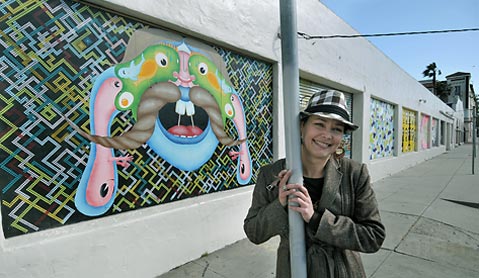
But in this back-and-forth battle involving cops, city workers, and hundreds of volunteers, is Santa Barbara missing an opportunity to channel possibly productive youthful energy? Laura Inks thinks so, and she would know, having started the only tolerated graffiti wall in Santa Barbara, two half-blocks in the Funk Zone on Mason and Helena streets where artists can work when given permission to do so.
“A guy was out there every single day painting the green fence green again because there was tagging,” said Inks, who got permission for the ongoing and changing outdoor exhibit (now called Artists Making a Street Scene) from Mountain Funding, the property owners of the long-stalled La Entrada project. “Since we put the project up, the graffiti around there virtually stopped.” And other cities are beginning to take note, as well — this week, Inks gave a tour of the Funk Zone to the American Planning Association’s California Chapter, which is having its annual meeting in Santa Barbara.
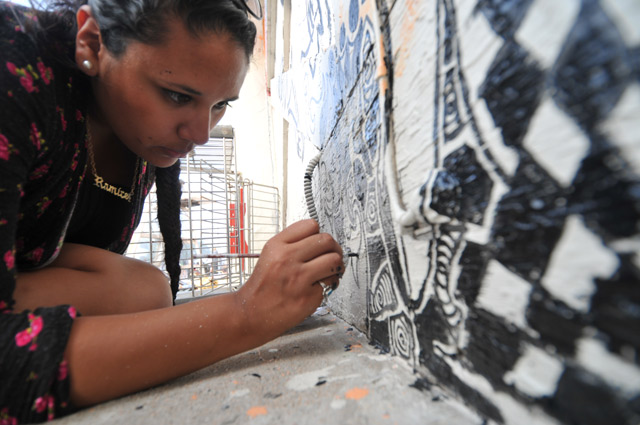
Inks, who is the director of the Jurkowitz Center for Arts Education at the Granada Theatre, believes that the walls also offer a better future for the kids involved. “You can’t really corral this group of kids, although they do love to paint and have their stuff seen. It’s motivation to have them save their paint, so it’s not going on buildings or underpasses,” she explained. “That was my goal initially: to get them off the streets and onto canvasses and boards, and make them see that they can sell it and make a living instead of a rap sheet.”
Osiris Castaneda, who has worked with Santa Barbara’s younger population for the better part of a decade as director of Youth Cinemedia, sees the graffiti issue as symbolic of the philosophically anti-urban city’s disconnect with many of its legitimately urban kids. “What we’re creating as a community is a type of art bought and sold by the rich. It’s not the kind of art from and by the people,” said Castaneda. “Santa Barbara really has to ask itself: Are we tapping the potential of this youth art energy, or are we going to criminalize it? And who’s to blame for that, if we’re not giving them space to express themselves? There’s this world movement of graffiti in the art world: Why are we ignoring it in Santa Barbara?”
The answers may not be easy, but it might be time to at least face these questions if Santa Barbara wants to get a grip on its graffiti problem.