Train or Lane?
The Race Is On

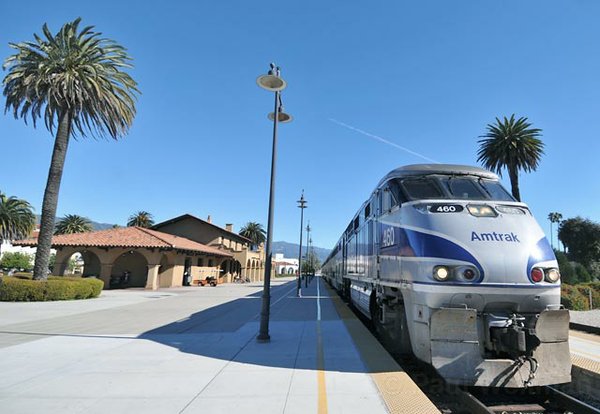
“Third Lane Is Third Rail”? This metaphor headlining a recent article in Santa Barbara Independent brings to mind a 2010 article titled “Third Lane is a Train.” A train and a lane, a lane and a train, either way they work well together.
To me, the “Third Lane is Third Rail” article reads like rearranging the chairs on the deck of the Titanic. There’s not much to choose from, and the completion date of the widening (provided the economy recovers) is well into the 2020s. I’m looking for a congestion solution in the near term, such as Gene Skoropowski, consultant to the rail corridors organization (LOSSAN) recommended. We’re talking three to four years, and that makes sense.
This is why the City of Goleta is following up on Skoropowski’s recommendation for moving the Goleta train platform north of its current location – in order for it be convenient for commuters from Ventura, who do not currently have a peak-hour rail option, as the earliest train from the south passes through Goleta at 10:30 a.m. Many Goleta and Santa Barbara employees can’t wait! A commuter train could happen sooner than you think – way sooner than the third lane.
How will it be paid for? In addition to the $25 million in seed money in Measure A for commuter rail, other sources of money are available. There are currently two sources of funds being applied for, including a $1.2 million grant for Jobs Access Reverse Commute (familiarly known as JARC), which is exactly what the Ventura-to-Goleta commuter rail service is all about.
The jobs center around the area near Los Carneros and 101, where many commuters from Ventura County are driving to. Then there’s the portion of UCSB’s thousands of employees who commute from the south, as well as many of the students.
The advocacy group CoastalRailNow came about because I thought it was a no-brainer to add a couple of peak-hour train runs from Ventura to Goleta. As a participant in the “101 In Motion” process, I worked hard to keep commuter rail in play as an option, and when the studies were done, rail was right there with a lane, in its ability to carry nearly the same number of commuters. I’ve learned what the obstacles are to adding trains to the corridor, and why the statewide organization I belong to, Rail Passengers Association of California (RailPAC) created this petition. Please visit the link, and if you agree with its premise, add your name to the list of people who would like more rail service on the coastal corridor. There’s no reason for commuters to be stuck in traffic, unless they have no viable option – which is what rail represents, a viable option. As the eternal optimist, I believe the right thing will be done, and people will have the options they deserve.
If you want to experience what rail travel is like, come to the National Train Day celebration at the Santa Barbara train station, 209 State Street, this Saturday, May 12, at 9 a.m. Board the southbound Surfliner at 9:20 and ride to Carpinteria. Board the northbound Surfliner at 10 a.m., and you’ll be back at the Santa Barbara station at 10:15. Listen to local leaders speak about regional transportation at the 10:30 a.m. press conference, and then enjoy the festivities. There’ll be magic by Mark Collier, food by Omni Fresco Catering, and train-cookie decorating for the kids, courtesy of Fresco Café. The model railroad layout will take you back to your childhood, and Ken Kelly has brought his best stuff this year, even a model of the train station and the famous Moreton Bay fig tree.