

It felt like walking into a horror movie: an abandoned trailer loaded with filth, tattered furniture, and mounds of newspapers clinging to the grandiose hinterlands of the Carrizo Plain National Monument. And then there was the massive, unfathomable pile of giant kangaroo rat carcasses.
Another dilapidated trailer sits 40 feet away. For years, these two structures at the base of the Panorama Hills have served as prime real estate for nesting ravens and barn owls, two species that despise one another.
They are surrounded by walls of wooden pallets, ideal refuges for western Pacific rattlesnakes. In the spring and summer, I’m always aware of where I put my hands and feet as I creep up on them.

In the spring of 2020, I was finishing the photography for my book, Carrizo Plain, Where the Mountains Meet the Grasslands, and wanted shots of a roosting barn owl.
I tiptoed up the steps of the far trailer when I abruptly stopped. The pile of giant kangaroo rat carcasses was something to behold. I assumed it was the work of the female barn owl perched inside who was raising three hungry owlets.
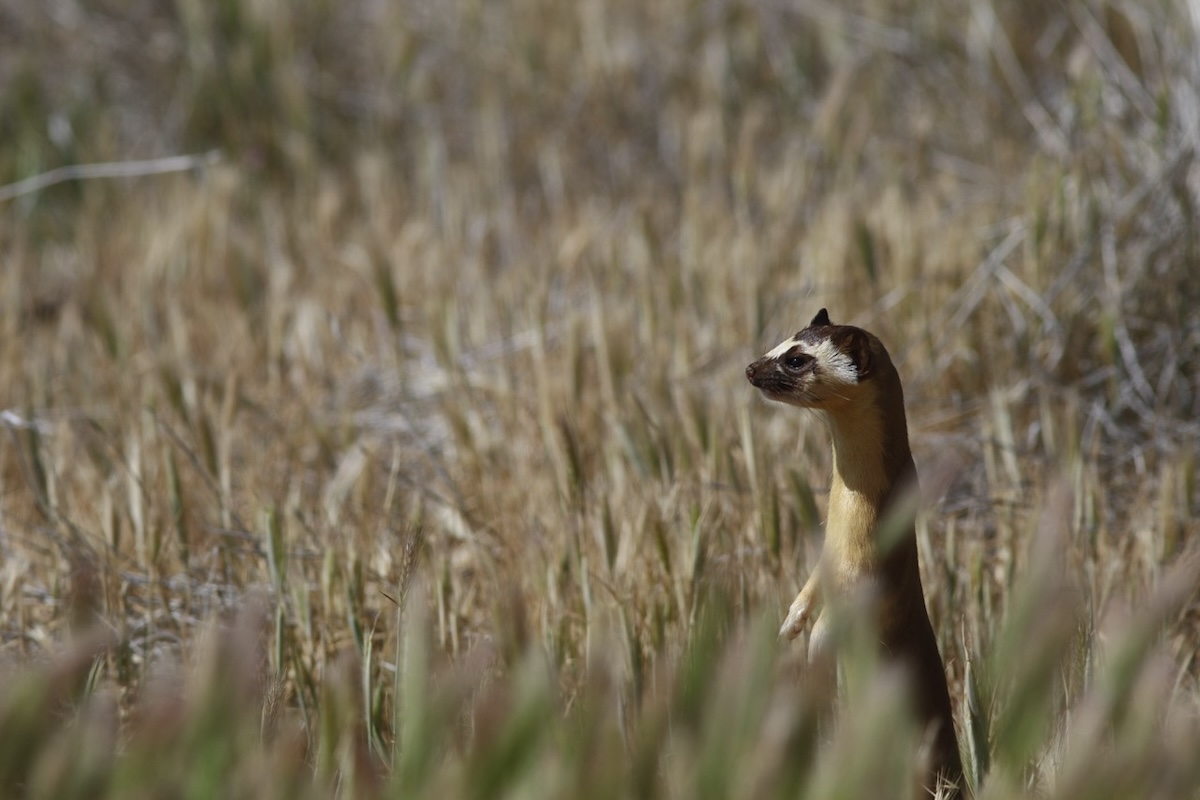
Later, I sent photos of the carnage to wildlife biologists who work on the Carrizo Plain to get their thoughts. They all came back with the same answer. The bodies were the handiwork of a busy but elusive long-tailed weasel.
“We don’t often see weasels, and if we do, it’s just for a second,” said Craig Fiehler, environmental scientist for the California Department of Fish and Wildlife. “I saw one last year. Usually, it’s in grassland habitat.”
Long-tailed weasels are found in every state in the Lower 48 but are rarely observed. On the Carrizo Plain, they use dens left by other burrowing mammals because they are constantly on the move. Otherwise, they are solitary creatures; mating is the only occasion they spend time together.
Despite only weighing eight to 12 ounces, they are one of the fiercest predators in North America. With a powerful bite, they can take on prey 10 times their size. They cover as much as seven miles a day, and due to their frenetic pace, they consume up to 40 percent of their body weight every 24 hours to satisfy their hyperactive metabolism. When prey is abundant, they kill more than they can eat and stash the extra food.
“They are primarily nocturnal, but I’ve only seen them during the day,” continued Fiehler. “Once or twice, I’ve seen them while spotlighting for kit foxes. They have great colors. I have never gotten one in a camera trap or coming to a bait.”

In the spring of 2020, I photographed a kit fox den for six weeks. By summer, the five pups had grown and were nearly ready to venture out on their own. My last morning at their den, something didn’t feel right. After two hours of no activity, I moved to a spot where I could see that den and their alternate den site. Still, nothing stirred.
Another hour drifted by, and then I saw an 18-inch, slender, long-tailed weasel emerge. It stood on its short, hind legs, and swayed its head from side to side to pick up the scent of its prey. Before I knew it, the weasel was bounding after an unlucky giant kangaroo rat.
Weasels are associated with misfortune and bad luck. I don’t believe that. I’ve now seen four on the Carrizo Plain, and I’d say it’s good luck to see something so elusive. Just don’t tell that to a giant kangaroo rat.









You must be logged in to post a comment.