

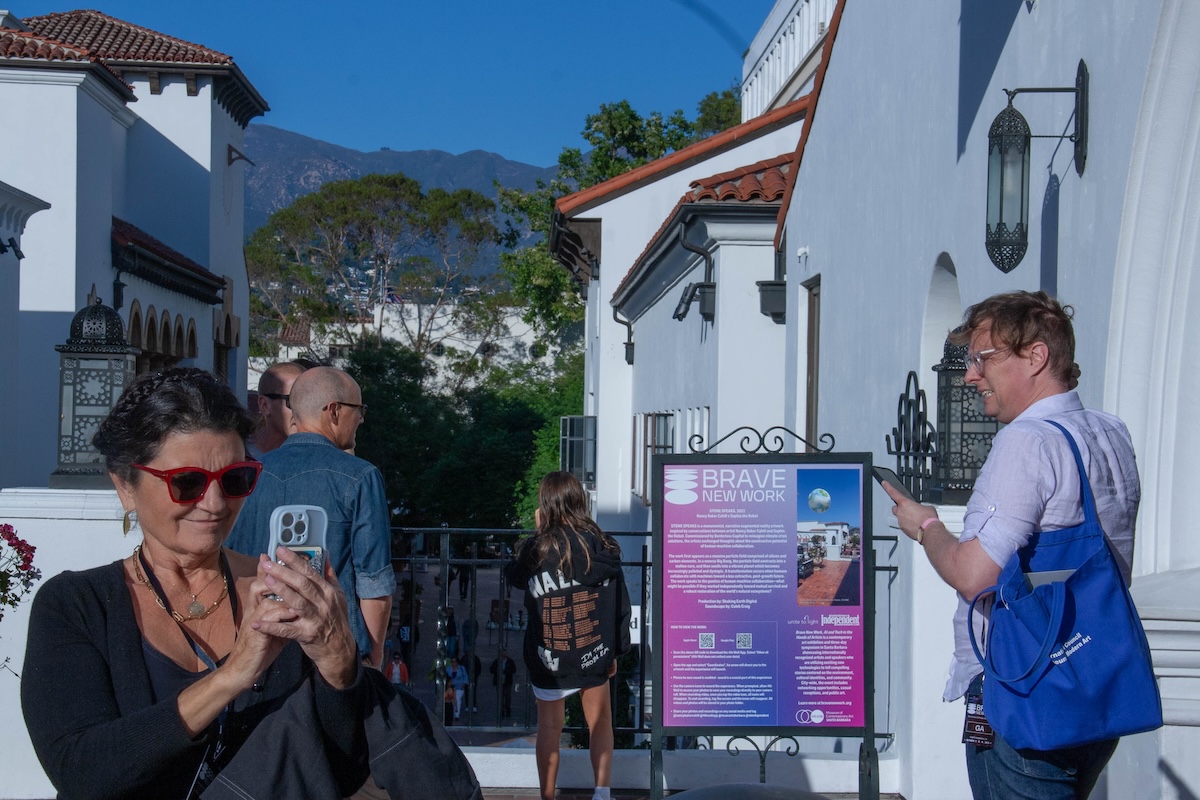
An incidental pleasure attached to last week’s first annual “Brave New Work” symposium and exhibition was the rare chance to actually enter and hang out in the erstwhile mysterious and historic Masonic Temple on Carillo Street. Access to the century-old building, housing Lodge #192 of the chapter of the 300-plus-year-old organization, has long been limited to members and insiders, but began opening its doors to public events and visitors this year.
It might have seemed an odd fellowship and juxtaposition to host the cutting-edge symposium — exploring and showcasing the merger of art and AI and other new tech-related topics — in this space where many of the interior features have a time-stood-still ambience, but all was well when the event held three of its panel discussions in the Masonic ballroom. The seminar, organized by entrepreneur Michael Delgado, with logistical help from the Independent and other entities, was a moveable feast, touching base at UCSB, SBMA, MCASB, CAW, SBHS, Sullivan Goss, and SBCAST (whose founder Alan Macy led an artist’s panel), and a culminating, public-invited video exhibition projected on the walls around the Central Library’s Michael Towbes Plaza.
But it all began in the Masonic’s inviting ballroom space. Less than a block away from the Mason’s HQ is another large building — the temple of Jeff Bezos — where much of the work behind the famed robotic helper-companion Alexa takes place. Kevin Davis, the de facto team leader, and who Delgado dubbed the “Grand Poobah” of Alexa, only had to walk three minutes to join the first panel discussion, along with another prominent high-tech force with a Santa Barbara footprint, Google’s Quantum Lab. From that Goleta industrial area outpost, whose artist-in-residence Forest Stearns was in-house at the Temple.
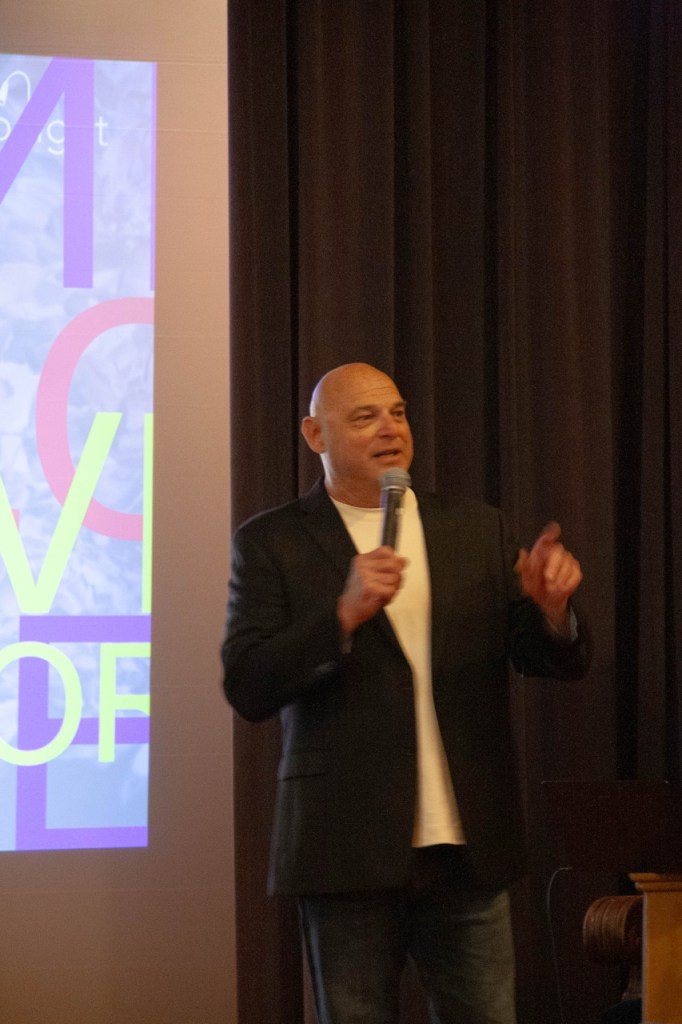
On day one of the three-day event, Delgado opened the proceedings with what amounted to a mission statement, noting, “just mention the term AI and you get a really visceral reaction. People react pretty much one way or the other, but primarily negatively. AI is very powerful and it’s invasive and it’s moving extremely fast. Those are three things that trigger us to think we’ve gotta run away or we have to fight this. It triggers our cave brain to say that’s a lot of scariness.
“But we don’t necessarily have to have a fight or flight response. Not to be cliché and say art will save the world, but if you think about art and self-expression, to express ourselves and our humanity, a third path is what can be useful — the art and technology piece of it.”
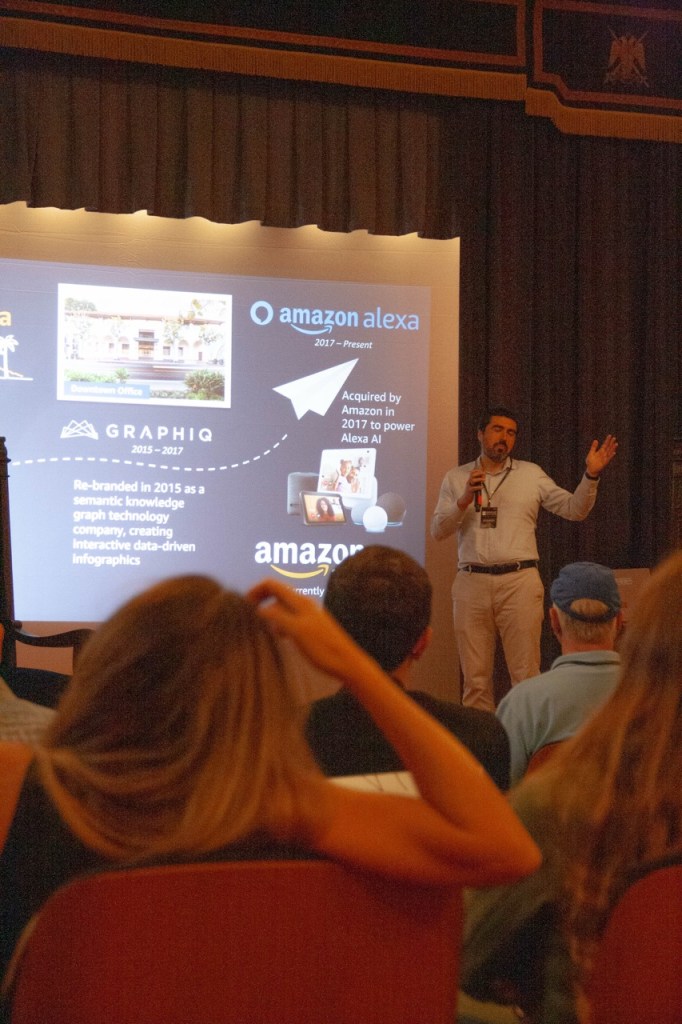
The panel discussion involved Davis largely talking about the background of the popular Alexa, promoting the presently unveiling next-generation Alexa+, furthering the company goal of “unlocking a lot of ability for anyone to connect with computers.” Stearns spoke of his evolution from a pure love of drawing to working with Quantum engineers to create elaborate murals and architectural iterations within the Google campus and elsewhere.
Much of the seminar, by definition, projected a positive and boosterist view of life in the age of AI going wild, but as Delgado pointed out, the public trepidation about its potential dark side can’t be ignored. During the open Q&A session, someone asked about said dark side.
Stearns suggested, “I hope to always lead with bringing the language of nature into this work. The reason why I wrap quantum computers in images of nature, and we have done dozens of these pieces within an amazing future-facing laboratory, is to always bring nature back to the conversation. The quantum computer team found me because they told me they speak the language of nature.
“I feel like I’m on the right team. I’m sure there are teams of really nefarious pirates out there and I’m not gonna join that team, personally. I can only steer my own ship.”
Davis expanded on the theme, noting that, “if you have a belief that humanity is generally good, that is generally gonna win out. That doesn’t mean that we should put our heads in the sand and not be aware that there are risks. There have always been bad actors and technology in general can sometimes help amplify some of those negative intentions. We certainly do try and make sure we’re doing the right things.
“Part of the reason I love getting up every morning is trying to make these things more factually accurate, get the right information to people, help arm them with truth. I’m a bit of an optimist, but I think it’ll work out and hopefully that we’ll have more of these conversations here in Santa Barbara and all over the place.”
For an actual taste of tech-enabled artwork, CAW (Community Arts Workshop) housed the exhibition “Symbiosis or Schism? The AI-Human Odyssey.” A companion exhibit sponsored by the Brill Foundation, Each artist engaged personal routes to the art-tech connection, from Kevin Mack’s elaborate process of using AI to create dense, complex, crisp and fantasy-laced scenes to Greg Tate’s surreal retooling of freeway scenery equipped with flown-in fragments of classical sculpture imagery. Ann Cutting and Ulrike Kerber deploy AI and digital tools to work with “an aesthetic that highlights female presence and power.”
For the Wednesday morning panel, artists from beyond Santa Barbara, both presently accounted for and via video, were in the spotlight at the Temple, for a discussion entitled “Signals & Systems: Artist Rewiring Perception in the Age of Intelligent Media.” Among the artists on hand was Victoria Vesna, who taught for several years at UCSB before heading to her current post at UCLA as Director of the Art & Science Program. Her early work in conceptual art, some of it supported by the Santa Barbara-based Bermant Foundation, led her naturally into such pieces as her recent meteorite-referential Alien Space Dust (as seen at the Library plaza).
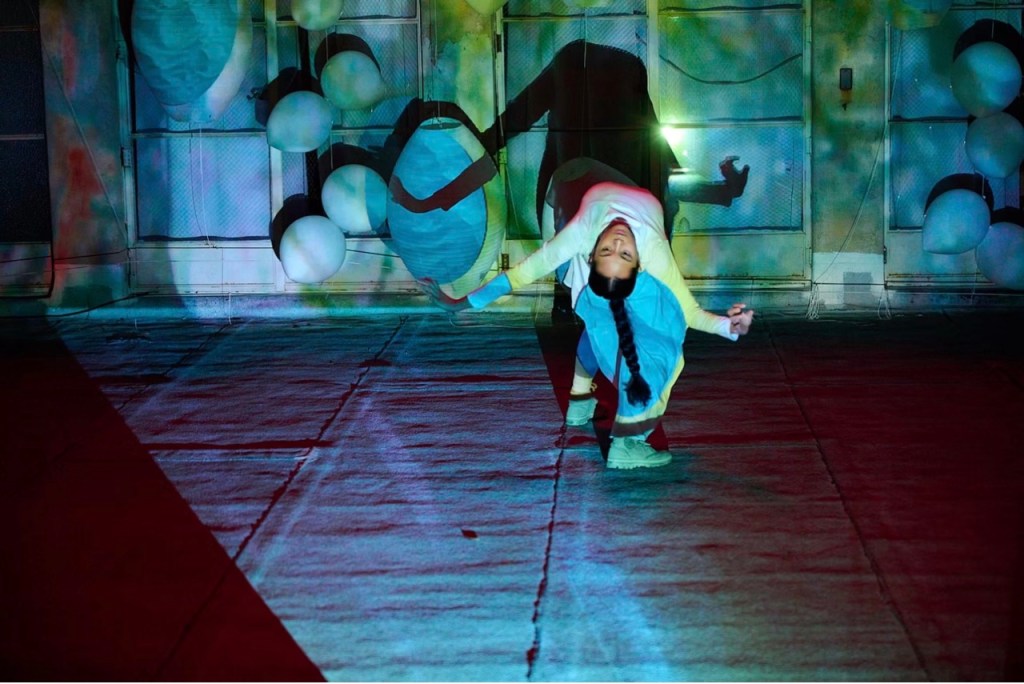
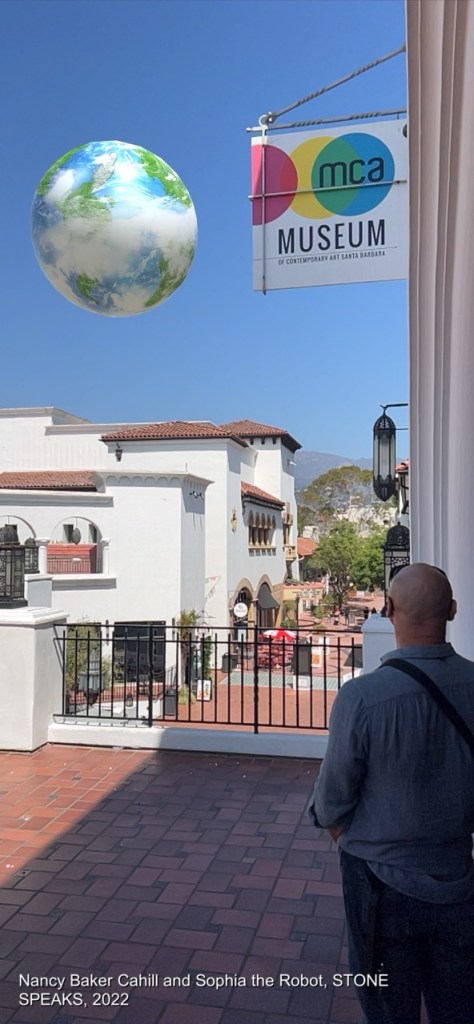
The art in focus here often came with significant artworld cred and placement, such as Nancy Baker Cahill’s audience-participatory Cento, at the Whitney Museum of Art in New York. Isabel Beavers, whose piece shown at the Library Plaza was her 3-D animation HyperAccumulators, explained, “I am both an artist and artistic director of an organization called Super Collider, and we are an artist collective that runs exhibitions focused around themes of art, science, and technology. A large part of my practice is organizing other artists in Los Angeles and beyond to have dialogues like the ones we are having today, to think about some of the issues at the forefront of society, and to work with artists whose practices don’t neatly fit into one category.
“All the artists here are asking really exciting and interesting questions about science, about art, about the role of art and about the future on our planet.”
Planetary concern is at the heart of Beattie Wolfe’s piece shown here, Smoke and Mirrors, culled from six decades of climate data and exposing fossil fuel corporation deceptions. The British Beattie is also a musician, who recently released an album with Brian Eno. She commented that, “music goes beyond what we really understand neurologically, as does art. And as Oliver Sacks identified, there are two things we need fundamentally as human beings to stay sentient — art and nature. That’s what I want to safeguard. And when I’m using technology in maybe unusual ways, ironically, it’s actually to try and reclaim a lot of what we lost in the beginning because of technology.”
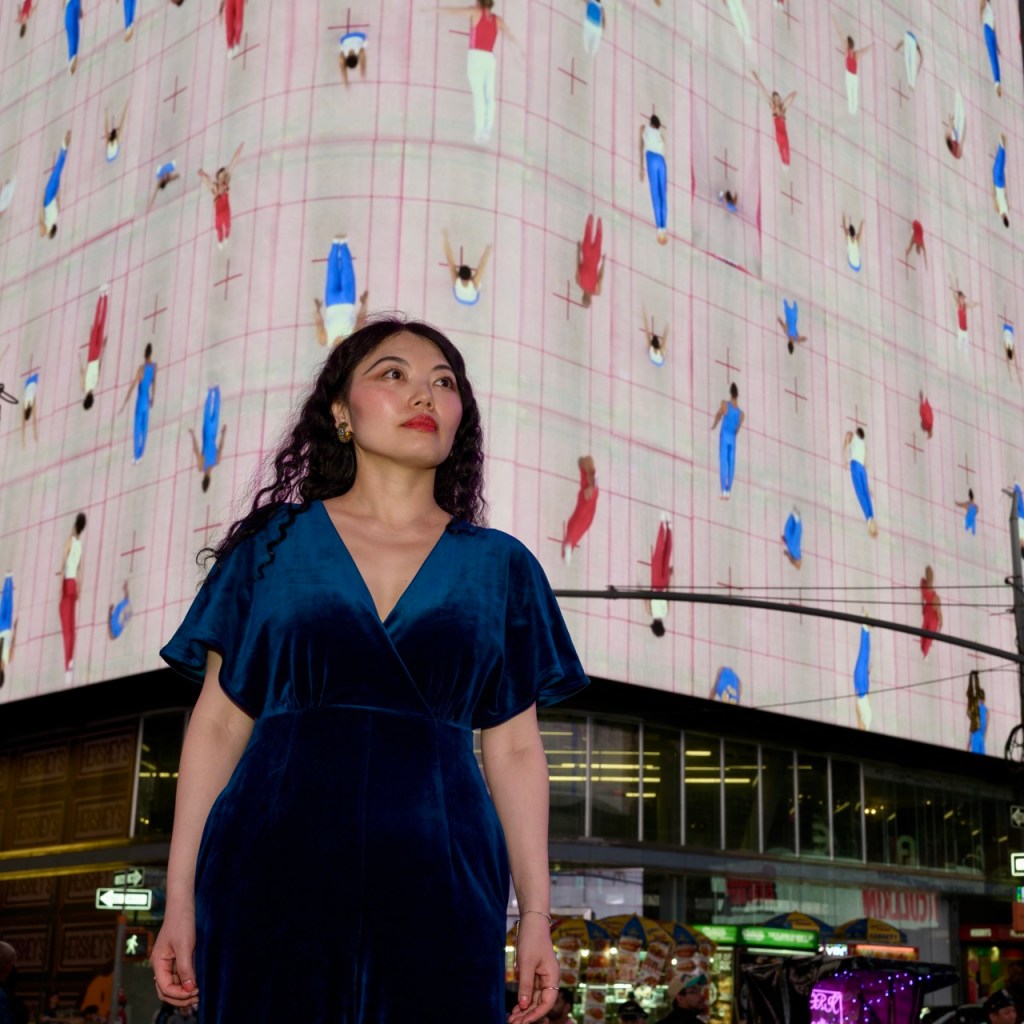
One of the most satisfying and inventive artworks presented, on screen and in discussion, was Yuje Zhou’s Trampoline Color Exercise. A dense but orderly mosaic of shots of multiple Olympic gymnasts on shifting color grids has a strange hypnotic minimalist effect, an ideal example of an art-tech marriage that works. The piece was recently featured on the 95 screens around New York City’s Times Square for three minutes between 11:57 and midnight, part of the city’s “Midnight Moment” project showcasing contemporary video work.
The Chinese-born Zhou explained, “I’m an immigrant, and a lot of my work has to deal with movement and coexistence or cohabitation in constructed urban spaces. It is playful at first, but when I made this piece it was during the pandemic and it was also during the time of the Russian-Ukraine war and I was thinking about geopolitics. The combination of colors actually references the flag colors of different super powers.”
Also in the room at the artist panel was UCSB professor Dr. Joanne Kuchera-Morin, who has been at UCSB for 41 years, and articulately addressed the subject of the art-tech interface, from her music perspective. “I’m a composer and I’ve always looked at things as instruments,” she said, “so the computer’s always been just another instrument to me, and there’s no reason that I can’t use that instrument, not use that instrument along with other instruments, with violins, cellos or whatever I do, and then to push that out.
“A lot of people thought in the early days that the pipe organ was gonna replace the orchestra because you could do the same thing (as an orchestra). It’s the same thing with thinking about the computer as an instrument. For me, there’s never been a disconnect since I had a PDP 11 (an early computer) drop in my lap in 1981.”
Heading out to the AlloSphere — Kuchera-Morin dazzling project that’s been in UCSB’s Nanotechnology building since 2017 — is a multi-sensory experience and head-trip unlike any other in Santa Barbara and beyond. Described as, “a large-scale instrument created as an environment to deliver rich, coherent, interactive, high-resolution 3D video and audio streams from massive scientific datasets,” the AlloSphere was put to good use by Kuchera-Morin, who presented her audio-visual, computer-generated piece Probably Possibly for a rapt group of visitors. It was a moving, ever-morphing display in what seemed more like 4-D. Afterward, she added, “I can also jam on this thing,” which she proceeded to demonstrate.
Art meets tech in a vivid, wrap-around way in this visionary three-story space.
For a welcome bit of pre-AI art historical grounding, at Santa Barbara Museum of Art, chief curator James Glisson offered a fascinating lecture-slide presentation with the title “A Brief History of the Impossible.” Up front, he made the disclaimer that, unlike the tech-fueled art at issue in this event, “I’m looking backwards, not forward.” But he made the important proviso that, vis a vis the criticism that AI-generated art lacks originality and filches source materials, “questions about originality and authenticity go back to the Baroque era in art.” He cited such varied examples as critical resistance to Caravaggio’s then-new embrace of realism, the dream-reality-absurdity garnering agendas of the Surrealists and the slow-to-be-embraced medium of photography. The Museum of Modern Art had its first fine art photography show in 1940, about a century after the medium’s invention.
After Glisson’s enticing lecture, the troops walked the short distance to the adjacent Library Plaza for a showing of tech-tapping art by the artists involved, splashed in epic scale all over the available public wall spaces, for all to see and hear.
This observer’s verdict: the Best of Fest award goes to Zhou’s mesmerizing Trampoline Color Exercise, which traveled well from Times Square to the new public plaza spread on Anapamu Street.
On day one, back in the Temple, Delgado touched on the vision, and potential future state of the project, noting that “the people who put this together have a shared vision. The reason we’re here in Santa Barbara is because art and technology has been going on here for a long time — at UCSB, and with Amazon and Google being now headquartered here. We want to turn this into a Davos (Swiss home of the World Economic Forum) crashed into an Art Basel, where it takes over the city and Santa Barbara is re-branded as a renaissance town.”
Related Posts


Premier Events
Sat, Mar 28
7:15 PM
Santa Barbara
Santa Barbara Stargazing Tour
Sat, Apr 18
5:30 PM
Solvang
The Winemaker’s Table: An Evening of Rideau Reds
Sun, Mar 22
2:00 PM
Solvang
Art Workshop – Origami Garlands
Sun, Mar 22
3:30 PM
Santa Barbara
History and Joy of Blues Music: Live Presentation
Sun, Mar 22
4:00 PM
Santa Barbara
SANTA BARBARA REVELS -PUB SING followed by Karaoke
Wed, Mar 25
6:30 PM
Santa Barbara
Vigil for Lament, Solidarity and Peace
Sat, Mar 28
All day
Santa Barbara
Coffee Culture Fest
Sat, Apr 18
11:30 AM
Goleta
The Santa Barbara Independent Backyard Brunch
Sat, Mar 28 7:15 PM
Santa Barbara
Santa Barbara Stargazing Tour
Sat, Apr 18 5:30 PM
Solvang
The Winemaker’s Table: An Evening of Rideau Reds
Sun, Mar 22 2:00 PM
Solvang
Art Workshop – Origami Garlands
Sun, Mar 22 3:30 PM
Santa Barbara
History and Joy of Blues Music: Live Presentation
Sun, Mar 22 4:00 PM
Santa Barbara
SANTA BARBARA REVELS -PUB SING followed by Karaoke
Wed, Mar 25 6:30 PM
Santa Barbara
Vigil for Lament, Solidarity and Peace
Sat, Mar 28 All day
Santa Barbara
Coffee Culture Fest
Sat, Apr 18 11:30 AM
Goleta


You must be logged in to post a comment.