
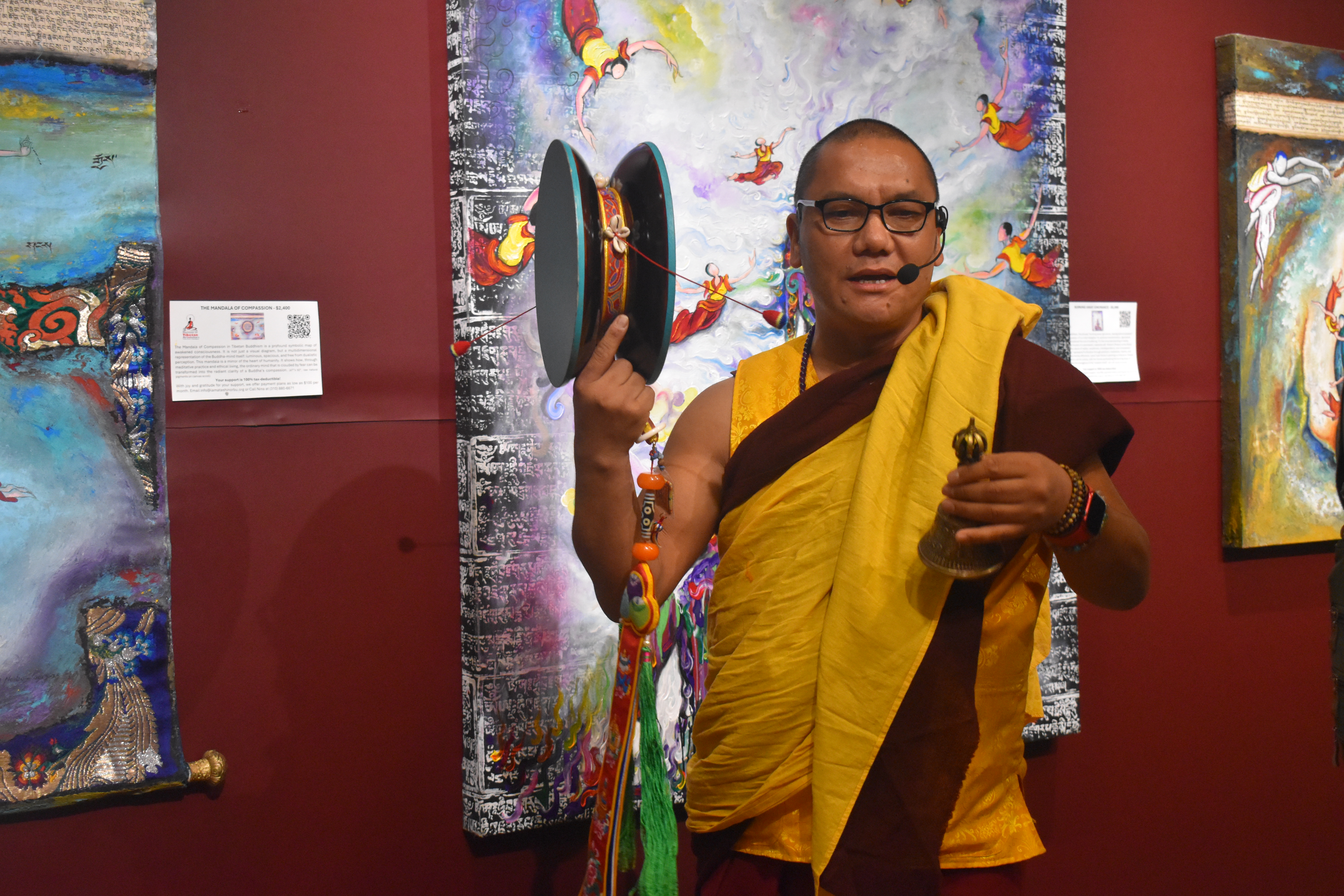
The soft ring of singing bowls and the warm waft of dumplings cut through the chatter of La Cumbre Plaza as the Museum of Tibetan Art & Culture and Legacy Art Studios held its “Grandest Opening” on November 21.
At the center of the celebration was Lama Tashi Norbu, a Tibetan Buddhist lama, contemporary artist, and founder of the Museum of Contemporary Tibetan Art in the Netherlands.
Internationally recognized for blending traditional Tibetan iconography with modern Western styles, Norbu trained at monasteries in Tibet before studying at European art academies, developing a hybrid approach merging thangka techniques with performance and art.
“Painting, and creating, just happened to be my life,” Norbu said. “I’ve been all over the world performing. There are facilities and education more accessible to artists outside of India, but it’s still my home, my culture.”
Norbu is also the only Tibetan Buddhist Lama officially sanctioned to perform Tibetan Sacred Tattoo ceremonies, a rare ritual blending mantra, symbolism, and spiritual work.

The evening opened with a condensed prayer and singing-bowl ceremony. With his eyes closed, Norbu chanted while a small ensemble playing traditional instruments layered sound beneath his voice. Roughly 30 attendees formed a loose seated circle around the room, attempting to follow along with lyric sheets passed hand-to-hand.
Crispin Barrymore — Santa Barbara music and founder of Legacy Arts International — also performed during the ceremony. Barrymore has collaborated with Norbu on cultural programming aimed at bridging Tibetan artistic traditions with Santa Barbara’s creative community.
After the ceremony, Penny Little, director of Santa Barbara’s Summer Solstice Festival, said she hopes to collaborate with the museum on bringing the organization’s Elephant Parade to Santa Barbara.
Elephant Parade orchestrates the largest global art exhibition of decorated elephant statues, aimed at promoting elephant conservation. And it’s all based on the story of Mosha, a young elephant who became a global emblem of resilience after losing her leg to a landmine. In Tibetan art, elephants often represent wisdom, strength, and compassion.
These life-size, baby elephant statues, designed by artists and celebrities, tour international cities to elevate conservation awareness. In Tibetan art, elephants often represent wisdom, strength, and compassion.
“The elephants are coming,” Little said with a smile.
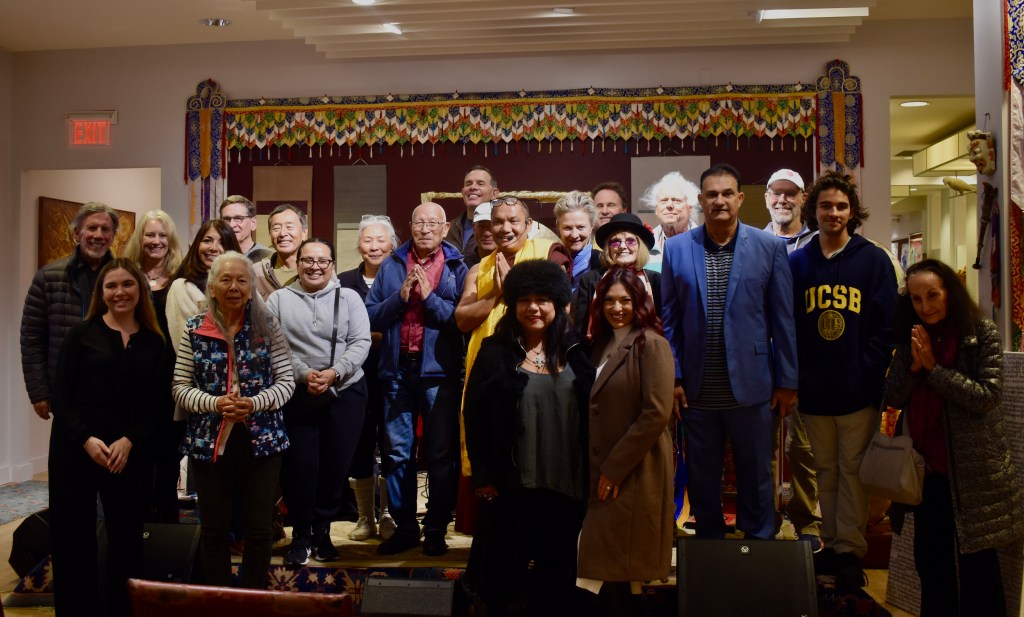
Later in the evening, Thepo Tulku — a longtime Tibetan teacher, friend of Norbu, and active contributor to Santa Barbara’s interfaith community — reflected on the purpose of the event.
“May Lama Tashi Norbu’s Tibetan contemporary art continue to inspire peace, preserve our identity, and remind the world of the values we hold close: compassion, resilience, and the sacred dignity of all beings,” Tulku said.
While Los Angeles and San Francisco each have Tibetan communities numbering in the low thousands, Santa Barbara has only a small handful of Tibetan residents. Visibility has grown in recent years through interfaith efforts led by figures like the president of the interfaith initiative of Santa Barbara County, Mahomed Khan, whose collaborations emphasize peace-building, shared spirituality, and cultural preservation.
This fall, the Santa Barbara County Board of Supervisors formally acknowledged the role of such work when it passed a resolution on September 23 supporting the Interfaith Initiative, affirming the importance of spiritual leaders — including Tibetan teachers — in fostering community unity.
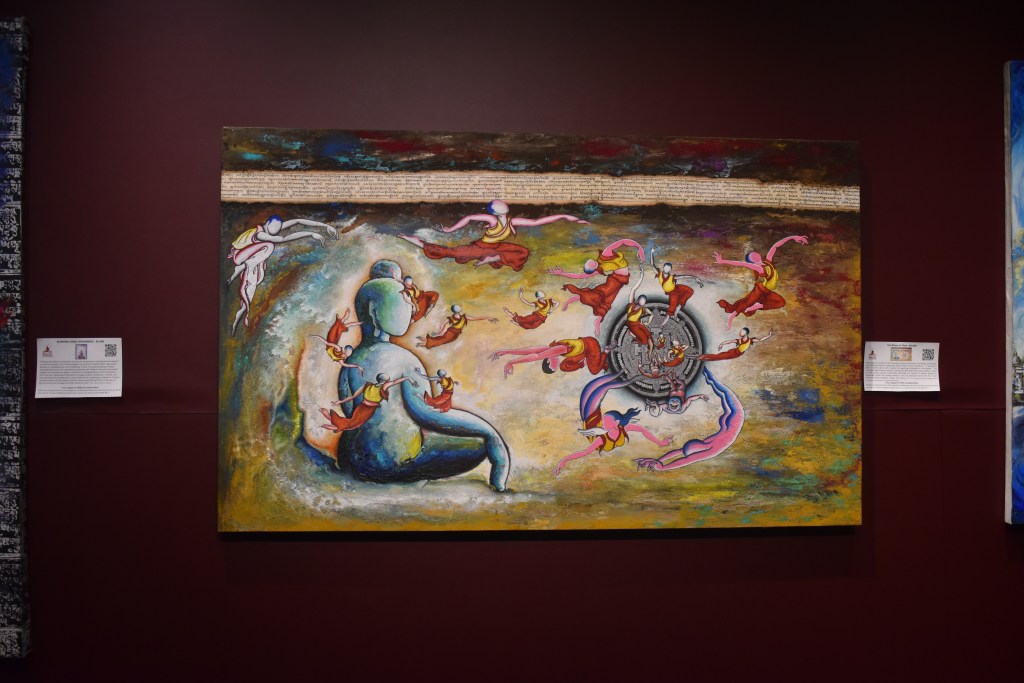
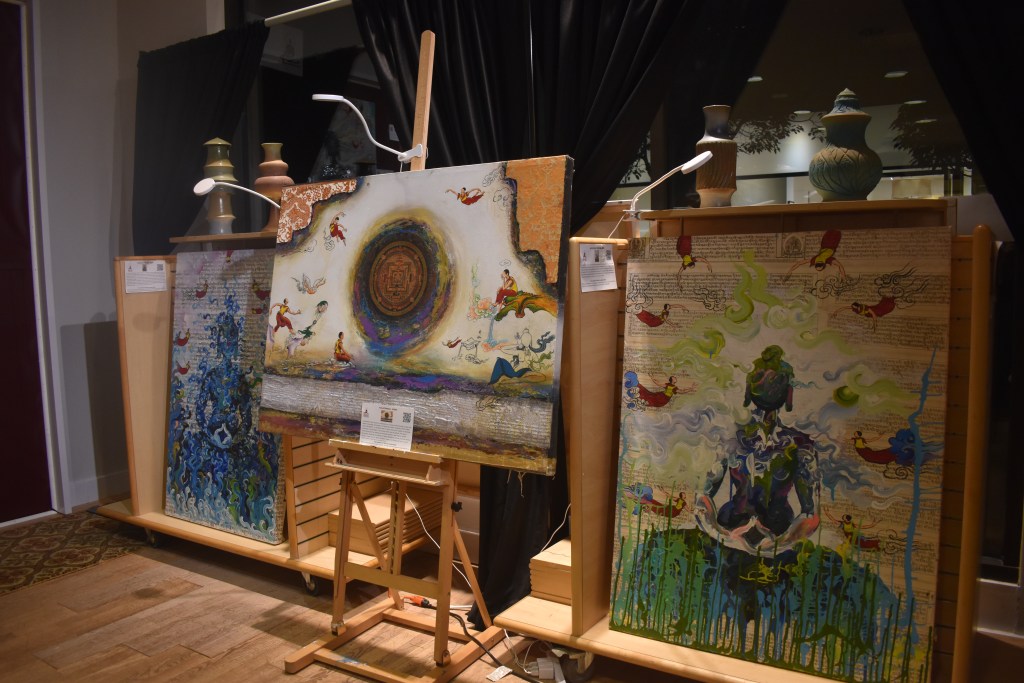
Around the gallery, Norbu’s paintings lined the walls, inviting viewers into a world where tradition and modernity intertwine. Wave-like depictions of the Buddha, vibrant color fields, and surreal abstract imagery blend ancient Tibetan Buddhist symbolism with a contemporary, expressive style.
Some paintings depict human figures or deities emerging from swirling clouds or waves of color, suggesting the impermanence of life and the continuity of consciousness. Norbu explained that Tibetan Buddhism views death not as an end but as a transition: “a journey the consciousness takes beyond the body.”
The works, some priced up to $10,000 and fully tax-deductible as charitable donations, were part of the museum’s broader fundraising effort.
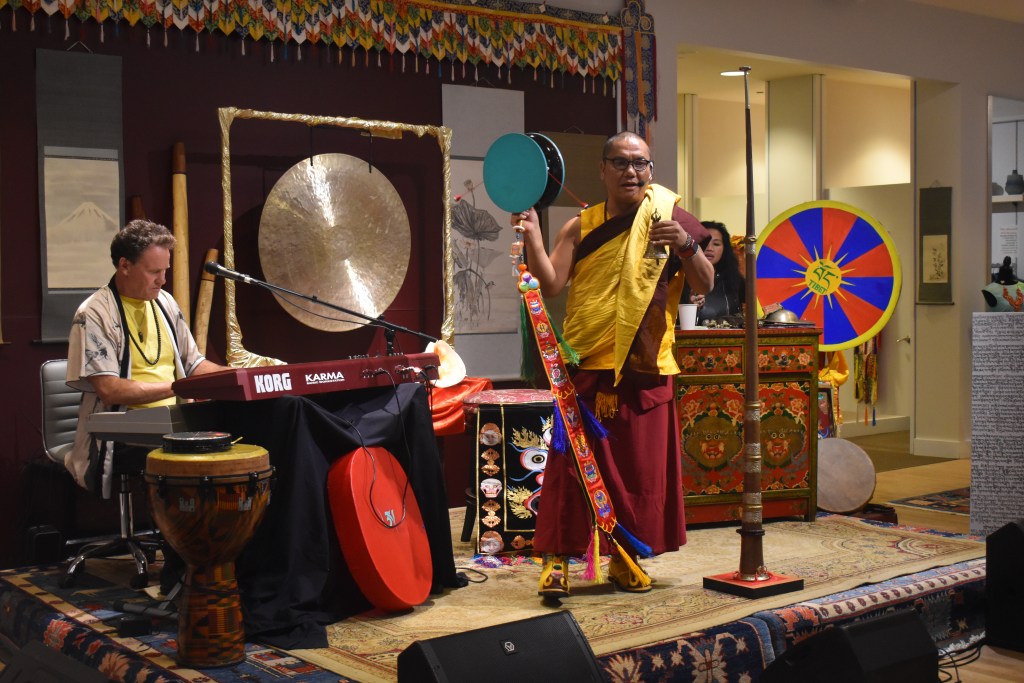
Beyond the performances and paintings, the evening highlighted the museum’s mission of connecting Tibetan spirituality with Western understanding. Norbu said the space offers younger generations a tangible way to explore Tibetan ideas, while holding onto the core values of the faith.
“Human value is compassion,” Tolku said. “A kind heart is the only way to world peace. The body is a temple, and the way we worship that temple is through the most important human value: kindness.”
The Museum of Tibetan Art & Culture and Legacy Art Studios is located at 120 South Hope Avenue, Suite F-20, in La Cumbre Plaza. For more information, see legacyartsb.com and lamatashinorbu.org.
Related Posts




Premier Events

Sat, Mar 14
7:00 PM
Santa Barbara
Red, White, & Blues II: The American Songbook
Sun, Mar 15
3:00 PM
Santa Barbara
Red, White, & Blues II: The American Songbook
Sat, Mar 28
7:15 PM
Santa Barbara
Santa Barbara Stargazing Tour

Sun, Mar 15
3:00 PM
Santa Barbara
Oscars 2026 Watch Party & VIP Reception
Tue, Mar 17
5:30 PM
Santa Barbara
SB Independent’s Annual St. Patrick’s Day Stroll 2026
Thu, Mar 19
6:00 PM
Santa Barbara
Chaucer’s Book Talk & Signing: Elizabeth Gilchrist
Sat, Mar 28
All day
Santa Barbara
Coffee Culture Fest
Sat, Apr 18
11:30 AM
Goleta
The Santa Barbara Independent Backyard Brunch
Sat, Mar 14 7:00 PM
Santa Barbara
Red, White, & Blues II: The American Songbook
Sun, Mar 15 3:00 PM
Santa Barbara
Red, White, & Blues II: The American Songbook
Sat, Mar 28 7:15 PM
Santa Barbara
Santa Barbara Stargazing Tour
Sun, Mar 15 3:00 PM
Santa Barbara
Oscars 2026 Watch Party & VIP Reception
Tue, Mar 17 5:30 PM
Santa Barbara
SB Independent’s Annual St. Patrick’s Day Stroll 2026
Thu, Mar 19 6:00 PM
Santa Barbara
Chaucer’s Book Talk & Signing: Elizabeth Gilchrist
Sat, Mar 28 All day
Santa Barbara
Coffee Culture Fest
Sat, Apr 18 11:30 AM
Goleta


You must be logged in to post a comment.