Will Vandenberg Space Force Base become the West Coast home of the world’s largest rocket, now being developed to put people back on the Moon and some day send crews to Mars?
That’s the question being asked after the U.S. Space Force announced a plan over the holidays to develop a new launch site at the Santa Barbara County base capable of hosting “heavy” and “super-heavy” rockets that will deliver massive payloads into orbit, and beyond.
With its Request for Information (RFI) posted on December 29, the Space Force is soliciting proposals from private launch providers to lease and build out the dormant site ― called Space Launch Complex (SLC) 14 ― on Vandenberg’s southern edge.
The lease would permit the operator to “design, construct, operate and maintain space launch infrastructure,” the RFI states, noting applicants must prove “sufficient financial maturity” to carry out such a project.
The RFI said Vandenberg wants to “increase launch diversity” by using SLC-14 for new vehicles that don’t currently operate at the base, and that it is particularly interested in spacecraft with “unique capabilities” that will be ready to fly within five years of signing an agreement.
“A heavy/super-heavy launch capability at [Vandenberg Space Force Base] offers a strategic advantage to the [United States Space Force], enabling the deployment of larger, more capable military satellites and facilitating rapid response missions during national security emergencies,” the RFI states. “Adding heavy/super-heavy launch capabilities at VSFB enhances resilience, diversifies the government’s portfolio, and accelerates satellite constellation reconstitution due to increased lift capacity.”
The conditions set forth in the RFI put only a handful of launch providers within reach of SLC-14. Top among them is SpaceX, already Vandenberg’s most active tenant. The company is expected to launch more than 100 Falcon 9 rockets this year, up from 50 last year, and recently received approval to convert another launch site, SLC-6, to accommodate its larger Falcon Heavy rockets.
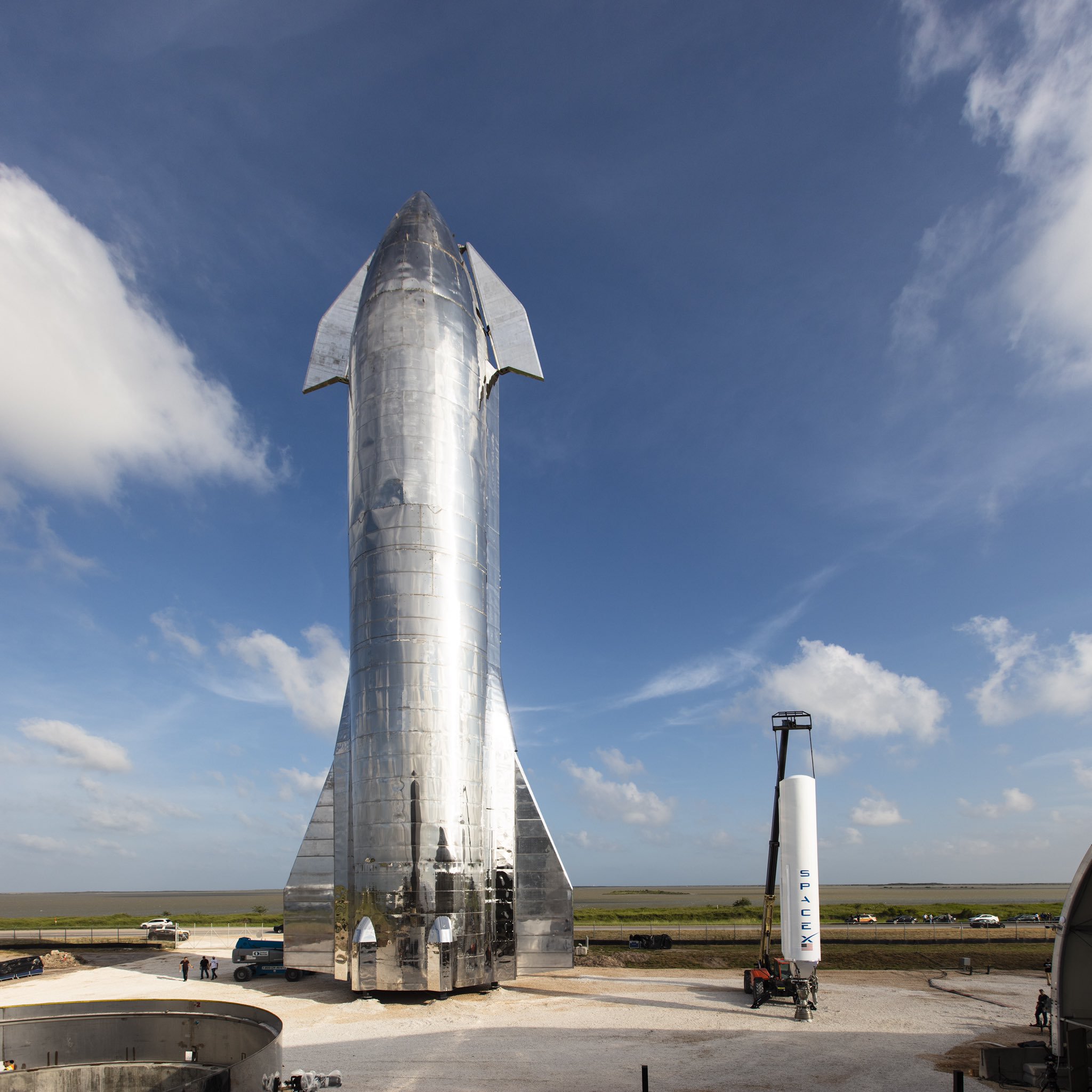
Dwarfing those already sizable vehicles is Starship, the crown jewel of the SpaceX fleet. Built primarily of stainless steel and powered by 33 Raptor engines, the world’s largest and most powerful rocket developed by the world’s richest man stands more than 400 tall. That’s taller than the Saturn V rocket which powered the iconic Apollo lunar program.
Starship and its booster are designed to ferry cargo and people into Earth orbit and further out into space, generating over 16 million pounds of thrust at liftoff. For comparison, Falcon 9 rockets, which stand 230 feet tall, generate approximately 1.7 million pounds of thrust.
The first Starship was built in 2020 and is now in its third iteration. So far, all 11 of its test flights have taken place at SpaceX’s headquarters in South Texas. Five of those tests were successful with six ending in fiery explosions. More flights are scheduled in Florida later this year.
Starship is slated to play a central role in returning humans to the moon as part of NASA’s Artemis program. NASA had previously aimed for 2027 for a crewed landing, but the recent testing failures have pushed the date out to 2028. Sometime by the middle of the century, SpaceX owner Elon Musk says he wants Starship to start sending manned missions to Mars, with the goal of establishing a self-sustaining colony on the red planet.
Another contender for the new launch site is Blue Origin. Jeff Bezos’s aerospace company, which currently flies out of Texas and Florida, recently announced plans for a super-heavy lift version of its New Glenn rocket. Relativity Space also has a shot. Like Blue Origin and SpaceX, their heavy lift rocket, the Terran R, is designed with a reusable booster that falls back to Earth after launch.
While SpaceX has not disclosed any plans to set up shop at SLC-14, industry experts say it could be a very attractive option given the launch advantages the West Coast base offers. Compared to Texas and Florida, its geographic location is much better suited for missions that require sun-synchronous orbits, which the company routinely carries out.
Launch providers have 45 days to respond to the RFI. Any decision to award a lease will be contingent on a launch safety analysis and completion of an environmental impact statement, the Space Force said.