

In the time since Tiffany Chung earned her MFA degree at UCSB in 2000 to now, much has changed with global concerns in her art, including human migration, wartime ripples, and climate change. Add to that the artist’s deeply invested interest in the dark aspects of history, combined with her remarkable technical and visual approach, and the result is something unique and powerful.
Chung, who was born in Vietnam in 1969 and based in Ho Chi Minh from 2000 to 2017, now residing in Houston, Texas, has ventured into the international art scene, with shows at the Smithsonian, the Dallas Museum of Art, and around the world. She comes home with quietly potent exhibition Tiffany Chung: indelible traces at the UCSB AD&A Museum, which also turns out to be one of the strongest exhibitions in this space in recent years.
Generous in scale and breadth, the current exhibition in her alma mater’s museum, curated by Orianna Cacchione, Deputy Director of the University of Richmond Museums, is Chung’s first comprehensive museum survey, and makes an impression at once bold, intricate, and subtle. Seventy works, in varied media, fill the entire museum footprint and offer a cohesive overview of the artist’s vision over the past quarter-century.
Maps are central to Chung’s aesthetic and philosophical outlook, a visual storytelling format capable of conveying microcosmic messages. She writes that “to study history, one needs to look at maps. To study a map, one needs to remap it.”
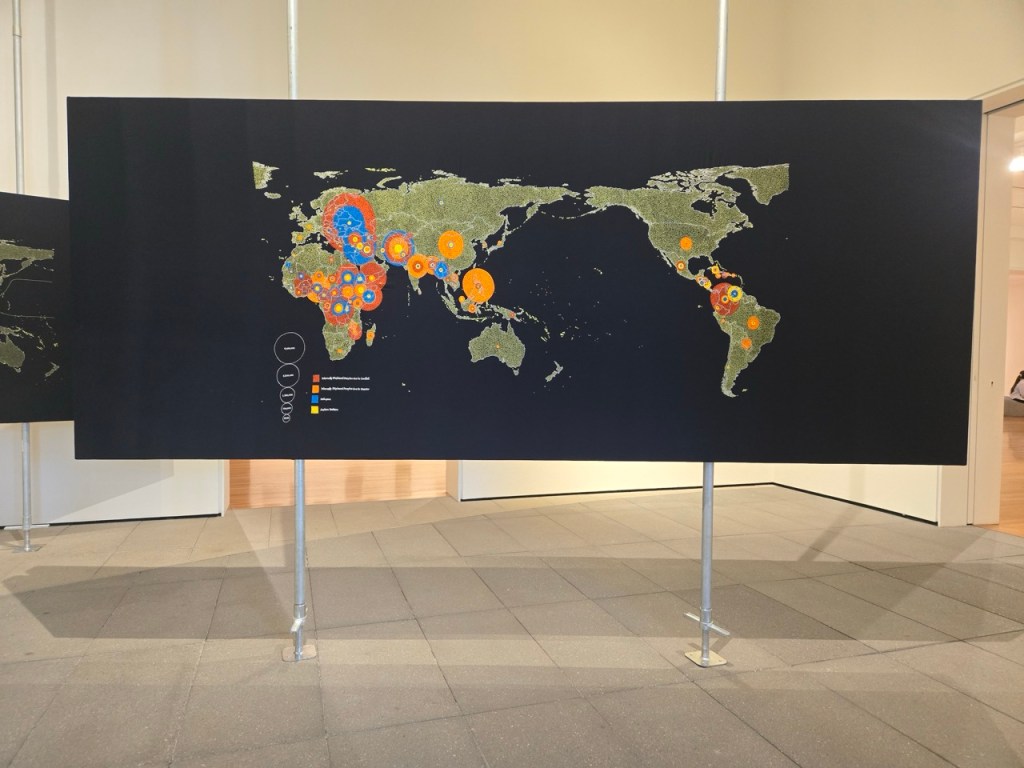
For a bracing example of Chung’s eloquent — and subversive — mapping interest, the tall-ceilinged gallery in the museum hosts sizable works of hyper-elaborate embroidery pieces identifying global transgressions. “El Pulpo” explores the corporate and “banana republic” mischief in Guatemala through the UNFCo (United Fruit Company, while “The Spice Trade” and the monumental double-sided piece “USM Global: tracing the U.S. military global footprint” track dubious ventures in commercial and military-industrial ambitions.
In the museum foyer, delicate works — acrylic, glitter, fabric, and thread on cloth handkerchiefs — provide a deceptively spare and lyrical vehicle for the underlying theme of pirate attacks in the Gulf of Thailand during the vulnerable period of Vietnamese refugee movement in 1985-86. Elsewhere in the museum, a similar dichotomy is encountered in “If Water Has Memories,” a three-channel video piece that, on the face of it, deals with the piracy tragedy in a meditative way.
What appears to be floral studies, with an impossibly fine embroidery technique resembling watercolor paintings, the thematic subplot has to do with the ulterior motives of historical explorations of the New World. Beyond curiosity and scientific, geographical inquiry, of course, was the avaricious pursuit of minerals and exotica of flora and fauna.
“The Syria Project” is another case of artistic flourish and sobering reality-tapping details, of civil war, displaced people, and suffering telegraphed through fragmented map art. Nearby, a series of ink-and-oil on vellum works feed from the statistics gathered by the United Nations High Commission for Refugees (UNHCR).
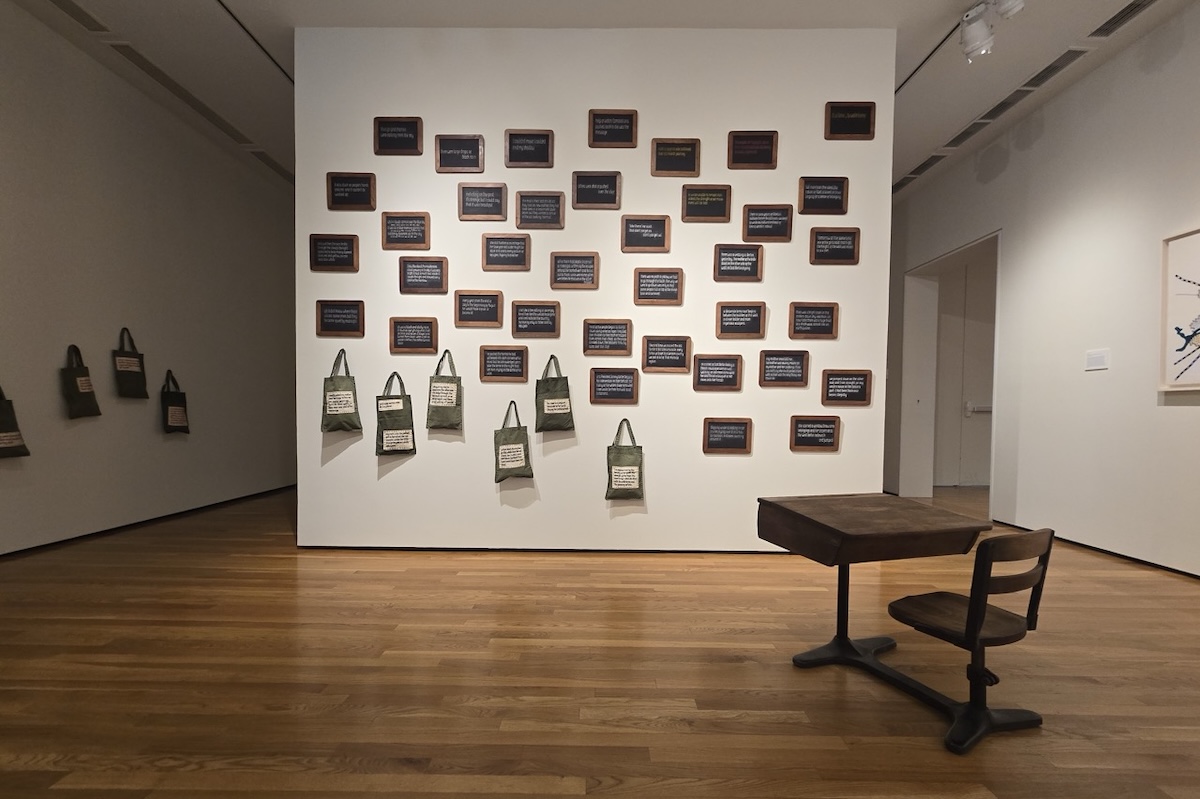
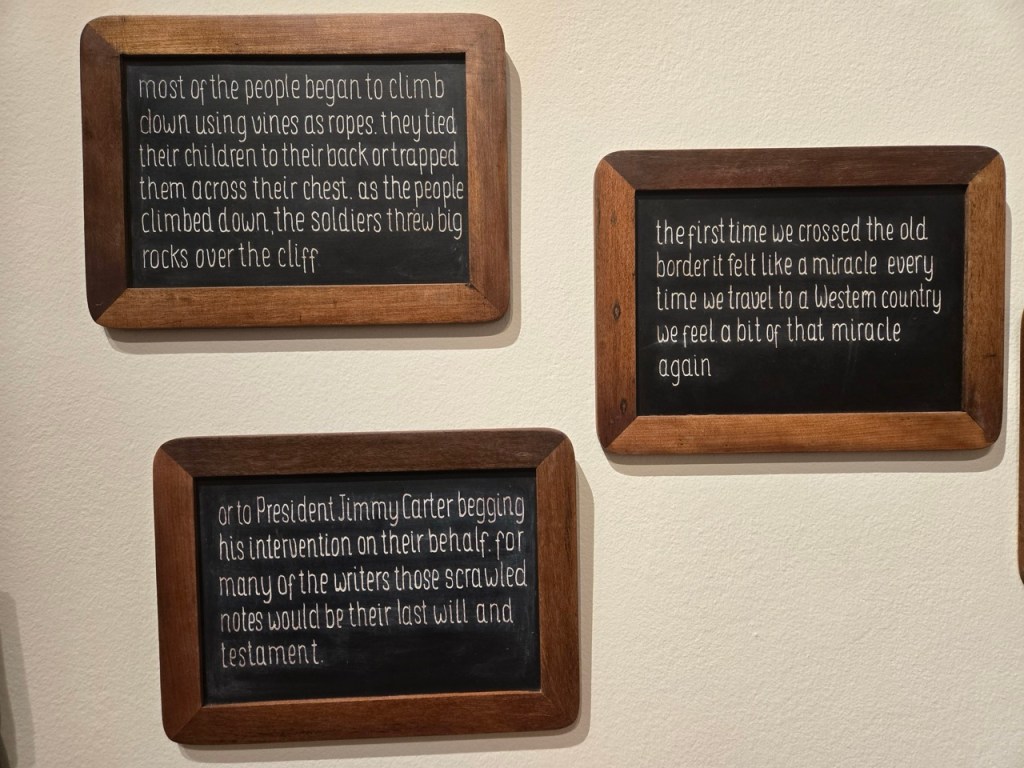
In a separate side gallery, Chung has created a vaguely classroom-like installation, “Scratching the Walls for Memory.” It refers to intimate messages on bags and chalkboards linked to Hiroshima and Nagasaki, Cambodian refugees, and other matters of innocence lost or stolen.
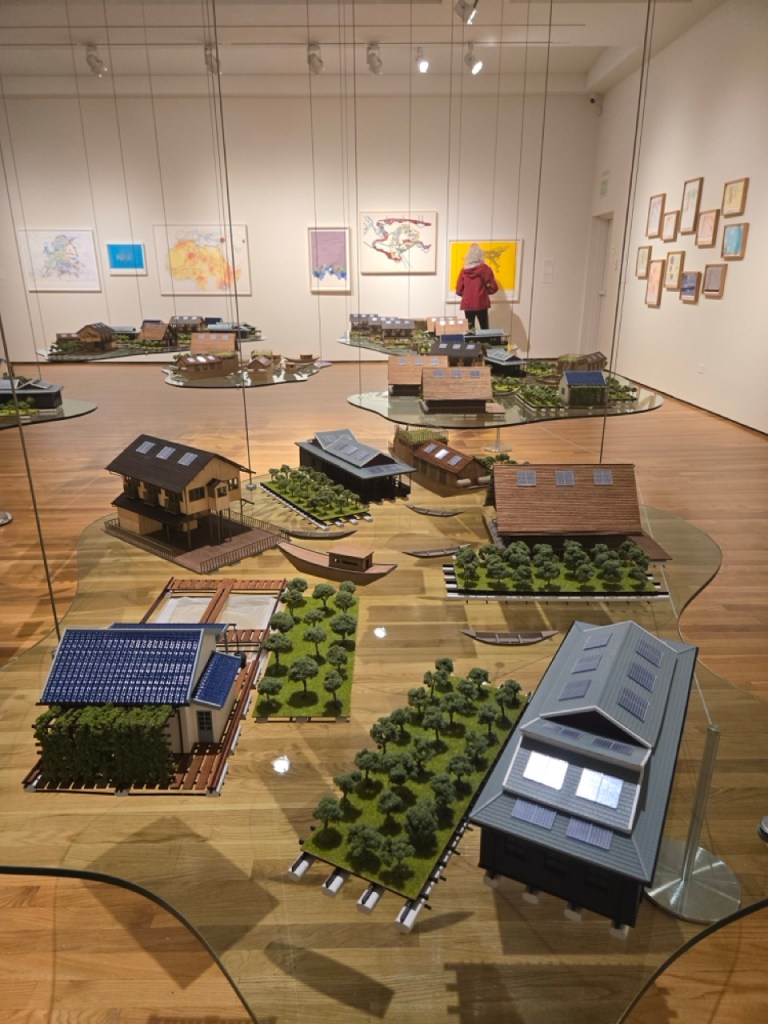
Moving into the three-dimensional art realm, the main gallery floor is largely taken up with Chung’s piece called “ajar: monsoon, drowning fish, color of water, and the floating world,” articulated in a series of six large town and harbor fragments, a response to rising tides and imperiled coastal communities in the wake of climate change.
In the back gallery, we find an installation identified as “Entangle Geographies.” Chung turns her perspective toward her own saga. As she writes, “we often begin our search of historical memories with a personal quest. That is my case.”
In the gallery-imparted artwork titled “Terra Rouge,” she states that case with an extensive timeline of events and patterns of migration guiding her path, and her family’s. Her father was a South Vietnamese helicopter pilot during the war and was captured, becoming a POW.
A blend of historical and personal photos and videos is interspersed with her common mode of artistic expression, with maps transformed into the stuff of artistic expression, but always informed by larger issues and narratives.
The sum effect of “indelible traces” is to demonstrate that Chung’s perspective as a conceptual artist functions on several levels at once. While pleasing to the eye and the senses, her art’s deeper resonances and references pull at our sense of moral and historical reflection, and sensible outrage. It’s a one-two punch kind of show.
After this first stop, the exhibition heads to the Weisman Art Museum at the University of Minnesota, the Blaffer Art Museum, and to her current home, at the University of Houston. For further investigations into Chung’s art, the unique multi-media think and experience tank on campus known as Allosphere, is hosting “Spheres of Time,” an immersive video installation commissioned by the AD&A Museum.
For more information, see museum.ucsb.edu.






You must be logged in to post a comment.