
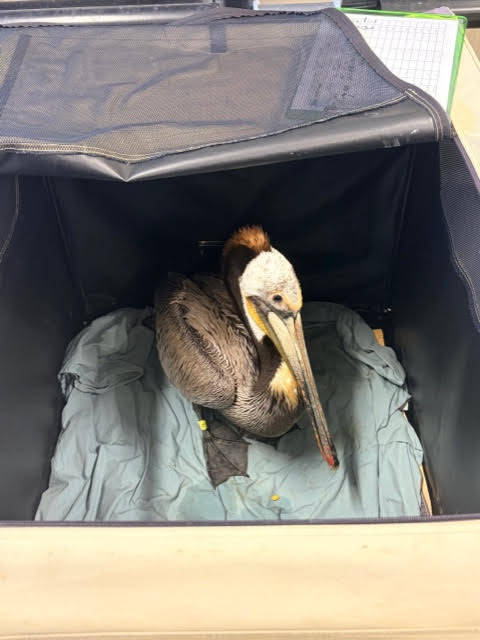
An unusual number of California brown pelicans — many dehydrated, emaciated, or injured — are turning up across Santa Barbara and Ventura counties, prompting concern among wildlife rehabilitators and raising questions about broader environmental factors that could be contributing to the birds’ distress.
The Santa Barbara Wildlife Care Network has admitted 46 pelicans so far this month, with 22 birds currently in treatment, according to Pam Perrimon, the organization’s education and communications coordinator.
Most are starving and are from “very unusual locations,” Perrimon said. The pelicans have been found in unexpected inland or roadside locations, according to rehabilitation staff — behavior that can indicate severe weakness or neurological impairment. Some have also arrived with fractured bones or signs of hypothermia.
The influx began in early March, when the nonprofit reported taking in 32 pelicans in the first two weeks alone — a volume staff described as unusually high. Additional pelagic species, including murres, cormorants, and grebes, have been brought in as well.
Wildlife officials say it is too early to determine a definitive cause.
“We cannot speculate on why these pelicans are coming in to us,” Perrimon said, noting that staff are continuing to monitor the situation.
Still, similar events have been reported up and down the California coast in recent years, often coinciding with environmental stressors that affect seabird food supplies or neurological health.
One widely discussed possibility is exposure to domoic acid, a neurotoxin produced during harmful algal blooms. The toxin can accumulate in small fish such as anchovies and sardines, which are then consumed by seabirds. Wildlife experts have previously linked domoic acid outbreaks to episodes of disorientation, seizures, and starvation in marine animals.
Other unconfirmed theories circulating among wildlife observers include the lingering ecological effects of an unusually warm winter, disease outbreaks such as avian influenza, or broader ocean-health pressures, including plastic pollution. None of these explanations has been verified in the current case.
The surge comes during what wildlife rehabilitators describe as “baby season,” traditionally the busiest time of year for rescue operations as young animals begin leaving nests. The organization treats roughly 4,600 wild patients annually, ranging from shorebirds and raptors to small mammals and reptiles.
Members of the public who encounter a pelican in distress are urged not to handle the animal directly, particularly if it shows signs of neurological illness such as loss of balance or seizures. Instead, residents should call the Wildlife Care Network’s helpline at (805) 681-1080.
Related Posts





Premier Events

Tue, Oct 06
All day
Santa Barbara
New and Emerging Technologies in the Hands of Artists: Brave New Work 2.0

Tue, Oct 06
6:00 PM
Santa Barbara
Chaucer’s Books- Horror Stories with Joseph Fink

Wed, Oct 07
7:30 PM
Santa Barbara
Ensemble Theatre Company Presents: “Buyer & Cellar”

Wed, Oct 07
7:30 PM
Santa Barbara
The Theatre Group at SBCC Presents: “CLUE”

Thu, Oct 08
7:00 PM
Santa Barbara
“A Night of Blues” with Morganfield Burnett

Fri, Oct 09
7:00 PM
Santa Barbara
Paseo Nuevo Spooky Movie Nights

Sat, Oct 10
1:30 PM
Goleta
🌴 Another Day in Paradise at S.B’s Premier Ice Rink

Sun, Oct 11
7:00 AM
Ojai
Flamenco Guitarist Tony Ybarra

Sun, Oct 11
10:00 AM
Santa Barbara
18th Annual Domestic Violence Solutions Brunch
Sun, Oct 11
10:00 AM
Santa Barbara
Free Community Day at S.B. Botanic Garden
Tue, Oct 06 All day
Santa Barbara
New and Emerging Technologies in the Hands of Artists: Brave New Work 2.0
Tue, Oct 06 6:00 PM
Santa Barbara
Chaucer’s Books- Horror Stories with Joseph Fink
Wed, Oct 07 7:30 PM
Santa Barbara
Ensemble Theatre Company Presents: “Buyer & Cellar”
Wed, Oct 07 7:30 PM
Santa Barbara
The Theatre Group at SBCC Presents: “CLUE”
Thu, Oct 08 7:00 PM
Santa Barbara
“A Night of Blues” with Morganfield Burnett
Fri, Oct 09 7:00 PM
Santa Barbara
Paseo Nuevo Spooky Movie Nights
Sat, Oct 10 1:30 PM
Goleta
🌴 Another Day in Paradise at S.B’s Premier Ice Rink
Sun, Oct 11 7:00 AM
Ojai
Flamenco Guitarist Tony Ybarra
Sun, Oct 11 10:00 AM
Santa Barbara
18th Annual Domestic Violence Solutions Brunch
Sun, Oct 11 10:00 AM
Santa Barbara

