

LOOK UP! You ever wonder what’s worse — not looking or not seeing? For me, the question grows less hypothetical by the minute. And no, I’m not talking about all the things we still can’t believe are happening. Instead, I’m talking about mundane, obvious stuff.
Big stuff. Right-in-front-of-us stuff.
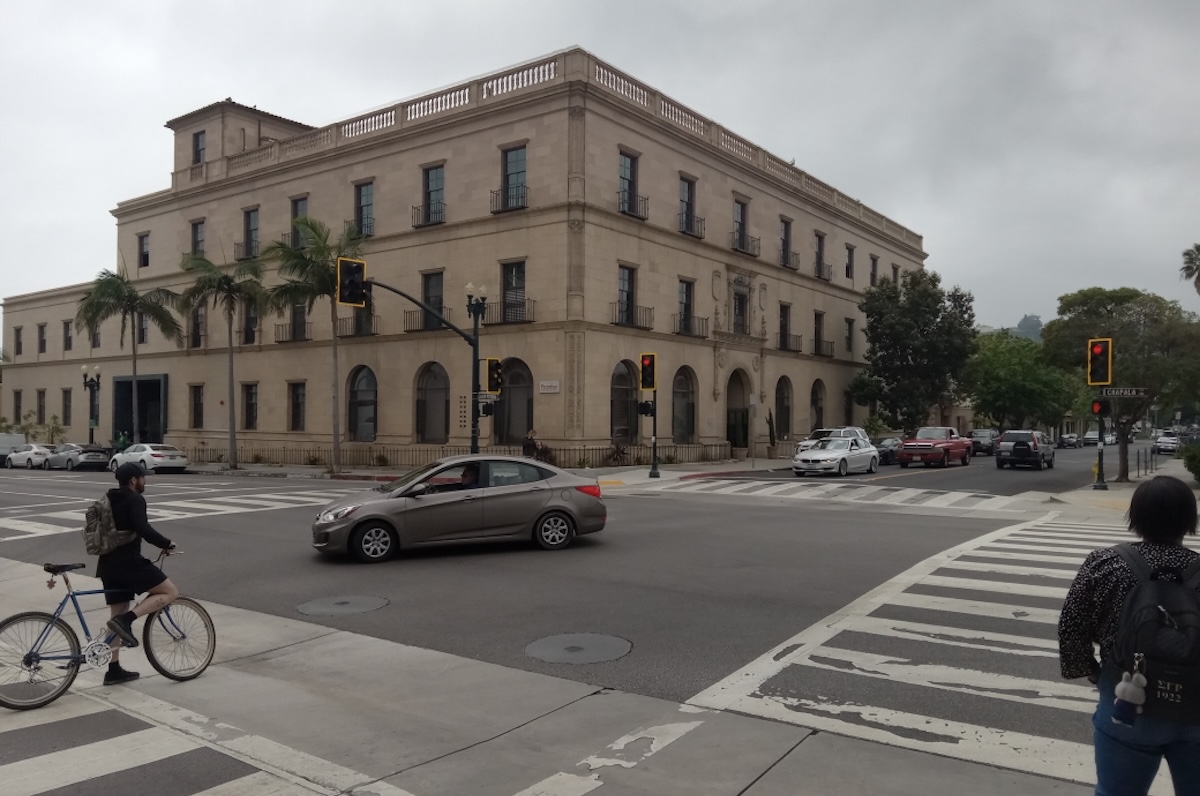
I can’t remember when I first stopped seeing that giant sandstone Spanish wedding cake of a castle that dominates the corner of Chapala and Canon Perdido streets, right in the sclerotic heart of our downtown Santa Barbara.
Maybe 30 years ago? Maybe 40?
In all that time, I never saw one person go inside. Or come out. In all those years, I never met a single person who said they had. Sure, I had friends who claimed their moms once worked there. But that was back in the pre-automated days when it was the Telephone Company building. And the phone company needed lots of moms to patch through all the long-distance telephone calls. And all those moms had to park somewhere. Hence, the vast, huge lake of a parking lot in the back.
Today nobody’s mom patches through long-distance calls. Efforts at upkeeping the building have been desultory. Real estate people call that “fallow.”
This morning, riding by in the crack-of-dawn darkness, the building was, as usual, dark. Except, eerily — maybe even creepily — I saw light coming out from the second floor.
Did I only imagine it was buzzing? What 1950s sci-fi, shape-shifter, body-snatcher movie was happening in there?
I checked out the two entrances. The mid-century Moderne entrance alcove by Chapala Street had that polished granite look of the late 1940s that proclaims, “Progress is our most important progress.” Today, it had, plastered onto its frosted-glass front window, not only a “No Trespassing” sign but also a legal document authorizing city police to roust any lost soul seeking the alcove as a port in the storm.


The other main entrance on Canon Perdido Street was even more forbidding. The gargantuan wooden-beam front door — big enough to function as a drawbridge for a moat — stood behind the spiked, black wrought-iron gate. A shiny new padlock dangled off its black latch.
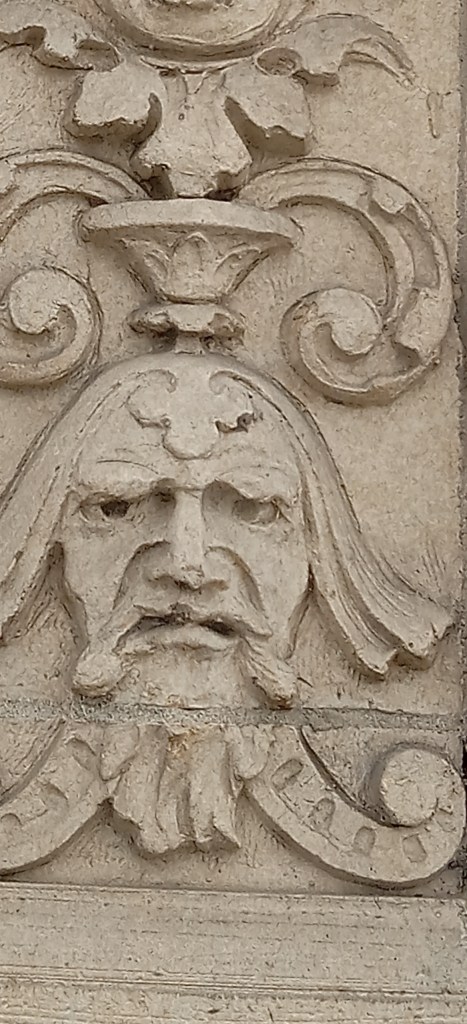
The building was constructed in 1927, two years after Santa Barbara’s great birthquake earthquake of 1925. The phone company added a third story in 1947, two years before the United States blew up the first atom bombs. The building was built to withstand both. Fireproof steel. Poured concrete. With a sandstone terra-cotta façade. It is described as an example of Plateresque architecture, a style credited to Italian architects brought to Spain during the 1500s to create buildings proclaiming that country’s imperial omnipotence. How the mighty have fallen.
For 99 years, this building, with a style unlike any other in Santa Barbara, has stood unnoticed and underappreciated. It’s amazing what you cannot see when you don’t see people going in and out.
All that, we are told, is about to change. The third floor is to become a super high-end, exclusive club — Canon Vaults is the name — giving off frisky speakeasy vibes mixed with a hint of James Bond. It will be where people with art collections, wine collections, rare coin collections, rare record collections, vintage baseball collections, and maybe even Granny’s old china that no one knows what to do with, will be able to store their stuff with sublime confidence it will be safe.
But it’s also offering a unique lounge experience where members can hang out, mingle, and engage in some highly curated events described as “immersive experiences, intimate gatherings, and meaningful connections with our exclusive members’ circle and distinguished guests.”
Admittedly, when I read stuff like that, I tend to seek refuge in Groucho Marx’s old line, “I don’t want to belong to any club that would have me as a member.” (Who said that was even an option?) But when you talk to Jason Jewell, the man behind Canon Vaults, for even a few minutes, you know the building won’t be a dead zone anymore.
Princeton educated, Jewell was a professional squash player for many years, chalking up court time in such faraway places as Saudi Arabia and the Arctic Circle. More recently, he’s been deep into investments. For a while, he and his father were on the forefront of trapeze parks.
Jewell’s enthusiasm falls on the irresistible side. He doesn’t speak so much as he dreams out loud. When he talks, fire hydrants tend to explode. Even when you take notes, you may not remember precisely what you heard. But you know something’s going to happen.
Jewell, in some ways, is just the tip of a massive self-storage iceberg. If I’m doing the math right, the first and second floors will also have self-storage, and outside in the parking lot will be a new five-story structure with about 68,000 square feet of more self-storage. All that, I am told, will make the development of a five-story, 44-unit apartment complex on the same property by Jewell’s partner Greg Reisz economically viable. Of those 44 units, four will be affordable.
Meanwhile, across town on East Canon Perdido, the old California State office building — now home to the State Department of Industrial Affairs and the Labor Board — will soon be converted to self-storage, too.
Why not housing? The Telephone Building has lead pollution on the ground that can’t be cleaned up because of the gargantuan one-megawatt backup generator that was plopped right on top. So that’s out.
But in addition, Santa Barbara has half the self-storage space most places in California have. As housing units get smaller — the new ones, that is — and their residents older, we face a crisis of excess stuff. All those family memories — you can’t just take ’em to the landfill.
Or maybe we can. Maybe we have to. See?



You must be logged in to post a comment.