

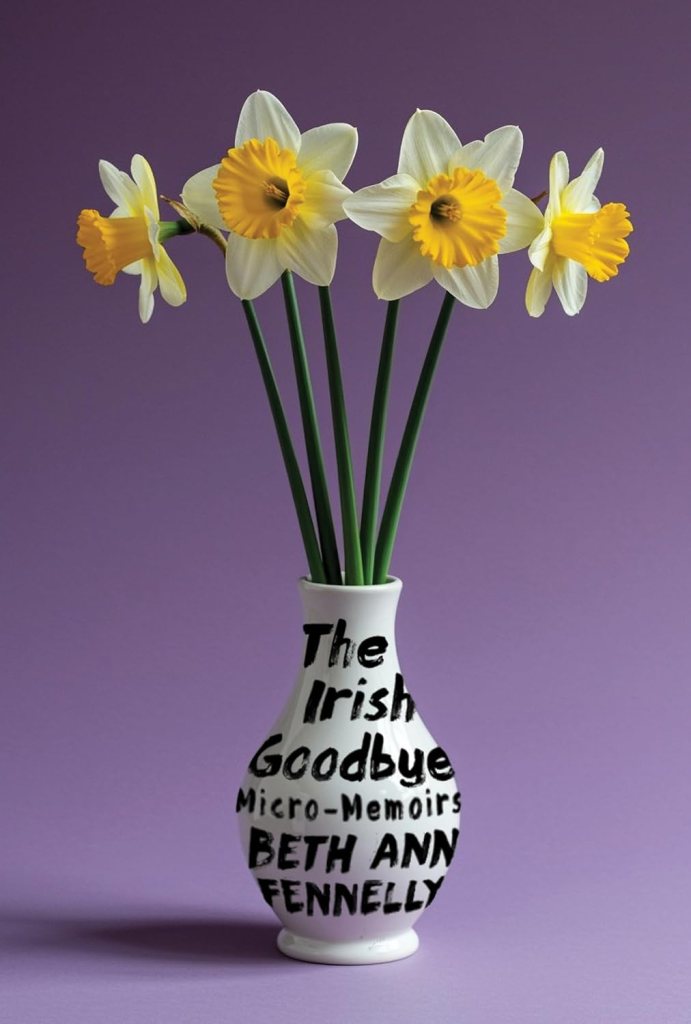
Back in 2018, I gave a rave review to Beth Ann Fennelly’s Heating & Cooling: 52 Micro-Memoirs. I was quite taken with her poet’s takes on the prosaic world, and I’ve been looking forward to the follow-up, which comes eight years later in the form of The Irish Goodbye: Micro-Memoirs. It’s a different book, to be sure — the author is older, wiser, possibly even funnier, but the “micro” element of the memoirs isn’t as prominent.
To be sure, The Irish Goodbye contains equivalents to the ultra-short essays found in Heating & Cooling. The entire text of “Birthday,” for instance, is “Even my earlobes look old.” And on the next page, the micro-memoir of “Number One Sign You Shouldn’t Send That Letter” consists of a single sentence: “Your tongue, dragging across the envelope glue, leaves a ghost of Malbec.”
On balance, though, in The Irish Goodbye, Fennelly allows herself more room to follow an idea or image or emotion wherever it wants to take her. In Heating & Cooling, a long piece might run six pages, but now we have essays of 12, 15, and even 17 pages, which are only “micro” if you are comparing your nonfiction to that of David Foster Wallace.
Still, even if there is a teeny bit of mislabeling in the book’s title, the longer memoirs themselves are certainly worth the read. The ten-page memoir, for instance, is about how Fennelly and her undergraduate roommates from Notre Dame have maintained, despite great odds, an incredibly close friendship over the years. The 15-page essay is an explanation of how and why the author came to have a nude portrait of herself painted. After the painting has been exhibited, she concludes: “It’s too late for avoidant poses and diffused light to distract, correct, or erase. I’m reminded that at all times — not just while confronting my portrait — I am nakedly human, flawed and alive.”
And the 17-page memoir, “The Stories We Tell About the Stories We Tell,” is a beautifully worked reflection on Fennelly’s year of teaching abroad, in her early twenties, in the grimly urban, post-Soviet wasteland of Silesia, on the Polish border. As she remembers and retells the experience for many years, the people there were mostly cold, distrustful and didn’t much like the “do-gooder American.” Many years later, teaching at a writers’ conference in Prague, she has the chance to revisit that far corner of Czechia. When she does so, expecting the worst, she finds upon meeting her former colleagues that they all have fond memories of her. Like any good essayist, she is inevitably humbled by the past: “I felt ashamed to reveal that … I no longer remembered my place in the world. That I had never understood it from the start.”
Among the more comfortably “micro” pieces are a series on married love carried over from the previous book. These are endearing and funny and absolutely true-to-life. To take just one example, here’s “Married Love: Because I’ve Been French Kissing Him for Twenty-Nine Years”: “I discern that earlier, during dinner, my husband must have bitten his tongue. I discern this after dinner, with my tongue.”
However, for all Fennelly’s good humor, high spirits, and optimism, there is a thread of tragedy running through the collection, which gives the book its title. An Irish goodbye is, of course, an abrupt and unannounced departure from a social event. One minute you’re there; the next, you’re gone. The person who has left without saying goodbye is the author’s sister, who died in 2008 of pneumonia, with significant contributions from “chronic tobacco use, fatty liver, elevated alcohol concentration, undernourishment.” In one essay, “What I Think About When Someone Says They’re Estranged from Their Sibling,” Fennelly acknowledges, “Maybe, if you were still alive, we also wouldn’t be close.” But you can tell she doesn’t really believe that. For all her older sister’s faults, Fennelly misses her fiercely, an aching that shadows the good times throughout this outstanding book.
This review originally appeared in the California Review of Books.









You must be logged in to post a comment.