For years stretching into decades, Woody Allen embodied the state of a filmmaker with a driving work ethic and prolific, virtually one-a-year pace, building up a filmography that wouldn’t seem to quit. That story ended as his (alleged) pedophilia placed him in the pariah public company of Weinstein, Bill Cosby, Charlie Rose, and others.
Although his career has had its fallow moments, director Steven Soderbergh may have picked up where Allen left off as American cinema’s unstoppable workhorse, brushing up against the border where popcorn and arthouse fare meet. Here comes the latest Soderbergh model, and yet another twist in a vast and growing filmography which has largely resisted typecasting: The Christophers, a fascinating cat-and-mouse pairing off of characters, interlaced with themes of artworld gamesmanship and fakery, the vicissitudes of art-making, and the bane of family snark.
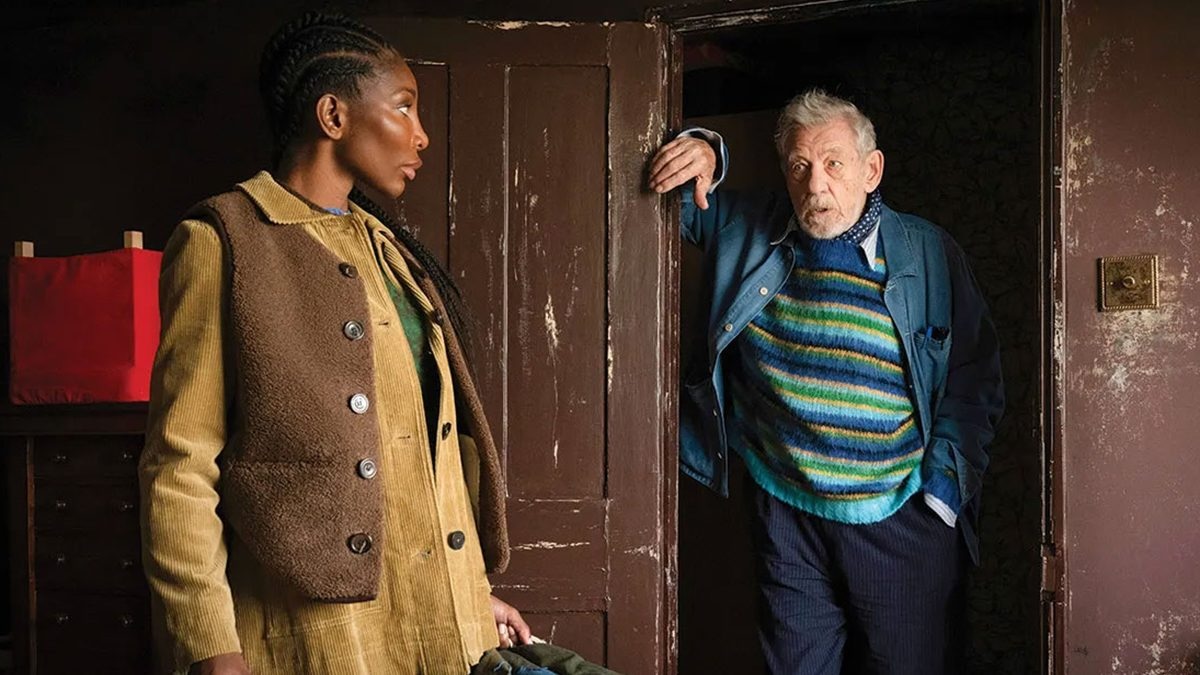
And clearly, the film will be remembered as a ripe vehicle for the charismatic and creepy powers of Sir Ian McKellan, who wholly embraces the central character, Julian Sklar, a cynical and wit-encrusted, aged and ailing artist of note, whom we love to hate to love. He is in a dormant state now: “My art, and my talent, have left long ago.” And he is rightfully paranoid about manipulative and conniving forces in his artistic life, even very close to home — with his own children (including ex-TV host James Corden, excellent in villain mode) devising a plot involving a forgery and an art market swindle.
Enter the young woman, Lori Butler (the aptly understated, yet potent actress Michaela Coel), presented as an assistant-for-hire, but with a backstory we gradually learn about. The emotional game played by the pair over the course of the film becomes its driving dramatic engine and source of intrigue, in a way reminiscent of a film like Sleuth, with Michael Caine and Laurence Olivier as sparring partners. Like that film, The Christophers has the lean, machined tautness and affectively claustrophobic location of theater.
McKellan is pitch perfect (make that fever pitch perfect) as a bloviating blowhard with little interest in the lives or opinions of others, not unlike Ethan Hawke’s stellar performance as the bitter but literate Lorenz Hart in Blue Moon. Sklar tells Butler in a job “interview,” “I have no problem asking questions. It’s the answers I have trouble with.” But comeuppance is clearly in order, along with an eventual coming to terms with certain skeletons in his closet, and in Butler’s.
One important-yet-vaporous motivating character in the story is the central, titular matter of “the Christophers”— a successful series of paintings he made of an ex-lover, the last unfinished batch of which apparently strangled his artistic forward momentum.
Soderberg brings just the right balance of passion and detachment to his role as a cinematic storyteller here, dealing expertly with a relatively simple — on the surface — narrative, but with complexities rippling beneath and around it. This is a director whose career has careened through his indie film breakout moment with Sex, Lies, and Videotape, through the Oceans 11 franchise and the Magic Mikes, and such quirky delights as 2024’s clever horror number Presence, imaginatively told from the perspective of a haunted house.
Deep into his film life with The Christophers, Soderberg plunges into what is essentially an intimate two-character face-off drama, and triumphs, with much help from the captivating actors in the crosshairs.