

This article was underwritten in part by the Mickey Flacks Journalism Fund for Social Justice, a proud, innovative supporter of local news. To make a contribution go to sbcan.org/journalism_fund.
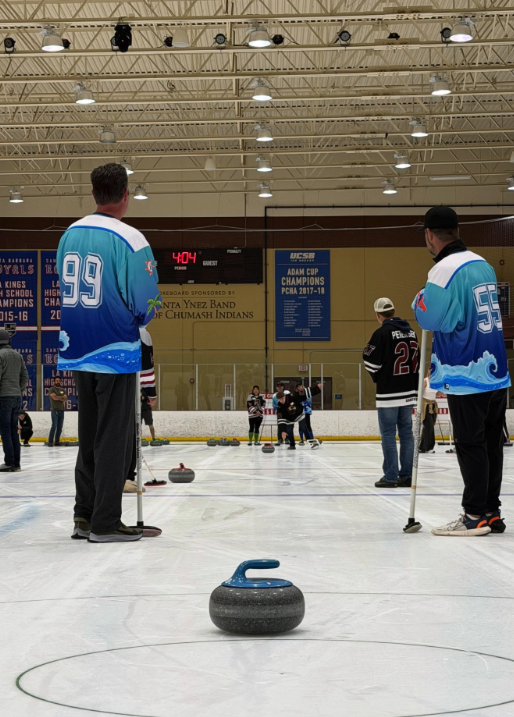
Between the rumble of curling stones moving like spaceships across the ice and the rapid squidge of brooms comes the consistent chatter and frequent cheers from Ice in Paradise’s large rink. More than 100 people are here on a Saturday learning how to skate or participating in the Goleta center’s first-ever curling tournament.
“We have young kids and people who are in their sixties and seventies out there,” said Hannah Otto, Ice in Paradise’s camp coordinator.
The 2025 Winter Olympic Games in Milan introduced (and reintroduced) people all over the world to curling. Several learners on the ice came to the event because they’d watched the sport on TV.
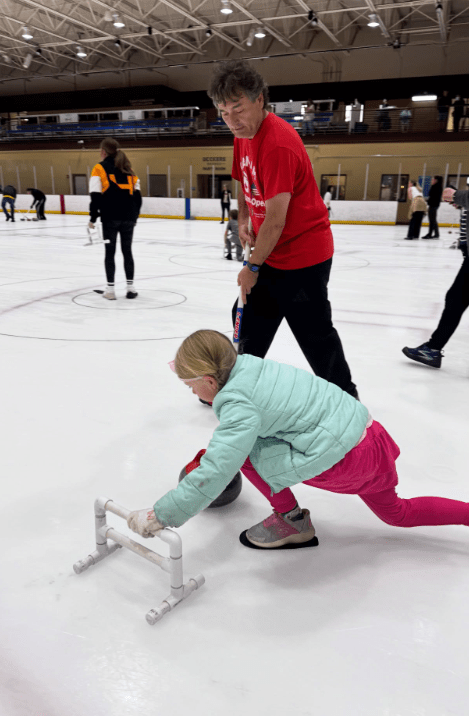
“I think our youngest [curler] is a 6-year-old, who got inspired from the Olympics,” said Otto. “So she’s, like, super stoked.”
Otto stood in Ice in Paradise’s main lobby. Around her, children raced in and out of the area and another employee, positioned next to a large trophy, checked people in to play.
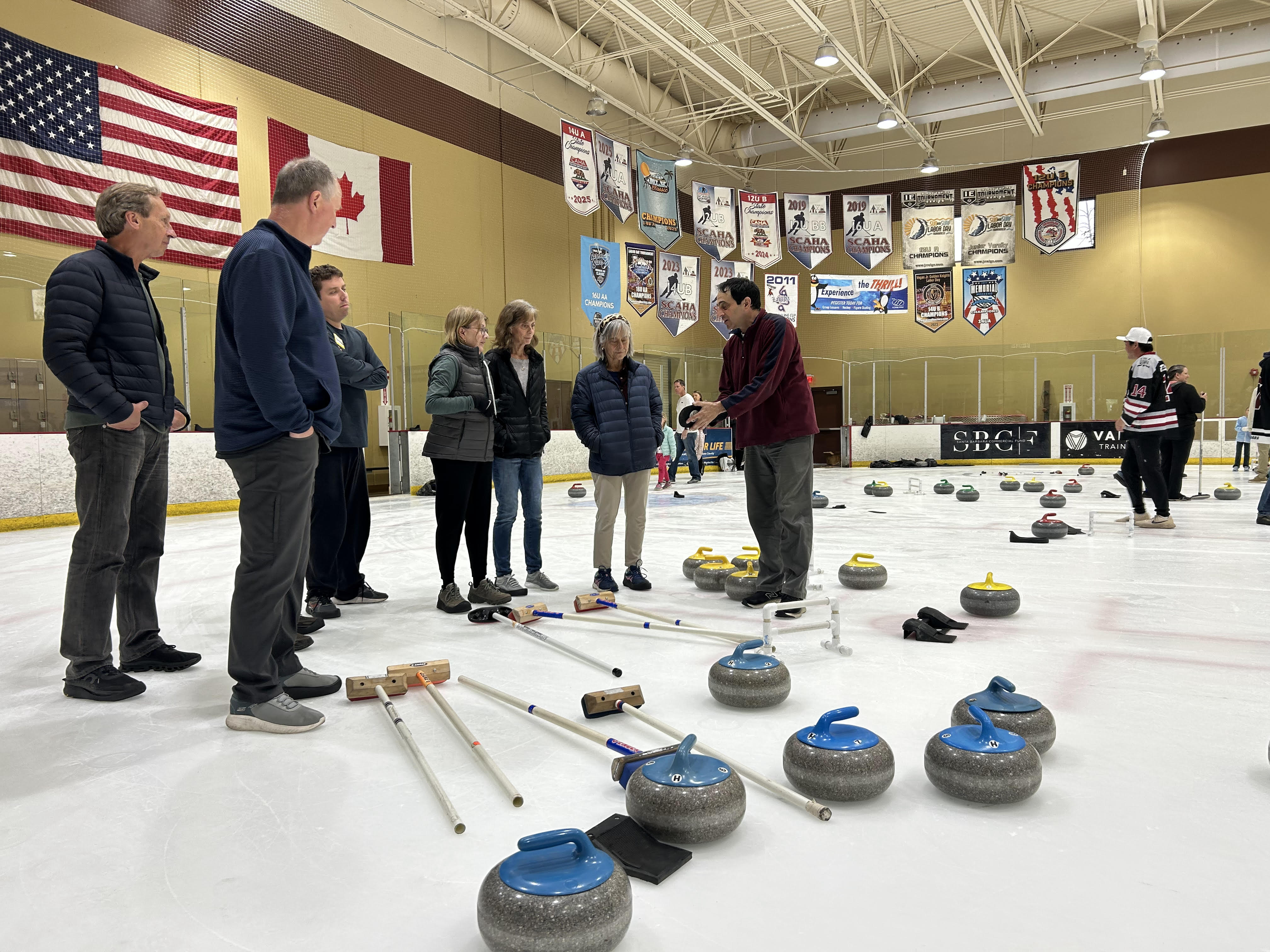
The event included three learn-to-curl sessions, which were all sold out. Participants, wearing sneakers and shoe-grips, stood in two groups at each end of the rink, learning the basics from two instructors.
What is the house? It’s that large bull’s-eye on the ice. How do you sweep? Rapidly and with a partner. How do you slide the stone? By pushing against a stop, called a hack, in a lunging motion.
Instructor Richard Lazarowich demonstrated how to line up your foot on the hack, hold the stone, and use the mini-stabilizer to make a throw. Lazarowich is part of the Granite Curling Club of California, a nonprofit that travels around the state teaching the sport. This is actually his eighth visit to Ice in Paradise since 2024.
Lazarowich picked up the sport at his home rink in San Jose in 2009. Since then, he’s competed and played in leagues, as well as taught others.
“You can meet new people teaching,” he said. “You can meet new people competing. So, you know, it’s the best of both worlds.”
The Granite Curling Club lent the equipment for the day’s event. Lazarowich loaded up about 1,500 lbs of curling supplies for it. The stones (which are made of granite mined mostly in Scotland, where the sport originated, or Wales) are about 40 lbs each.
Across the ice, Lazarowich’s students practice sweeping together with their elbows high. He recommended approaching the sport with patience and a little humility.
“You will fall,” he said. “Laugh at yourself, because nobody gets it [the first time]. Even the elite curlers, they don’t get it their first time. And so nothing is ever perfect.”
Nearby, instructor Nick Kitinski is helping another group of students. Kitinski picked up the sport in 7th grade while growing up in Sweden. When he moved to the United States in 1992, he put his pursuit on pause until he found a team in 2007. From there, he started his own team in Los Angeles and frequently helps the Granite Curling Club with lessons across the state.
“It’s a sport that brings everybody together,” Kitinski said. “There’s usually three generations that play it together on ice.”
It’s true of Kitinski’s group: There’s a pair of couples, a group of friends, a parent and adult-child team, and a parent with an elementary schooler.
Kitinski said he’s seen the sport evolve over time — he even saw a change in how the stones were rotated (curled) in this year’s Olympic games.
“We were taught to only curl it two to three revolutions once we release it. But now they have like, five to eight revolutions. It’s a whole new kind of mindset to how the stone is moving,” he said.
Still, the key to learning, Kitinski said, is persistence.
“The first-time players are here; they’re falling down a little bit, but by the end of the session, they’re actually almost really good,” he said.
In the center of the rink, teams played their tournament games while taking breaks to hydrate and talk. Rotating stones regularly found their spots in the bull’s-eye (excuse me, house). The vibe, however, was casual. Teammates cheered for each other, and congratulated opponents on good throws.
Otto said the rink is hoping to provide more curling lessons and tournaments in the future. Kitinski said he thought the interest was there — and that the Santa Barbara area likely has enough people to start a club.
If it ever wants to, he said, the wider curling community would be there to help.
Related Posts



Premier Events
Fri, Oct 23
2:00 PM
Santa Barbara
Music & Meditation: Clarinetist Nancy Mathison & Pianist Antonio Artese

Thu, Oct 22
5:30 PM
Santa Barbara
Best Fest: A Celebration of the Best of Santa Barbara® Readers’ Poll 2026 – Rain or Shine

Thu, Oct 22
6:00 PM
Santa Barbara
Chaucer’s Books Author Talk & Signing- Daniel M. Jaffe “Russian Silhouette: A Memoir of Activism and Identity”
Fri, Oct 23
5:30 PM
Solvang
Solvang Haunted House and Street Fair
Fri, Oct 23
7:00 PM
Santa Barbara
Beth Amine’s 20th Anniversary Wildcat Dance Variety Show

Fri, Oct 23
7:00 PM
Santa Barbara
This & That Performs at Roy

Fri, Oct 23
9:00 PM
Santa Barbara
Casa de la Raza Fundraiser: Brasscals! with DJ Darla Bea
Sat, Oct 24
10:30 AM
Santa Barbara
Picnic in the Cemetery: A Live Historical Event
Sat, Oct 24
11:00 AM
Goleta
2nd Annual Charger Cup to Benefit DP High Golfers

Sat, Oct 24
12:00 PM
Santa Barbara
Makers Hive Market
Sat, Oct 24
2:00 PM
Santa Barbara
Japanese Sacred Architecture: Shinto and Buddhism
Fri, Oct 23 2:00 PM
Santa Barbara
Music & Meditation: Clarinetist Nancy Mathison & Pianist Antonio Artese
Thu, Oct 22 5:30 PM
Santa Barbara
Best Fest: A Celebration of the Best of Santa Barbara® Readers’ Poll 2026 – Rain or Shine
Thu, Oct 22 6:00 PM
Santa Barbara
Chaucer’s Books Author Talk & Signing- Daniel M. Jaffe “Russian Silhouette: A Memoir of Activism and Identity”
Fri, Oct 23 5:30 PM
Solvang
Solvang Haunted House and Street Fair
Fri, Oct 23 7:00 PM
Santa Barbara
Beth Amine’s 20th Anniversary Wildcat Dance Variety Show
Fri, Oct 23 7:00 PM
Santa Barbara
This & That Performs at Roy
Fri, Oct 23 9:00 PM
Santa Barbara
Casa de la Raza Fundraiser: Brasscals! with DJ Darla Bea
Sat, Oct 24 10:30 AM
Santa Barbara
Picnic in the Cemetery: A Live Historical Event
Sat, Oct 24 11:00 AM
Goleta
2nd Annual Charger Cup to Benefit DP High Golfers
Sat, Oct 24 12:00 PM
Santa Barbara
Makers Hive Market
Sat, Oct 24 2:00 PM
Santa Barbara



You must be logged in to post a comment.