

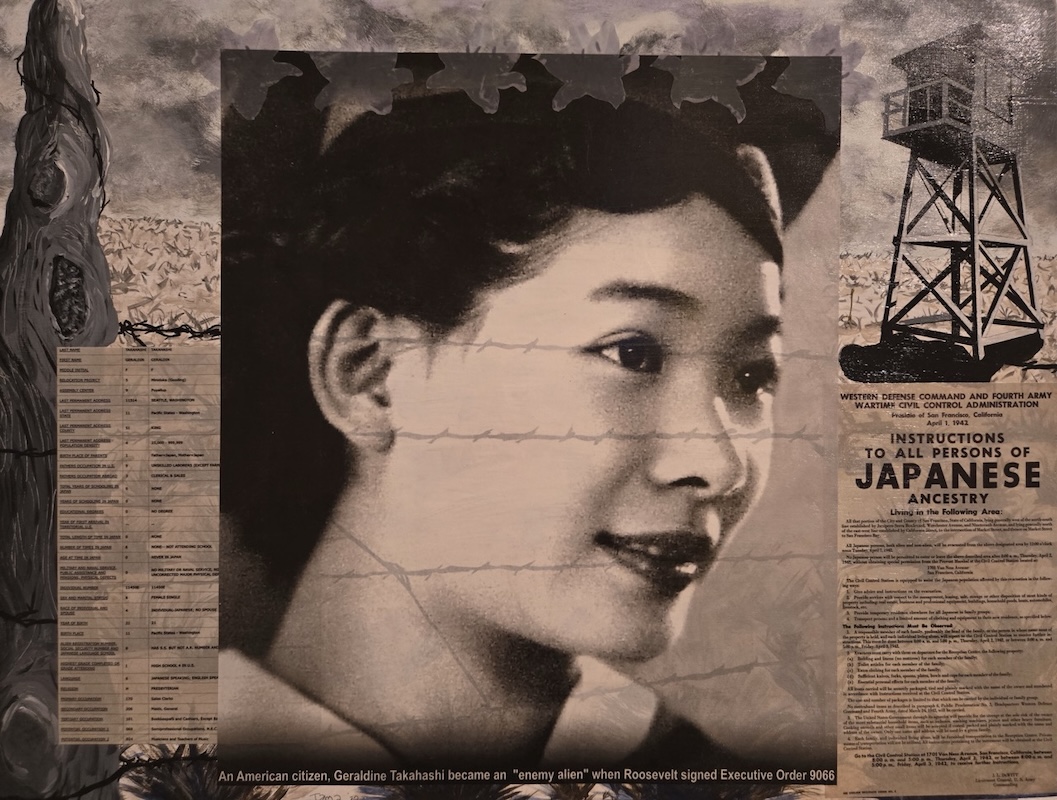
In 1943, photographer and multimedia artist Tama Takahashi’s father’s family was cruelly uprooted from their Seattle home and life as keepers of a mom-and-pop store. As part of the notorious and shameful Japanese internment project during WWII, which displaced more than 120,000 American citizens, they were shipped off to the concentration camp in the Eastern Idaho desert region of Minidoka.
In 2022, Takahashi went on a family and heritage rediscovery mission to the site of the camp, the best preserved of many such sites (including the relatively close Manzanar, near Death Valley). She had camera and curiosity in hand, seeking, as she wrote, to see where “my family had suffered the humiliation, a false narrative that led to the loss of dignity, property, money, and a place society was devastating.”
Fast-forwarding to now, her current exhibition of a small sampling of those images, plus ancillary material, Memories of Barbed Wire: Resilience in the Japanese American Community, is pulled together in a moving exhibition at the Museum of Contemporary Art Santa Barbara (MCASB). Takahashi majored in art and film at UCSD, worked as a camera assistant in the film/TV industry for 20 years, has shown her art at the Tokyo Metropolitan Art Museum and elsewhere internationally, and has had a studio in Santa Barbara since 2023.
Aside from its virtues as a sobering reminder of American folly during wartime and an expression of the artist’s particular gifts, her current MCASB show also carries chilling resonance with very current political realities. We are, after all, presently in an ICE-driven era of mostly race-based detainments and prison camps, soft-peddled under other names.
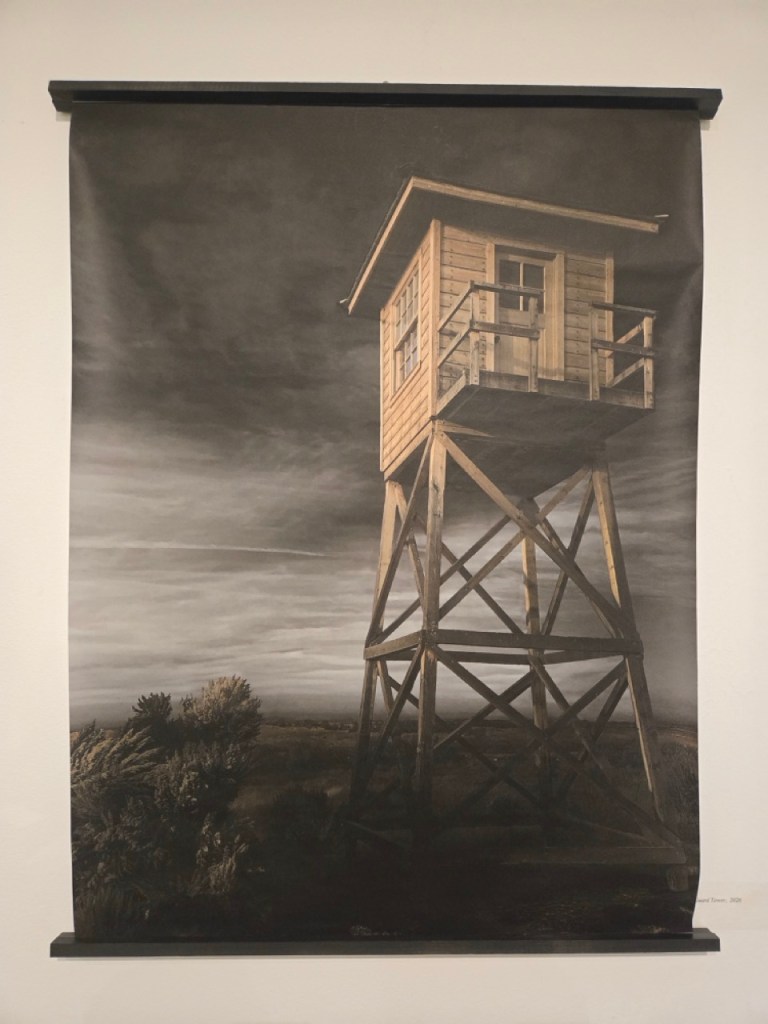
Among the images, given a painterly patina through printing on vellum, is “Guard Tower,” an ominous symbol of repression, portrayed more archly by shooting from below with a wide lens. “Mess Hall” captures an eerie and ghostly reminder of past forced residents in this space, now caked in dust and shadows. “LS Barricades” is a ground-heavy image whose mix of black-and-white and pale hand-colored-ish yellowing plays up a feeling of frozen time, frozen pain.
Imagery placed around the small gallery space, inside the museum compound, hangs on walls flanking a central ceremonial tree-like sculpture, on which are placed vintage photographs from happier times, and twisted paper printed with texts half-obscured in the origami-like knotting process. Messages are more clearly stated on another plant-like structure made to host contributions of haikus and other reflections from gallery visitors.
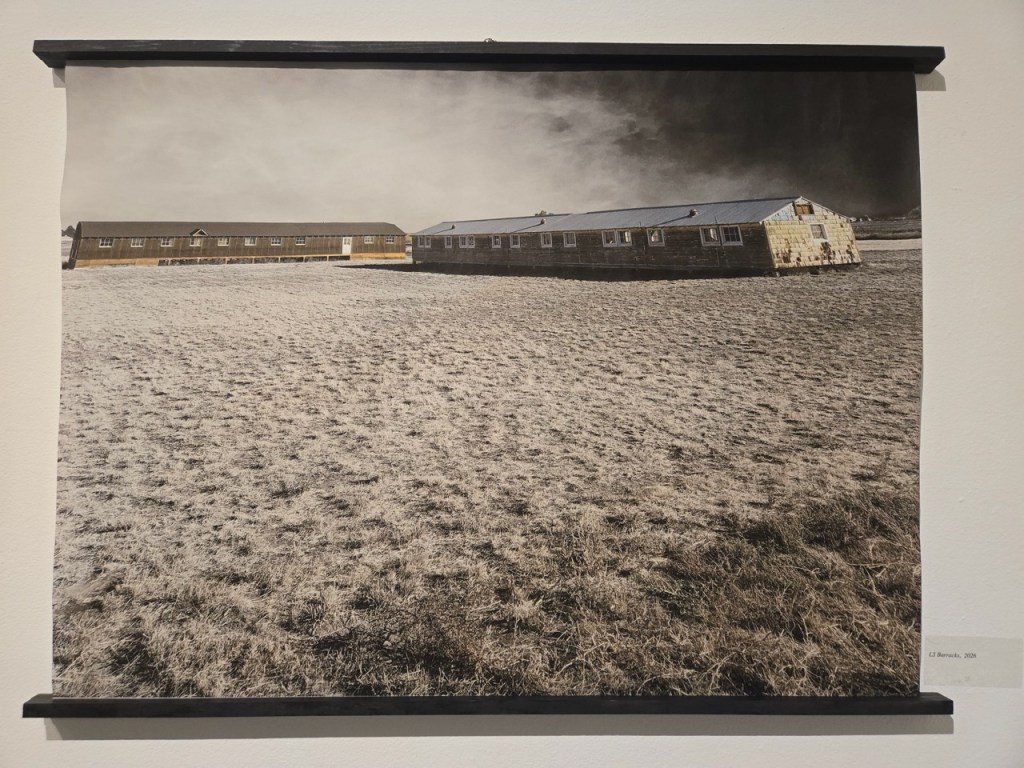
“LS Barracks” by Tama Takahashi, Museum of Contemporary Art Santa Barbara, 2026 | Photo: Josef Woodard 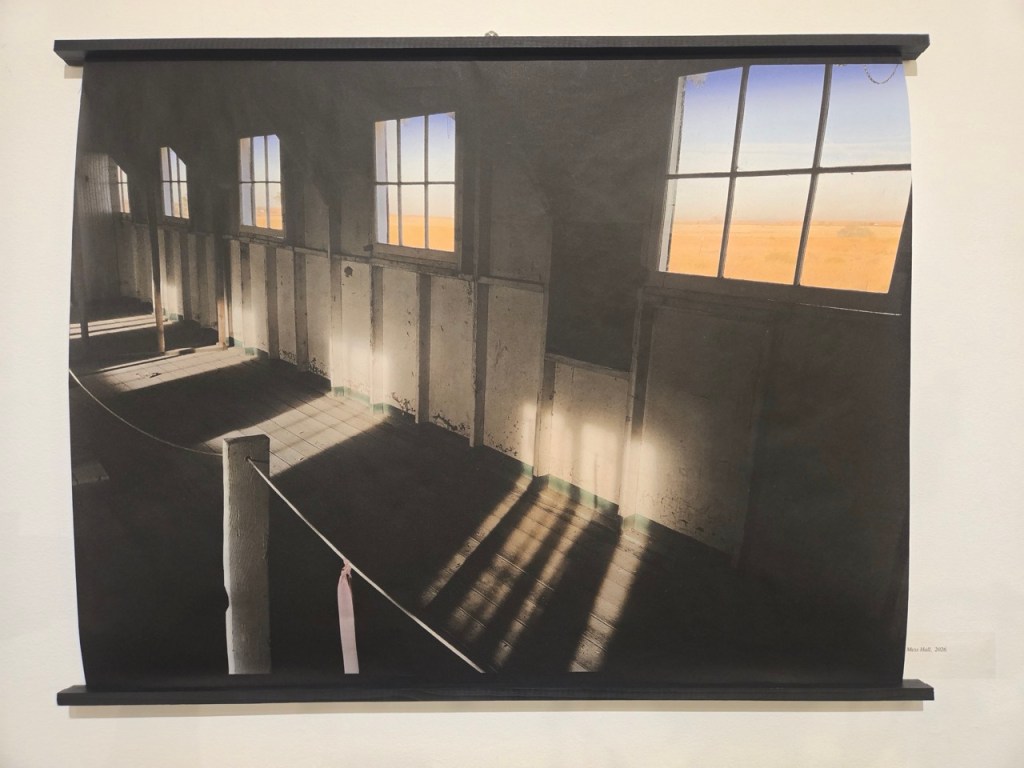
“Mess Hall” by Tama Takahashi, Museum of Contemporary Art Santa Barbara, 2026 | Photo: Josef Woodard 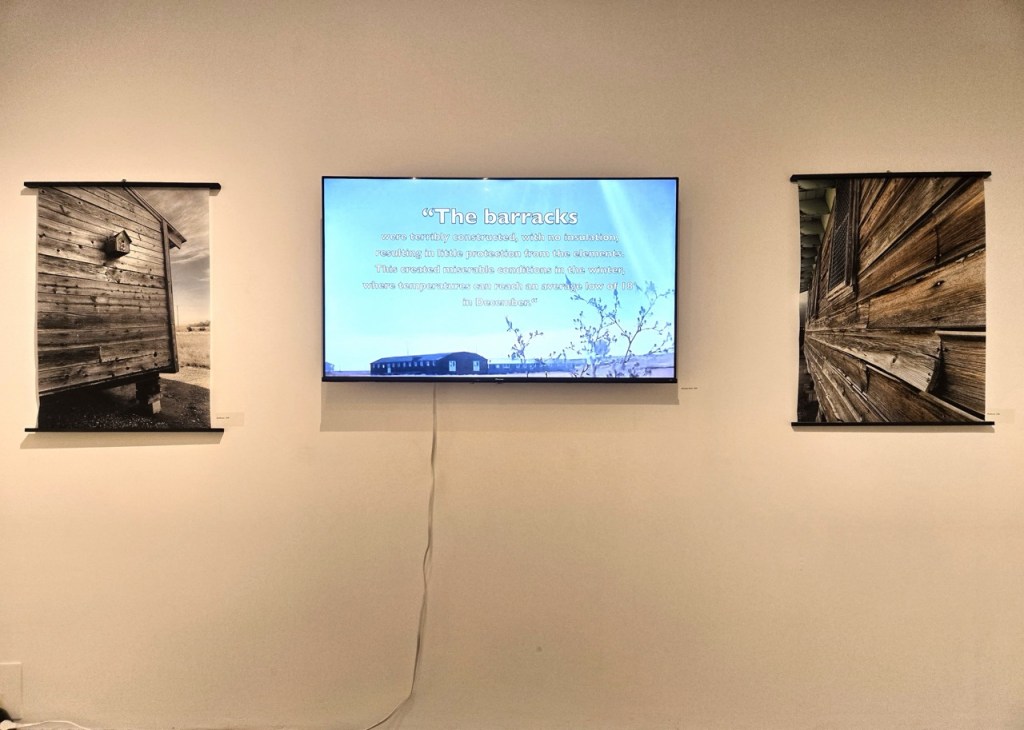
Gallery shot of ‘Memories of Barbed Wire: Resilience in the Japanese American Community’ exhibition by Tama Takahashi at Museum of Contemporary Art Santa Barbara | Photo: Josef Woodard 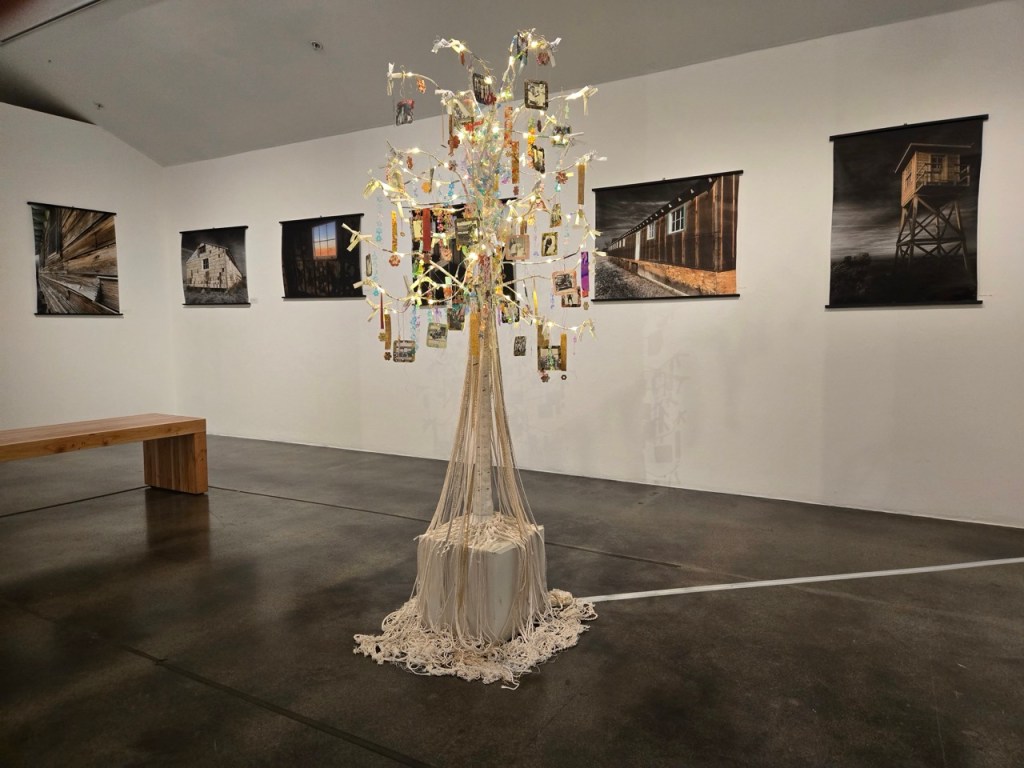
Gallery shot of ‘Memories of Barbed Wire: Resilience in the Japanese American Community’ exhibition by Tama Takahashi at Museum of Contemporary Art Santa Barbara | Photo: Josef Woodard
One relevant example: “A shadow will reveal where the light is. Never be afraid to follow. – R.V.A.”
Also in the gallery is a video piece on one wall, equipped with survivors’ texts describing conditions at the camp and shots of the existing buildings and bleak desert terrain of “Magic Valley,” in the Snake River Plain, returned to its original state after the camp’s demise. Starkly coating the sonic ambience of the gallery, somehow poetically, is the sound of wind through the dry overgrown grasses on the property and the rickety ghost structures.
Elements in Takahashi’s exhibition are expressively all of a piece, adding to the artful summation of a noble reclamation project.
In addition to the exhibition being on view through July 25 at the museum, MCASB will host a free Artist’s Walkthrough on Saturday, June 27, at 1 p.m., featuring refreshments compliments of Nimita’s Cuisine. In addition, there will be a panel discussion on Saturday, July 18, at 1 p.m. featuring Takahashi with special guests Sam Mihara, Wade Nomura, and Mark Masaoka. For more information, see mcasantabarbara.org/tama-takahashi.



You must be logged in to post a comment.