

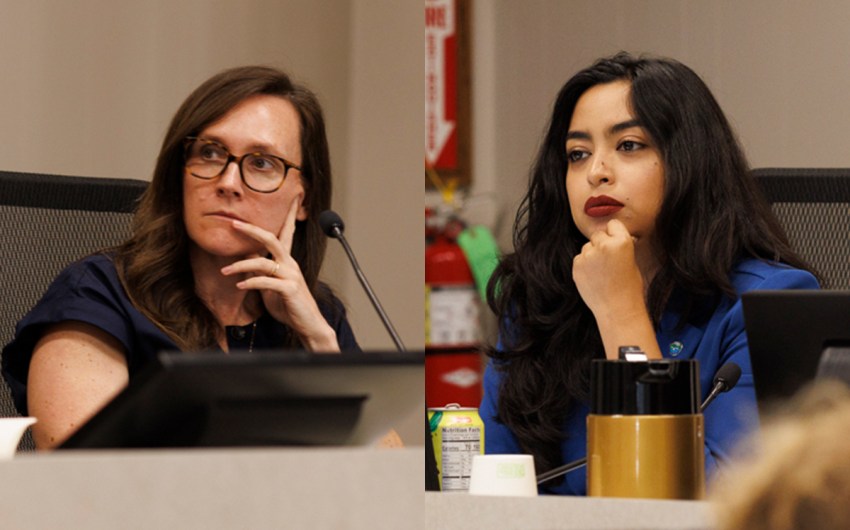
Before being elected to Santa Barbara City Council, District 1 representative Wendy Santamaria made a name for herself as a fiery community organizer and tenants rights advocate who regularly spoke up at public meetings on housing-related issues. During her 2024 campaign, Santamaria promised to stand up for constituents and city renters who felt that their needs were being ignored while the city’s housing crisis got worse each year.
Councilmember Santamaria’s victory in the 2024 election signaled a shift in the city’s leadership, giving the council a new 4-3 majority in favor of a citywide rent stabilization policy — something that had been considered for years but never had the votes to come to fruition.
Since joining the City Council, Santamaria has continued to be outspoken on housing issues, becoming a prominent figure in the debates about affordability, tenant protections, and rent stabilization. Her efforts on the council — along with the additional support of councilmembers Kristen Sneddon, Meagan Harmon, and Oscar Gutierrez — have helped lead to the city’s current temporary rent freeze and proposed rent stabilization program.
As the City Council prepares to review the proposed rent stabilization ordinance this Tuesday, July 28, the Santa Barbara Independent arranged an interview with Councilmember Santamaria to pick her brain about the proposed policy, and give her a chance to speak about the highly contested planning process leading to the current draft.
First off: What is “rent stabilization,” and why does the city need it? What’s the difference between the proposed local rent stabilization policy and what people typically think of as “rent control”?
When people think of “rent control,” they often think of New York City’s system of permanent price freezes or the rent-control laws adopted in Santa Monica, San Francisco, and Berkeley, where rents could not reset to market after tenants moved out. Those policies regulate housing much like a public utility and require significant oversight and appeals.
Rent stabilization is different. If rent control is like a citywide train system with fixed rails and government-set pricing, rent stabilization is more like speed limits and traffic controls. It allows annual rent increases, lets landlords recover capital improvement costs when necessary, exit the market, reset rents to market after vacancy, and exempts new construction, preserving incentives to build in Santa Barbara. Rather than freezing rents, it slows rent increases and protects tenants from rent shocks that lead to displacement.
Why does that matter? Because most Santa Barbara residents are renters, and too many families are watching more of every paycheck disappear into housing costs. Stable rents mean families can stay in their homes, children can remain in their schools, and fewer people are forced to choose between paying rent and buying groceries. It also reduces pressure on our homeless response system.
But the benefits go even further. Every dollar that stays in a family’s pocket is a dollar that can support a neighborhood restaurant, a trip to the Santa Barbara Zoo, a birthday cake from a local bakery, or even a new small business. Rent stabilization strengthens our local economy, helps businesses hire locally, reduces long commutes, improves emergency response times, protects our community from displacement, and invests in the people who make Santa Barbara the extraordinary place we all call home.
You’ve been a vocal supporter of rent stabilization since before you even ran for City Council in 2024, and during your campaign, you often spoke about the need to protect renters. What’s it been like to see this go from the ground floor to a (nearly) finalized draft ordinance?
The goal has always been simple: keep people housed. That was our mission in 2020, when a wave of evictions swept through our community during the COVID-19 pandemic. It remained our mission when tenants were displaced so long-term rentals could be converted into by-the-bed student housing. And it is the mission of this rent stabilization ordinance: to keep people in their homes.
I have lost count of how many times I organized my neighbors to speak at City Council meetings, only to feel like our lived experiences were dismissed or ignored. Even when the votes and resources were stacked against us, showing up was always worth it. Every voice moved us one step closer to protecting our most vulnerable neighbors.
Today, serving on the dais, I remain connected to the working families who keep Santa Barbara running. I’ve gone from giving public comment to hearing it, but the stories, the struggles, and the need haven’t changed. They remind me that our city depends on working families, and working families deserve stable rents. It’s time we stabilize the cost of living for the people who make Santa Barbara possible.
I also carry with me the countless tenants who fought alongside us but were ultimately displaced from their homes and our city. Many still follow this work, hoping they can one day return to the community where they built their lives. My hope is that this ordinance brings that day a little closer — for them, and for every family determined to call Santa Barbara home.
This issue has obviously drawn a lot of debate, and there have been concerns raised by property owners and economists about the unintended consequences of rent stabilization. How do you balance the input from all interested parties to ensure this policy is the best fit for Santa Barbara?
Legitimate concerns deserve thoughtful solutions. For example, landlords who own only two or three units still need to maintain their properties and cover necessary capital improvements. That is why we chose to allow those costs to be passed through to tenants over time, ensuring small housing providers can continue investing in Santa Barbara.
Other concerns, such as claiming that rent stabilization or rent freezes are unconstitutional takings are not legitimate concerns — regulations are not “takings” simply because a lawyer is hired to say that they are. That’s not my opinion; that’s the opinion of the federal judge who dismissed the Santa Barbara Rental Property Association lawsuit against the city two weeks ago. The judge reaffirmed what we already knew: what we are putting forward is lawful and necessary for the health of our city.
At its heart, this debate asks a simple question: Are we prioritizing people’s ability to have a stable, healthy place to live, or the growth rate of a few investment portfolios? How do we make sure that the people who keep our city running have a stable place to live? The answer is not the status quo. And while building more housing is essential, it cannot, by itself, happen quickly enough to prevent displacement or address today’s housing crisis. We must protect existing housing stock and prevent displacement now.
You’ve said before that rent stabilization is just one tool in the box to address the Santa Barbara housing crisis. How can this be used alongside other measures, and what else needs to be addressed to tackle the entire problem?

Any solution to the affordable housing crisis requires supply, subsidy, and stability. Building an adequate supply of affordable housing takes a very long time. Rent stabilization can protect local families from displacement in the meantime.
Supply should not mean oversized, market-rate, out-of-character developments that permanently alter neighborhoods. We need to supply housing that local Santa Barbarans can afford, which requires committing to a dedicated funding source for our local housing trust fund, strengthening our inclusionary housing requirements, streamlining permitting processes, and providing simplified pathways to maintain, improve, and expand existing informal housing stock.
The market alone cannot solve Santa Barbara’s housing affordability crisis: median renter income in Santa Barbara is $68,000 per year, new market-rate units are around $3,500 per month, and we cannot sustain a city where the majority of people’s income goes to rent. It is critical that the city commit to a dedicated funding source for the local housing trust fund, because tenant subsidies alone, like housing vouchers, are unsustainable in this market.
Rent stabilization can curb this demand on resources and make subsidies go a little further. It also slows down the rate of displacement, evictions, and homelessness — thereby decreasing the amount of money needed for homelessness response. Keeping people housed will always be the most cost-effective way to solve homelessness.
The city is on a tight deadline to implement the rent stabilization program in 2027. What are the next steps, and what questions remain before final approval?
I wouldn’t say it’s a deadline; we have a goal to implement the rent stabilization program by January 2027. We need to do this right without rushing, and if that means extending the rent freeze until the program is fully implemented, then we can act to extend protections until the program is done right.
The next steps are ensuring that the draft reflects council direction, that the public feedback from the comment period is fully considered, and that the draft moves forward with clear, consistent protections for tenants and ensures that landlords have access to a program that provides a fair return.
Public feedback made it clear that the current draft registry only applies to a portion of our rental housing stock, and that won’t give us a complete and accurate picture of our local housing market. The other major point from the public feedback was that our allowance for capital improvement passthroughs did not account for tenant safety during disruptive construction. We will discuss how to protect tenants from disruptive construction and provide clear safety plans so capital improvements can be completed without completely turning a tenant’s life upside down.
Any last thoughts on this entire ordinance planning process?
This process has produced extensive feedback from everyone in the community. In the last month, I have reviewed the 179 proposed amendments in the staff’s report, read more than 600 public comments, worked with our City Attorney’s office on a weekly basis, and met with constituents to understand points of disagreement. The answers are here; the public gave them to us.
As long as we continue to engage in good faith, we can continue to fine-tune this ordinance to best serve our city. It is my hope that even those who disagree with the concept of protecting tenants will be willing to come to the table to contribute to this new era of housing reform.
Related Posts



Premier Events

Sat, Oct 17
9:00 AM
Santa Barbara
Mesa Harmony Garden Fall Plant Sale Continues…

Fri, Oct 23
2:00 PM
Santa Barbara
Music & Meditation: Clarinetist Nancy Mathison & Pianist Antonio Artese
Sat, Oct 24
9:00 AM
Santa Barbara
Mesa Harmony Garden Fall Plant Sale Continues…

Sun, Oct 18
9:00 AM
Santa Barbara
“Move with MADD” Santa Barbara 3K Community Walk & Fundraiser to Prevents Impaired Driving

Sun, Oct 18
11:00 AM
Santa Barbara
17th Annual Asian American Neighborhood Festival

Sun, Oct 18
1:00 PM
Santa Barbara
Lincoln Elementary School 150th All Year Reunion

Sun, Oct 18
3:00 PM
Santa Barbara
Seaworthy Author Talk -Will Sofrin

Sun, Oct 18
3:00 PM
Goleta
Free Concert Offers Journey Through Italian Music

Mon, Oct 19
7:00 PM
Santa Barbara
PFLAG Santa Barbara October Meeting: “Schools and Inclusive Practices – What creates a safe and inclusive school?”

Tue, Oct 20
7:00 PM
Santa Barbara
Get Out the Vote Night @ SOHO, Music Performance by Loyal Defense Workers

Wed, Oct 21
6:30 PM
Santa Barbara
Teflon Comedy/Non-Schtick – Evening of Comedy

Thu, Oct 22
5:30 PM
Santa Barbara
Best Fest: A Celebration of the Best of Santa Barbara® Readers’ Poll 2026
Sat, Oct 17 9:00 AM
Santa Barbara
Mesa Harmony Garden Fall Plant Sale Continues…
Fri, Oct 23 2:00 PM
Santa Barbara
Music & Meditation: Clarinetist Nancy Mathison & Pianist Antonio Artese
Sat, Oct 24 9:00 AM
Santa Barbara
Mesa Harmony Garden Fall Plant Sale Continues…
Sun, Oct 18 9:00 AM
Santa Barbara
“Move with MADD” Santa Barbara 3K Community Walk & Fundraiser to Prevents Impaired Driving
Sun, Oct 18 11:00 AM
Santa Barbara
17th Annual Asian American Neighborhood Festival
Sun, Oct 18 1:00 PM
Santa Barbara
Lincoln Elementary School 150th All Year Reunion
Sun, Oct 18 3:00 PM
Santa Barbara
Seaworthy Author Talk -Will Sofrin
Sun, Oct 18 3:00 PM
Goleta
Free Concert Offers Journey Through Italian Music

Mon, Oct 19 7:00 PM
Santa Barbara
PFLAG Santa Barbara October Meeting: “Schools and Inclusive Practices – What creates a safe and inclusive school?”
Tue, Oct 20 7:00 PM
Santa Barbara
Get Out the Vote Night @ SOHO, Music Performance by Loyal Defense Workers
Wed, Oct 21 6:30 PM
Santa Barbara
Teflon Comedy/Non-Schtick – Evening of Comedy
Thu, Oct 22 5:30 PM
Santa Barbara


You must be logged in to post a comment.