

In the beginning was a chair. But the chair was not a chair, to paraphrase Magritte’s surrealist iconic painting The Treachery of Images.
A soiled old empire chair set on the stage of the Brave New Work 2.0 (BNW), as the symposium’s founder Michael Delgado spun out a yarn suggesting that, with a bit of refurbishing, this “family heirloom” could fetch $50,000 on the antiques market.
It was a ruse, of course, and the setup was a ploy to illustrate the treachery of meaning, in the creative realm of art and especially in the ethically complicated world of AI.
Delgado, an entrepreneur and head of the marketing company Brandwell Arts, explained that he had just “recontextualized the chair. This is what Brave New Work is about — recontextualizing things.” He also noted that “this is a day after which everything will be different.”
A driving impetus for BNW has been an exploration of technology and art and prognostications about the future, and the future already among us. In keeping with the nature of much of the art it deals with, Delgado’s ambitious experiment is a work-in-progress, in search of self and audience.
“What’s with this town?” he asked a particularly lean morning crowd during the three-day event, implying a level of provincial apathy in Santa Barbara. But the slow-to-grow audience may be in part a response to the event’s ambiguity of mission and purpose, and who it might appeal to, not to mention the distractions of life during a work week. It is also distinctly possible that this sort of enterprise would fare better in a larger urban context.
The symposium largely consists of panel discussions with participants of local origin — especially UCSB, but also the local arm of Amazon — and beyond, with some artists and participants joining in via Zoom (replete with technical glitches: what’s a tech conference without them). Venturing on and about the current and developing interaction of art, technology — certainly including AI — culture and society. In this year’s model, there was a special focus on environmental issues, tied to the subhead “environmental edition.”
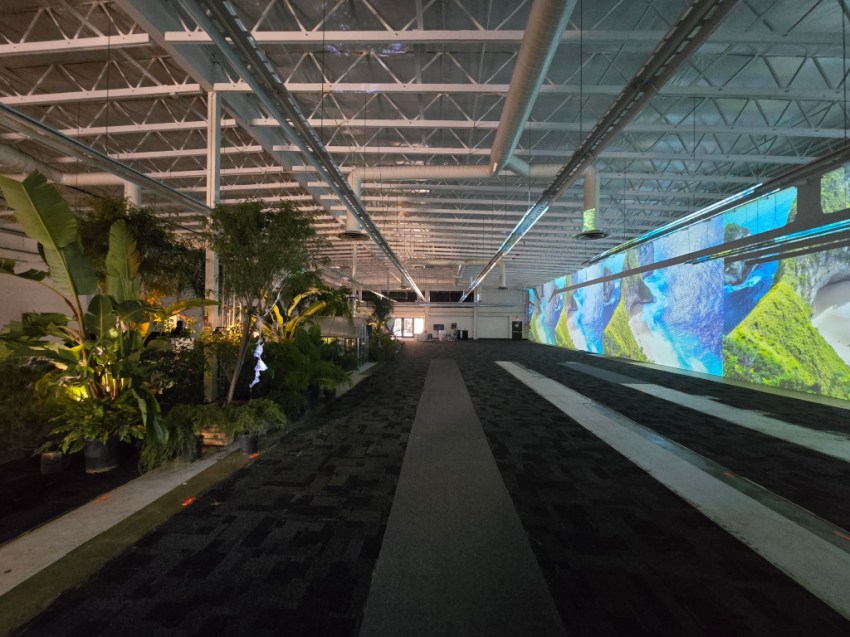
Location has so far been a source of intrigue and allure for BNW. Last year’s inaugural event was headquartered in the heretofore-secretive quarters of the large and historic Masonic Lodge on Carrillo Street. This year, BNW took over a very different space: the vast real estate of the former Staples building at 410 State Street, now owned by UCSB. The space was dramatically refitted to the purpose of the event, with a discussion zone with seating and a display of relevant artworks by artists involved.
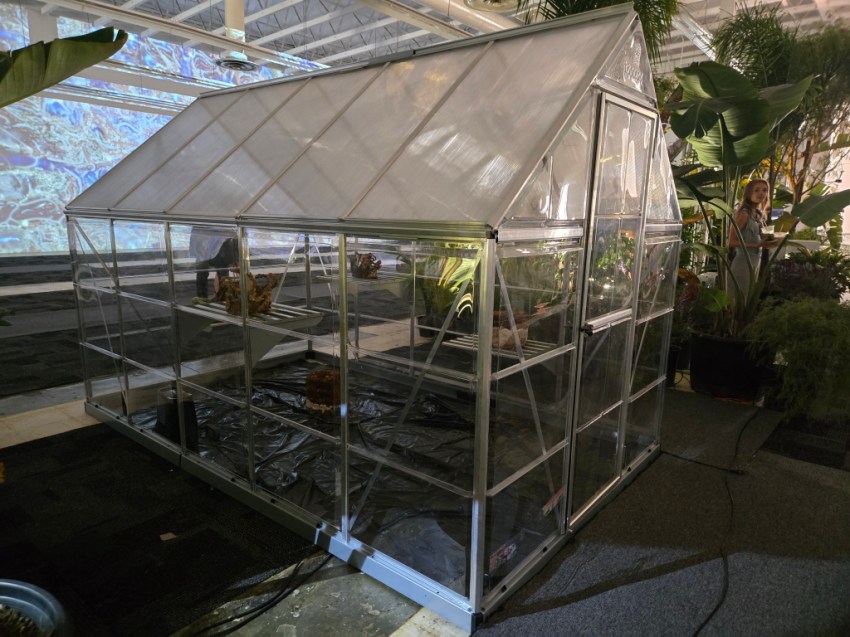
Projections, some of which were triggered by real time AI-driven systems linked to plants, filled and irradiated one long wall in the space, with large plants and nature-oriented artworks placed in the central meridian.
Another earthy element in the house was Marlowe, Delgado’s small pug who roamed the floor as an unofficial mascot. When a dog-phobic audience member loudly registered his displeasure with Marlowe’s brief barking, when startled by applause, Delgado snapped, “The dog stays!” “The dog stays” thereafter became a kind of impromptu motto of pride and determination at the event, essentially branded as such by a marketing guy Patrick Hanlon (author of AI and Primal Branding), on Thursday’s final panel. Voila, a branding hook, and possible slogan for next year’s T-shirt.
Opening the event on Tuesday morning, the panel called “Living Systems: Art, Intelligence and the Ecology of Interconnection” had James Glisson, Chief Curator of the Santa Barbara Museum of Art as its moderator. Last year he presented an illuminating slide lecture and Glisson plays a logical role in the “work” part of the seminar’s focus, a certifiable liaison to the fine arts realm in town.
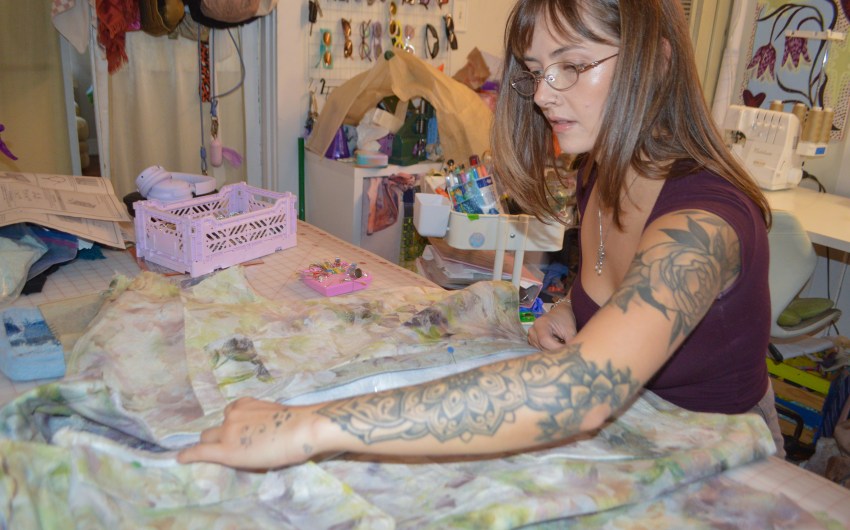
On board for this relevant panel: Chilean-in-Ojai textile artist Minga Opazo, who addresses the environmental and social downsides of fashion in her literally layered art; the Greek artist Nefeli Mnoukdaki, a PhD student at UCSB’s MAT (Media Arts and Technology) program, using “brain organoids” to guide her work; and Los Angeles artist Debra Scacco, a self-described “professional instigator,” working with cartography to plumb social and environmental issues. “There is nowhere that is nowhere,” she said, “that doesn’t have life beneath the surface.”

In the next panel, “World Building,” moderator Lawrence Azerad led a discussion with outer space-oriented Supercollider director Richelle Ellis, “artist and futurist” Kira Xonorika, and artist and UCLA Art-Sci Center director Victoria Vesna. Vesna made the point that “there are no squares in nature, and yet all the buildings and rooms are square. We’re so disconnected from nature. We need to get back to the garden and learn from the indigenous,” a partial reference to the work of Xonorika, whose heritage is linked to the indigenous South American Guarani people.
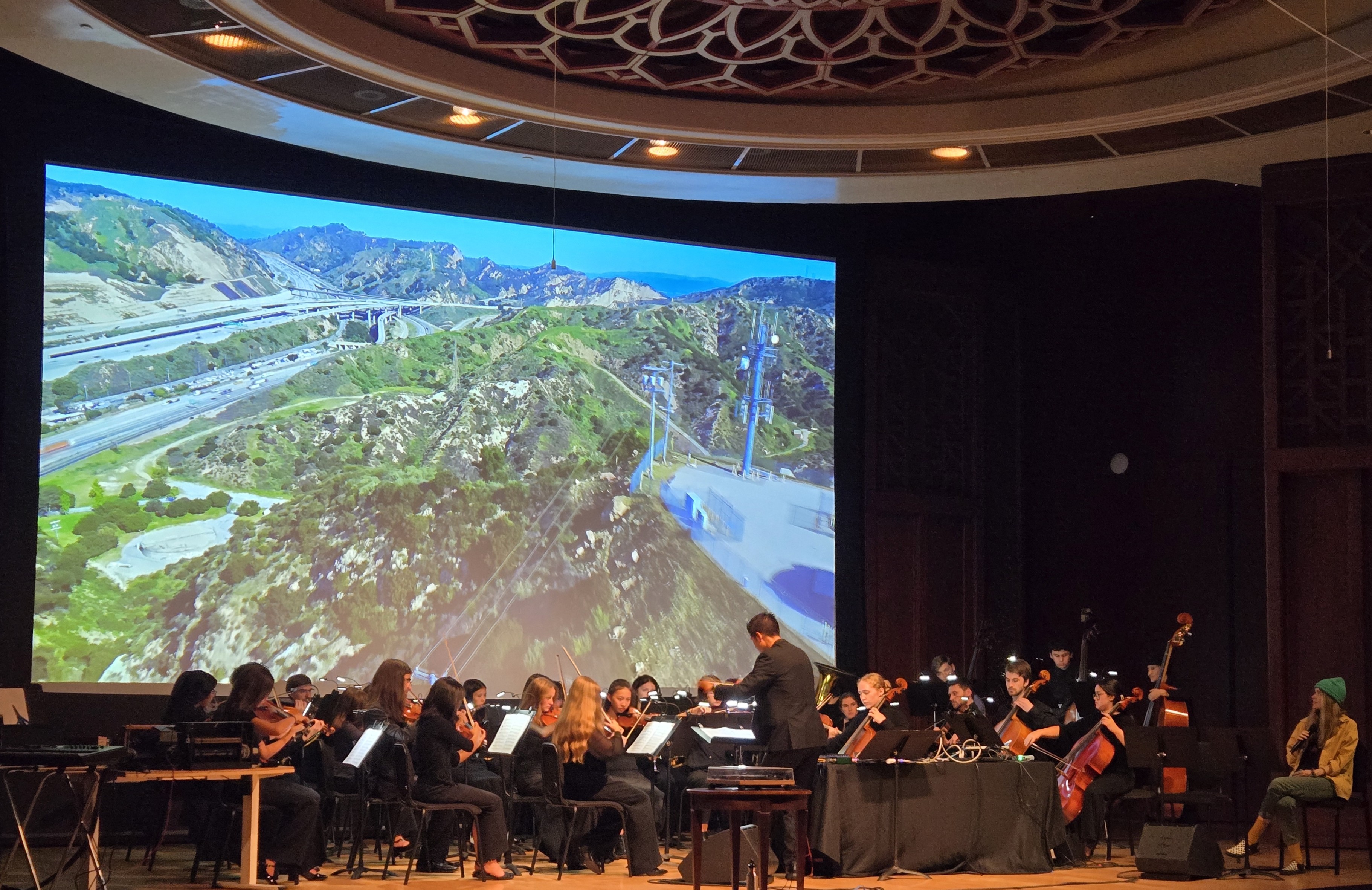
The keynote performance event of this year’s BNW was a three-pronged concert/screening in the glorious Hahn Hall of the Music Academy of the West campus, on Tuesday evening. Marketing efforts emphasized the first performance of the short film L.A. Pipe Dreams, by artist-musician-environmental activist Beattie Wolfe, with contributions from her friend, pop-cum-ambient star Brian Eno. A live accompaniment was provided by the Santa Barbara Youth Symphony, conducted by Daniel Gee. The youthful ensemble easily handled the ambient drone and long tone score, with Eno’s aura in the margins.
The film itself is a rather generic, if pleasantly impressionistic, documentary about the infamous and dubious water-sourcing in Los Angeles, funneled down from the Mono basin through the epic California aqueduct. Yes, we’ve all seen Chinatown.
Next up was the artist known as Money Mark, a keyboardist and electronician for such pop stars as Beastie Boys, Beck, and Jack White. Mark chose this opportunity to unveil a side project obsession and project, dealing with player piano rolls which document actual performances by such classical stars as Claude Debussy.
Aside from its function as a popular music conveyance 100 years ago the fascinating player piano has been repurposed creatively by some contemporary and modern artists — most notably, the great American maverick composer Conlon Nancarrow, who brought the instrument to a great artistic height. (Nancarrow was an American expatriate to Mexico City in the 1940s, who imagined hyper-complex music deemed unplayable by humans, before the advent of computers, and relied on elaborately punched player piano rolls as his palette.)
At Hahn Hall, Mark toyed with rolls of Stevie Wonder’s “For Once in My Life” and Debussy’s Claire de lune, scrolling through various instrumental timbres from his synthesizer-sampler. Both of the works in the concert’s first half were admittedly works-in-progress and touted as premieres, but they seemed not ready for prime time — like premature premieres.
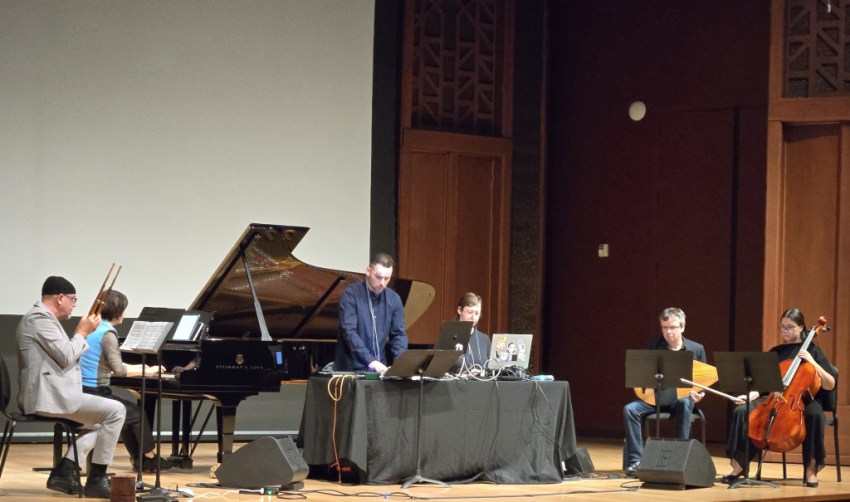
The best came last, with new music composer Gene Coleman’s fascinating art-meets-technology piece “Neuro Music.” Here, an ensemble of musicians — piano, cello, the ancient Japanese shō and a Chinese stringed instrument — were affected by real-time readings of brain and heart activity, via EEG and ECG data drawn from performers on stage. The music varied from structured to rerouted, soft to rough, consonant to dissonant, to intriguing ends.
We could imagine this piece being presented by the serious “serious music” source that is the Music Academy of the West.
Wednesday’s program went to college, specifically to the brain wellspring of UCSB departments of physics and psychology (Jonathan Schooler, Andrea Young), MAT (chair Marko Peljhan, Marcos Novak) and the impressively complex operation of the AlloSphere, founded and run by JoAnn Kuchera Morin, described as “a three-story, ultra-large immersive instrument and virtual reality laboratory.” The AlloSphere, a Wednesday afternoon visit to which was a richly rewarding trip (in more ways than one), was represented on the panel by Latvian Voldemars Johansons, whose work melds sound at a granular level, science and “visuality.”
In Wednesday’s spotlight were subjects of Quantum Mechanics — in the “Beyond Classical Reality” panel — and Organoids (tiny 3D organisms developed through stem cells) — in the “Organoids and the Quantum Orchestra” panel. Fascinating discussions about theories of time and consciousness, and yes, organoids, dominated the day. Admittedly, much of it was beyond my own intellectual pay grade.
Much of the focus and ammo of the Brave New Work expo in progress has been about the cutting edge and cybernetic properties of the ubiquitous AI, on a popular scale via such familiar characters as Claude, Chad, and, of course, Alexa. That subject came into sharpest focus on the final day, in a morning panel consisting of marketing maven Hanlon (“icons are hard-wired to our brains to keep us centered”), “Alexa” puppeteer Kevin Davis, and a veteran Hollywood, production designer Rick Carter, who discovered the wonders of using AI to sketch up his dream-making ideas.
The panelist who had the shortest commute to the event was Davis, the Amazon engineer whose main project is the ever-pervasive robot Alexa, based in the large Amazon building at the corner of State and Carrillo streets.
Carter, who has worked with major directors including Robert Zemeckis, James Cameron, and Steven Spielberg (who he made many films with, including Jurassic Park and his prophetic 2001 film AI: Artificial Intelligence), is an active proponent of and user of AI, at least as a cinematic sketch tool. He demonstrated his handiwork by screening a very recently-made short film for the audience, about an artificial girl seeking real worldly dimensions, but having second thoughts. “It is the sketch” for his idea and potential film pitch, he explained. “I have always been a painter, but I lost all my paintings in the [Pacific Palisades] fire two years ago. I learned to let go of that. Now, I can create a sketch, using AI. I have a new medium that opened up for me at age 75.”
In the closing Q&A portion of the day, Davis commented, “I am a tech optimist. I’m surprised by the discord around AI. I would like to see us going into the positive aspect of AI.” Alexa would agree.
For this BNW-goer’s money, the various panel discussions yielded an almost dizzying plethora of data from different angles, and thought provocation was in the air for a few days on lower State Street. But for my admittedly subjective and often music-obsessive vantage, Gene Coleman was the star of the show. Marlowe also wins honorable mention.
The dog stays.
Related Posts
Premier Events
Sat, Oct 17
9:00 AM
Santa Barbara
Mesa Harmony Garden Fall Plant Sale Continues…
Sat, Oct 17
2:00 PM
Santa Barbara
A New America: Phoenix Rising- Conversation with Dr. James Tepfer
Fri, Oct 23
2:00 PM
Santa Barbara
Music & Meditation: Clarinetist Nancy Mathison & Pianist Antonio Artese
Sat, Oct 24
9:00 AM
Santa Barbara
Mesa Harmony Garden Fall Plant Sale Continues…
Sat, Oct 17
8:00 AM
Goleta
Isla Vista Elementary Rummage Sale Fundraiser
Sat, Oct 17
9:00 AM
Santa Barbara
No Kings: Vote Early Carpinteria
Sat, Oct 17
10:00 AM
Santa Barbara
No Kings: Vote Early Lompoc
Sat, Oct 17
12:00 PM
Santa Barbara
No Kings: Vote Early Rally S.B
Sat, Oct 17
1:30 PM
Santa Barbara
Screening of “Unseen” A Documentary and Q&A with Director Set Hernandez and Subject Pedro
Sat, Oct 17
2:00 PM
Santa Barbara
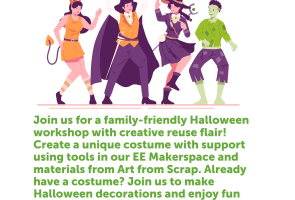
Halloween Costumes, Decorations Workshop & Games
Sat, Oct 17
3:00 PM
Montecito
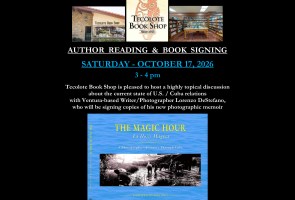
Author Talk & Signing Lorenzo DeStefano ”The Magic Hour” Photography
Sat, Oct 17
5:00 PM
Santa Barbara
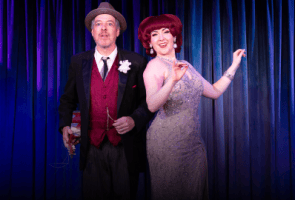
“Lucy Darling – All That and More”
Sun, Oct 18
9:00 AM
Santa Barbara
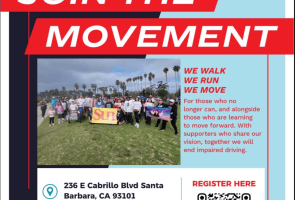
“Move with MADD” Santa Barbara 3K Community Walk & Fundraiser to Prevents Impaired Driving
Sun, Oct 18
11:00 AM
Santa Barbara
17th Annual Asian American Neighborhood Festival
Sat, Oct 17 9:00 AM
Santa Barbara
Mesa Harmony Garden Fall Plant Sale Continues…
Sat, Oct 17 2:00 PM
Santa Barbara
A New America: Phoenix Rising- Conversation with Dr. James Tepfer
Fri, Oct 23 2:00 PM
Santa Barbara
Music & Meditation: Clarinetist Nancy Mathison & Pianist Antonio Artese
Sat, Oct 24 9:00 AM
Santa Barbara
Mesa Harmony Garden Fall Plant Sale Continues…
Sat, Oct 17 8:00 AM
Goleta
Isla Vista Elementary Rummage Sale Fundraiser
Sat, Oct 17 9:00 AM
Santa Barbara
No Kings: Vote Early Carpinteria
Sat, Oct 17 10:00 AM
Santa Barbara
No Kings: Vote Early Lompoc
Sat, Oct 17 12:00 PM
Santa Barbara
No Kings: Vote Early Rally S.B
Sat, Oct 17 1:30 PM
Santa Barbara
Screening of “Unseen” A Documentary and Q&A with Director Set Hernandez and Subject Pedro
Sat, Oct 17 2:00 PM
Santa Barbara
Halloween Costumes, Decorations Workshop & Games
Sat, Oct 17 3:00 PM
Montecito
Author Talk & Signing Lorenzo DeStefano ”The Magic Hour” Photography
Sat, Oct 17 5:00 PM
Santa Barbara
“Lucy Darling – All That and More”
Sun, Oct 18 9:00 AM
Santa Barbara
“Move with MADD” Santa Barbara 3K Community Walk & Fundraiser to Prevents Impaired Driving
Sun, Oct 18 11:00 AM
Santa Barbara



You must be logged in to post a comment.