

Generally speaking, the sylvan compound that is the Music Academy of the West’s (MAW) Miraflores campus/estate springs mainly to life during the summer months. But there are exceptions, as happened recently with a welcome confluence of memorable musical (and soiree-style) events on the grounds.
On Saturday night, MAW itself was the focus of attention, as well as fundraising, at an evening alliteratively dubbed “Denk, Denim, and Diamonds.” No less august a performer than world-renowned pianist/witty commentator Jeremy Denk was in the spotlight for a night of cocktails and dinner at long tables in Lehmann Hall, all benefitting the Academy’s summer program and its year-round “Sing!” program.
The Denk affair followed closely on the heels of Hahn Hall events of note — the first concert of the year by Camerata Pacifica (catch their next concert this Friday, February 7), on the theme of Bach, revisited and revered, and then two concerts in UCSB Arts & Lectures’s “Hear and Now” series: Russian pianist Alexander Malofeev’s recital kicked things off, followed by Sunday afternoon’s fun-loving meetup of the Imani Winds and the Boston Brass.
The grounds were alive with the sounds of varied music and the savory taste of fine dining, in denim and otherwise.
Denk has appeared in Santa Barbara many times, and is now virtually an honorary, very part-time local as one of the MAW faculty known for giving coveted performances each summer. Among the highlights of last year’s Music Academy season was Denk’s combo “lecture” (although he dismissed that L-word) and insightful reading of Charles Ives’s great American Concord Sonata.
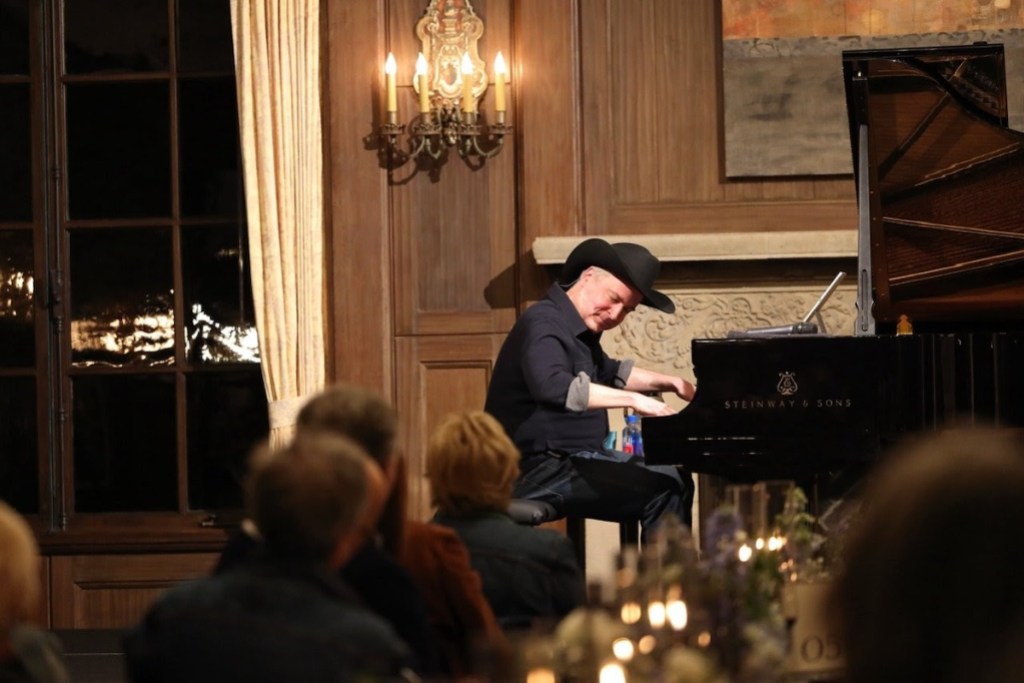
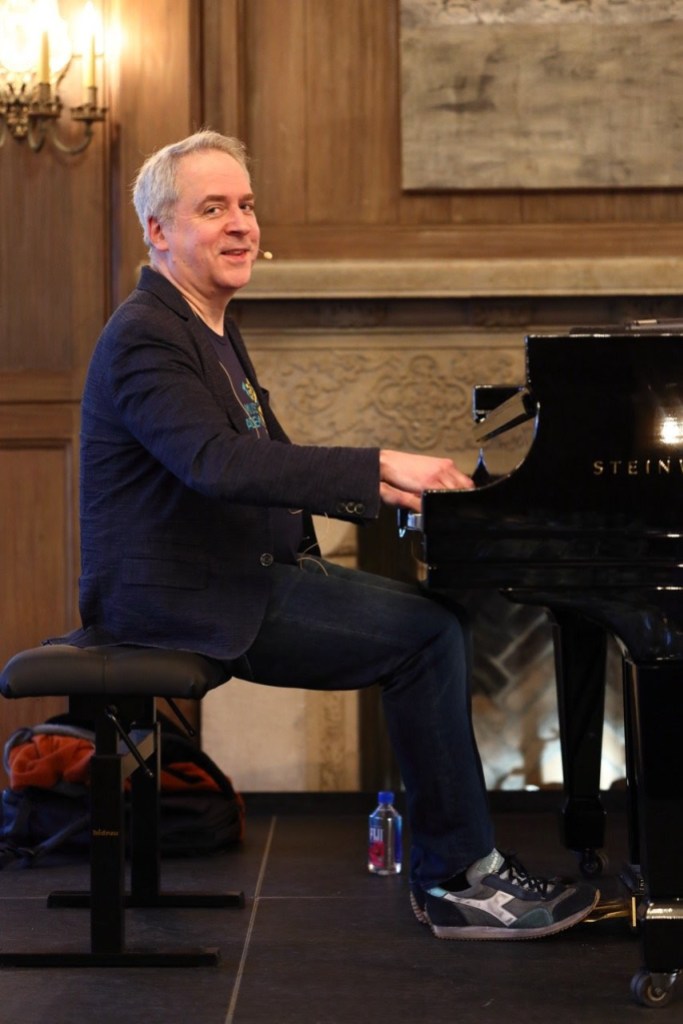
Last weekend, the MacArthur “Genius” came donning a black cowboy hat for the occasion and served up another talk-action event, this time delving into Beethoven’s moody and majestic Opus 110 — the penultimate score in a piano sonata canon 32 pieces deep. Before the main course (I had the herb crusted grilled flat iron steak, thank you), Denk offered a fascinating “blow by blow” run-though of selected features in the Opus 110 score, speaking and playing as if the music was a character with motivations, questions, and shifting emotions. Beethovenian stuff. Denk illustrated the quote from Bach’s St. Matthew Passion and a German folk song, and, quoting András Schiff, the tolling chords sounding like “the clock strikes,” followed by an upside-down fugue.
After dinner, he leapt into the world that is this miraculous opus, heading deep into the varied and mercurial terrain of the score. As usual, the performance had the requisite Denk-ian qualities of sharp focus and carefully curated degrees of expressive moxie.
The following afternoon, the Imani Winds/Boston Brass gathering was a more liberal mix of lightweight fare (even a Vegas-sized take on the Dean Martin hit “Sway”) and more serious stuff. Each of these respected groups took the stage, alone and in full tenet ensemble format, opening with a salty fanfare by Shostakovich, Galop, and made strong impressions with work as varied as Paul Hindemith’s “March from Symphonic Metamorphosis” and a moving fresh arrangement of Stevie Wonder’s inspirational classic “Overjoyed,” arranged by Imani clarinetist Mark Dover and with a soulful vocal by hornist Kevin Newton.
Latin American flavors made for a welcome sub-theme of the program, with two works by the great Argentinian nuevo tango king Astor Piazzolla, a jazz-cum-classical-Cuban work by Paquito D’Rivera, and an ear-friendly and light custom-made work for both groups by trumpeter Arturo Sandoval, “Metales y Maderas (Brass meets Winds).” Lalo Schifrin, the film composer best-known for his 5/4 Mission Impossible theme, supplied one of the concert’s high points with the inventive New Orleans–referential “La Nouvelle Orleans” and another Latin tinge capped off the program, with the rearranged (by Boston Brass hornist Chris Castellanos) tune of “Malaguena,” for all musicians on board.
One odd moment on this Grammy Awards day/night came when the Imani Winds first took the stage, and bassoonist Monica Ellis half-ruefully announced that she had learned 30 seconds earlier that they had lost in the Grammy sweepstakes. However, let it be noted that the group won a Grammy last year, and should be shoe-in for future trophies on the mantle. Their Hahn Hall showing reminded us of their special way and sense of mission.
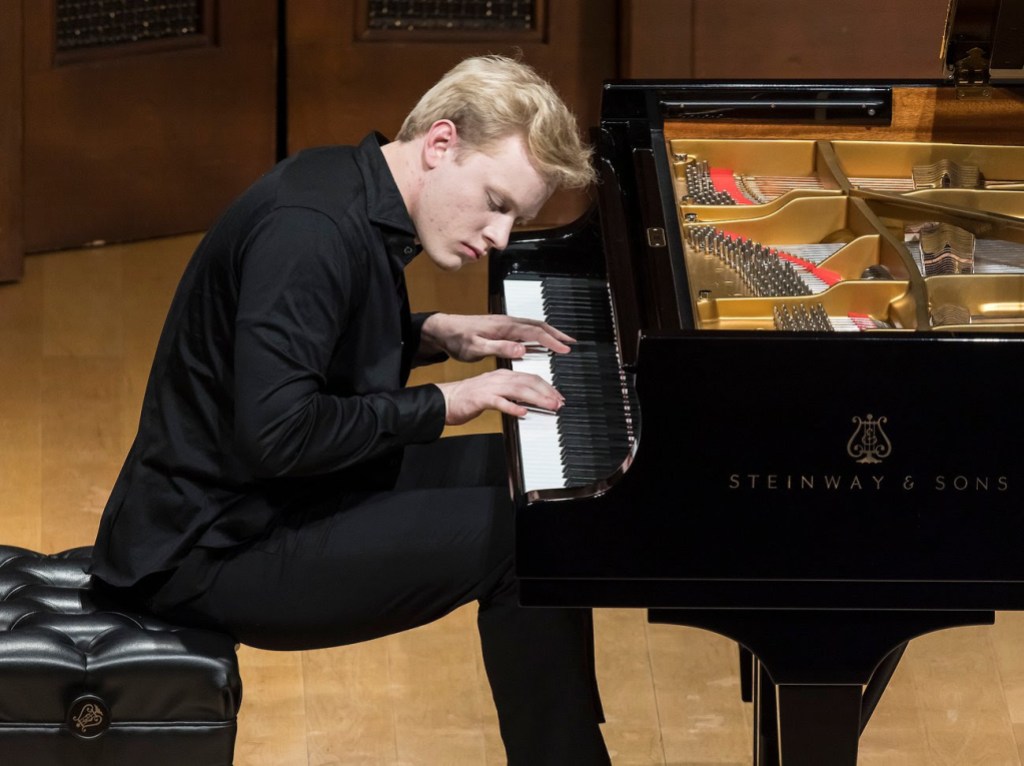
A week earlier, the Hahn Hall stage played host to a sole musician, in command of his work and the room, Malofeev in his Santa Barbara debut. Although the 23-year-old sensation has a boy-ish countenance, he plays with uncommon depth and maturity. Malofeev had his career “coming out” after winning the Tchaikovsky Competition for Young Musicians at 13 and is ascending into the ranks of coveted recitalists and orchestral soloists.
Here, the Russian element was well-accounted for, but thankfully steered clear of Tchaikovsky or other name brand sources. In the first half, Malofeev called on an intriguing Sonata No. 3 by Dmitri Kabalevsky, best known for his simpler pedagogical music but here showing his more complex palette. Two works by post-romantic pre-modernist Alexander Scriabin exerted a thicket of intellectual intrigue more than emotional verities.
Czech composer Leoš Janáček’s “In the Mists” blends suitably impressionistic passages with restlessly searching moments and was boldly articulated by the young pianist.
For my money, the best came first: Malofeev melted onstage and trained his intense focus, bodily and musically, on Schubert’s Drei Klavierstücke. The effect was riveting and leaves a lingering memory superseding the boldly played but sometimes wearying Russian bluster of what was to come.
Three Things I Love About Missus Jones
Rickie Lee Jones paid us another visit last Saturday, reaffirming the notion that her enigmatic yet embraceable music fits perfectly in the Lobero Theater’s intimate atmosphere. She was in unusually good and unorthodox company, with the ever-loveable violinist-vocalist Petra Haden, and flexible drummer/percussionist Mike Dillon (his vibraphone parts were artfully built-to-suit Jones’s jazz-flecked art-pop sensibility), backing up her voice, acoustic guitar, and piano work.
Leslie Dinaberg wrote a full review of the show (see independent.com), but I was left with at least three strong impressions to make note of. Jones has a poetic way with standards, as heard on her latest album Pieces of Treasure and this night’s “Cry Me a River” (the song which gets away with tasteful use of the word “plebian”). Shades of Billie Holiday and Abbey Lincoln mix with Jones’s own secret sauce. From her own eloquent and unique songbook, her hypnotic 1979 song “On Saturday Afternoons in 1963” (with the recurring line “years may go by”) hits home as an anthem of time’s passage, growing deeper by the year.
And “The Last Chance Texaco,” the show-closer and also the title of her memoir, is some kind of masterpiece in its own category. The strategic contrasts of brighter verses and modulation — emotionally and harmonically — into the bleaker prospects of its chorus becomes a structural refrain marked by a certain genius. But never mind analysis: The song lives in a world of its own, every time we hear it. And hearing it at the Lobero seems all the more bittersweet.
TO-DOINGS:
The eagerly awaited arrival of the wondrous alto saxophonist/bandleader Lakecia Benjamin, at Campbell Hall on Friday, February 7, conflicts with the attentions of the film geeks among us, who will be gobbled up in SBIFF partaking. But on this occasion, the inner jazz aficionado wins out, given the rarity of world-class jazz concerts in town. (See story here).
For a solid country music fix — of the old, pre-“Today’s Country” sort — head to the Lobero Theater on Tuesday, February 12, for Randy Travis. And for a taste of one of the greatest and wittiest acoustic guitarists around, with non-linear storytelling to boot, check out Leo Kottke, making another of his many stops at the Lobero on Friday, February 7.





You must be logged in to post a comment.