
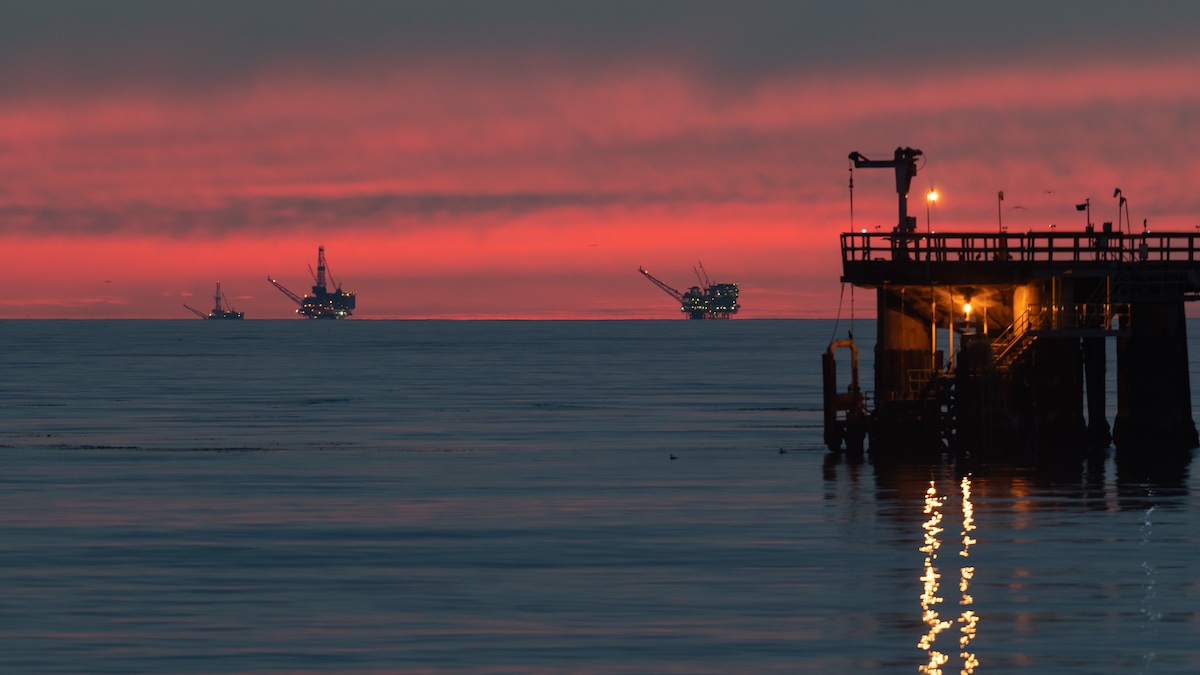
Sable Offshore experienced a critical new setback in its ongoing quest to restart oil production off the Gaviota Coast, this time in the form of a terse letter signed by California State Fire Marshal Daniel Berlant, putting Sable on notice that the company had not repaired all the corroded portions of its damaged pipeline according to the specifications required by his office.
Absent this level of repair, Berlant notified Sable on October 22, its application to restart the vast oil and gas plant up the coast, its much storied pipeline, and the three offshore platforms it purchased from Exxon two years ago could not be processed. According to Berlant, Sable has failed to make the repairs according to the specifications included in a special state waiver the fire marshal issued last December that would allow Sable to deploy a method of corrosion control and management other than the one originally approved when the pipeline was first permitted in 1986. Because the system’s corrosion control system did not work as hoped, the pipeline sprung a serious rupture in May 2015, and the pipeline has not been operative since.
Sable shot back a quick response the following day, informing Berlant he got it wrong. “The OSFM (Office of the State Fire Marshal) conclusions are in error, ignore the remainder of the waivers, and are inconsistent with numerous discussions between OSFM and Sable,” the company said
At issue is the extent to which the waiver issued last year calls on Sable to add a certain better-safe-than-sorry, belts-and-suspenders fudge factor to the repairs it made to the pipeline. The waiver mandates that all lengths of the pipeline that are corroded by 40 percent or greater must be repaired. But beyond that, the fire marshal claimed, Sable needed to have factored in a margin of error specific to the diagnostic in-line tool used to read the extent of corrosion.
Typically, that margin of error would be ten percent. In other words, a stretch of pipe showing corrosion levels of 30 percent would need to be repaired as if it was 40 percent corroded. That, Berlant stated, has not been done. Until that is, he said, the restart application cannot begin to be processed. Sable stated in its letter that nothing in the fire marshal’s waiver language says this. In addition, Sable Vice President B. Lance Yearwood noted in the company’s letter that he had had many verbal communications with fire marshal staff and that no one ever said anything about what’s called in the trade: “tool tolerance.”
A spokesperson for the fire marshal declined to say how many repaired corrosion anomalies ― as they are known ― are now being reviewed. Some, he said, fall outside the coastal zone, that stretch of coastal real estate over which the California Coastal Commission exerts jurisdictional control. But some, he added, could “potentially” fall within the coastal zone. The key word there is “potentially.” Whether it is or isn’t is legally significant because Sable and the Coastal Commission have been at loggerheads in the courts over the pipeline repair work Sable did this past year.
The Coastal Commission has insisted that Sable needed a coastal development permit for such repairs; Sable has insisted otherwise and kept working despite two cease and desist orders being sent by the Coastal Commission executive director. In response, the Coastal Commission fined Sable $18 million and successfully sought a court order blocking Sable from any further unpermitted repair work.
Sable, in turn, sued the Coastal Commission, demanding $347 million in damages for slowing down the company. But two weeks ago, Santa Barbara Superior Court Judge Thomas Anderle ruled in the Coastal Commission’s favor, concluding that Sable, in fact, needed coastal development permits to repair the stretch of pipeline running along the coast. Sable has vowed to appeal that ruling.
The fire marshal’s letter is a big deal because no other state agency can approve Sable’s application to re-start production. That’s not to say other agencies don’t have a big say over portions of the project. It’s up to the state parks director to approve, deny, or approve conditionally Sable’s application for a four mile pipeline easement running through Refugio State Park.
Based on a bill passed by the state legislature and signed by Governor Gavin Newsom, Sable will be required by law to get a Coastal Development Permit from the Coastal Commission. That law, however, doesn’t go into effect until January 1. For Sable, this adds an element of urgency to securing fire marshal approval before then. Sable and the fire marshal will now meet and confer to determine what work is necessary and what work is not. According to a fire marshal spokesperson, that can take anywhere from two to four weeks.
In the meantime, Reuters has reported that Sable is seeking $1.7 billion in additional financing to buy the infrastructure necessary to locate an offshore storage and treatment barge in federal waters more than three miles off the coast. The company has been talking to officials within the Trump administration, far more welcoming to offshore oil production than the state legislature, about such a prospect. And, even perhaps, some financing.
Also, the Board of Supervisors will be holding a second hearing this Tuesday on Sable’s application to transfer the title and permits it bought from Exxon. Santa Barbara County is perhaps the only place on earth to have adopted an ordinance designed to weed fly-by-night oil operators from those with the track record and deep pockets to respond to a major spill. Last October, the county’s planning commission voted to approve such a transfer permit, but on appeal the supervisors were deadlocked 2-2 and the transfer failed for lack of a majority.
This coming Tuesday, the likelihood of such a deadlock repeating itself seem slim as Supervisor Joan Hartmann — who had recused herself from the prior vote on the grounds that the pipeline came within a short distance of her home in Buellton — has now been notified she can vote on this narrow measure. Hartmann has been vocal about the extent to which she regards climate change as the existential threat of the moment; should Sable go on line, the county’s greenhouse gas emissions, she has said, will double.
Also this coming Tuesday, Sable will be arraigned on criminal charges filed by the Santa Barbara District Attorney’s Office. These charges involve work done without permit over creeks and streams over which the Central Coast branch of the Regional Water Quality Control District holds jurisdictional sway. In such cases — corporations charged with criminal offenses — no one from Sable needs to show up in person other than the company’s legal counsel. Bail is not an issue. The only thing likely to happen is for Sable to announce that it’s pleading not guilty to the charges.
Related Posts



Premier Events

Wed, Oct 14
5:30 PM
Santa Barbara
Free Home Hardening & Firescaping Workshop

Sat, Oct 10
9:00 AM
Santa Barbara
SBNC 1st Annual Health & Wellness Fair

Sat, Oct 10
1:30 PM
Goleta
🌴 Another Day in Paradise at S.B’s Premier Ice Rink

Sun, Oct 11
7:00 AM
Ojai
Flamenco Guitarist Tony Ybarra

Sun, Oct 11
10:00 AM
Santa Barbara
18th Annual Domestic Violence Solutions Brunch
Sun, Oct 11
10:00 AM
Santa Barbara
Free Community Day at S.B. Botanic Garden

Sun, Oct 11
10:00 AM
Santa Barbara
Downtown Classic Car Show Santa Barbara

Sun, Oct 11
11:00 AM
Santa Barbara
Raíces y Sueños: Bilingual Storytime at Santa Barbara Museum of Art

Sun, Oct 11
2:00 PM
Santa Barbara
The Theatre Group at SBCC Presents: “CLUE”

Sun, Oct 11
10:00 PM
Santa Ynez
Inaugural Santa Ynez Art Walk

Mon, Oct 12
6:30 PM
Santa Barbara
Science Pub: Discuss “Ophiolites & Plate Tectonics” with Dr. Rioux
Wed, Oct 14 5:30 PM
Santa Barbara
Free Home Hardening & Firescaping Workshop
Sat, Oct 10 9:00 AM
Santa Barbara
SBNC 1st Annual Health & Wellness Fair
Sat, Oct 10 1:30 PM
Goleta
🌴 Another Day in Paradise at S.B’s Premier Ice Rink
Sun, Oct 11 7:00 AM
Ojai
Flamenco Guitarist Tony Ybarra
Sun, Oct 11 10:00 AM
Santa Barbara
18th Annual Domestic Violence Solutions Brunch
Sun, Oct 11 10:00 AM
Santa Barbara
Free Community Day at S.B. Botanic Garden
Sun, Oct 11 10:00 AM
Santa Barbara
Downtown Classic Car Show Santa Barbara
Sun, Oct 11 11:00 AM
Santa Barbara
Raíces y Sueños: Bilingual Storytime at Santa Barbara Museum of Art
Sun, Oct 11 2:00 PM
Santa Barbara
The Theatre Group at SBCC Presents: “CLUE”
Sun, Oct 11 10:00 PM
Santa Ynez
Inaugural Santa Ynez Art Walk
Mon, Oct 12 6:30 PM
Santa Barbara

