

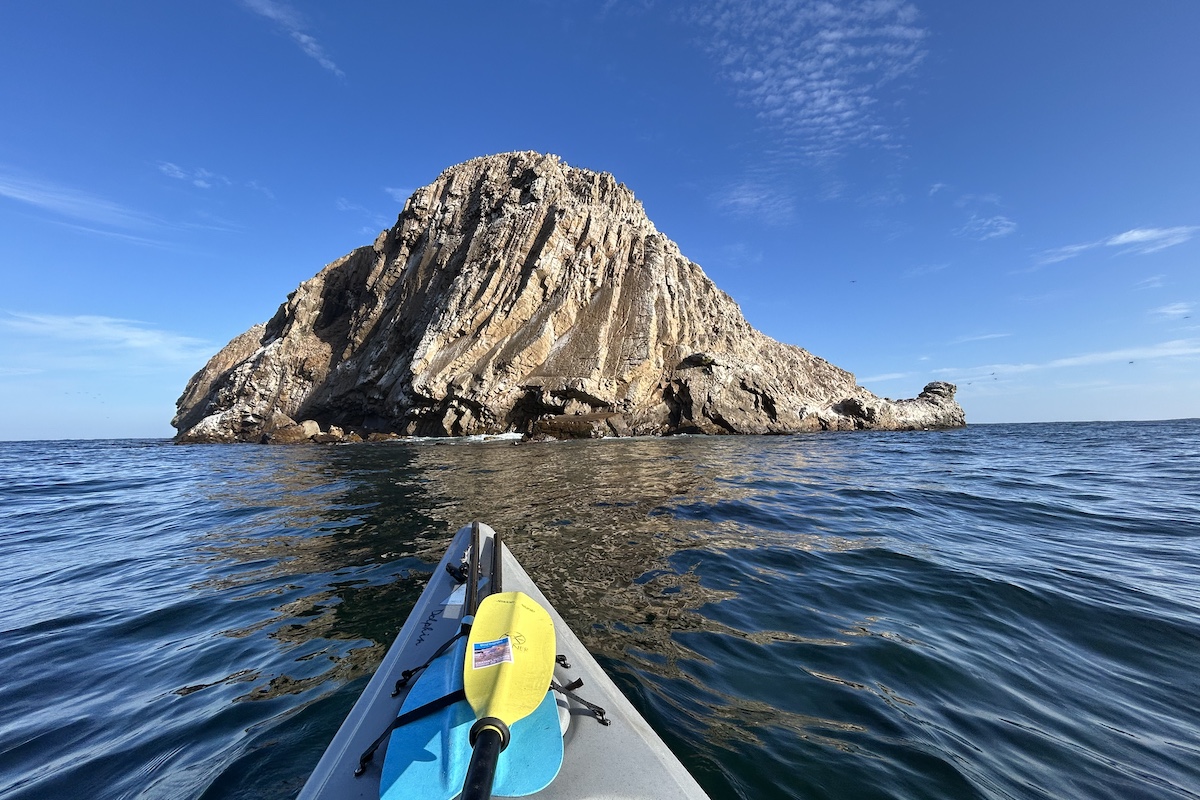
Sometimes, the weather on San Miguel makes me a little paranoid. Every time I go out to the windswept place, I search for a friendly window to circumnavigate my favorite of the Channel Islands.
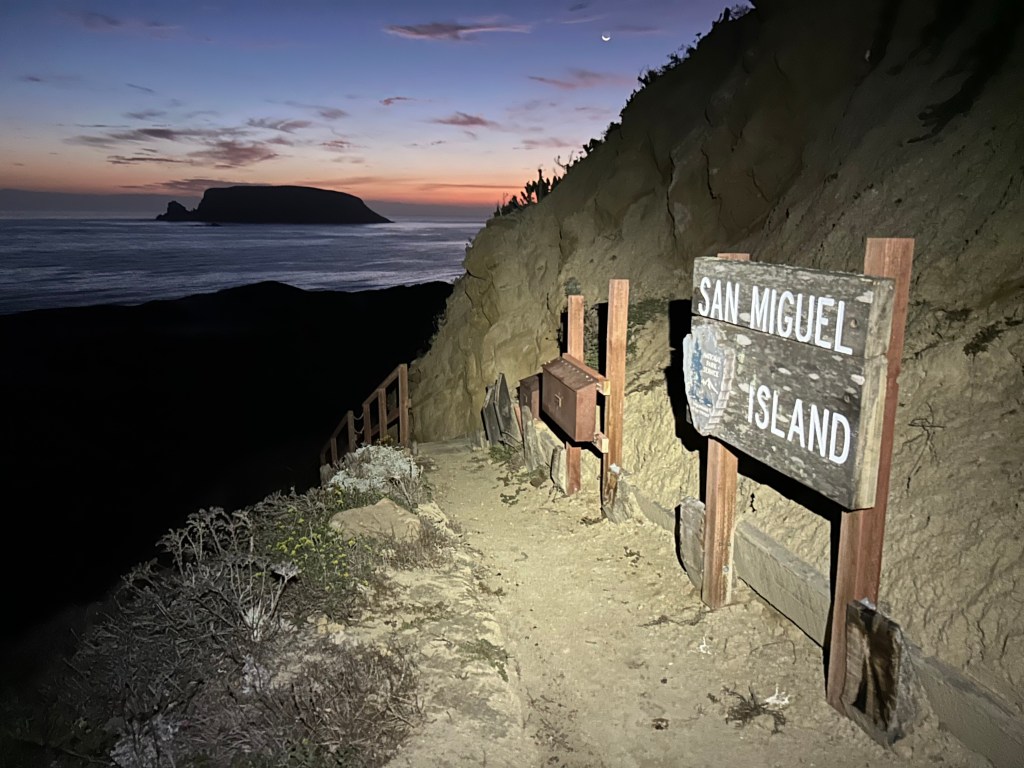
It was late September, and I was attempting to sleep the night before a potential circumnavigation, but 40 mph northwest winds kept me awake. Growing nervous, I jumped out of my sleeping bag at 1 a.m. and ran down Nidever Canyon to check on my and Zack’s kayaks.
They were tucked behind a steep sandstone slab seemingly out of the wind, but I was wrong. My kayak had lifted off and blown 30 yards down the beach. Eating sand, and with my headlamp burning bright, I pulled our kayaks into a flotsam of driftwood and coastal sage scrub, as secure a place as I could find under the darkness of scenic Cuyler Harbor.
Back at the top of the canyon, I slept easy the rest of the night. A predawn launch awaited the next morning. As northwest winds dissipated through the evening, my confidence swelled. San Miguel possesses 27 coastal miles, but I guesstimated 20 miles of paddling around the island’s teeming reefs, sandspits, wave-battered rock outcroppings, sandy pocket beaches, and throngs of pinnipeds.
The Indicators
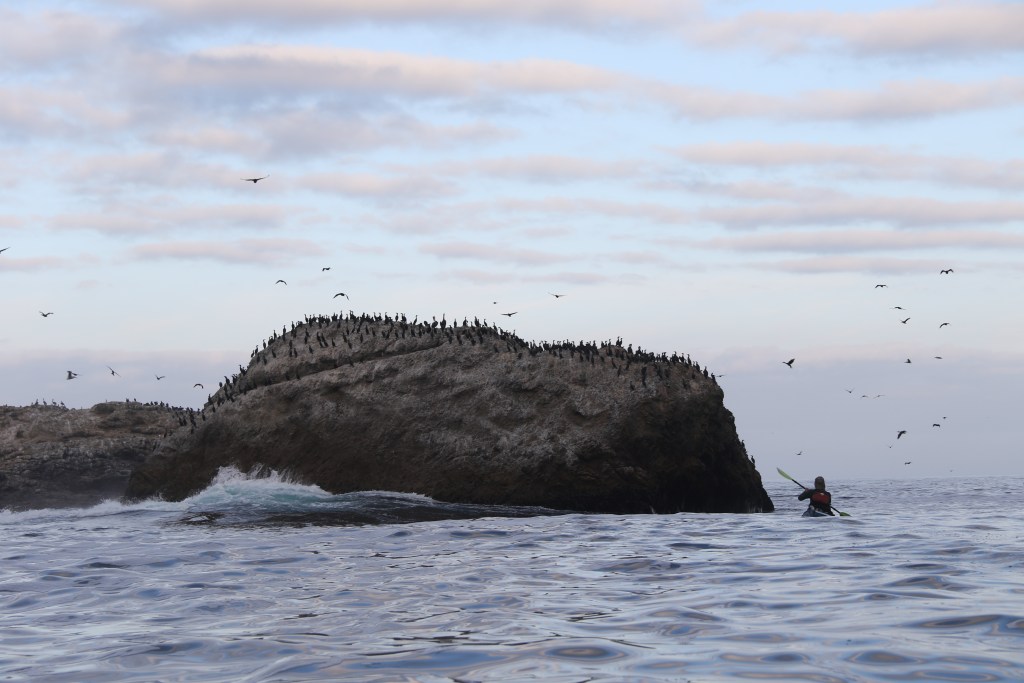
There may not be a better, more advantageous indicator of how a circumnavigation might go around San Miguel than burly Harris Point. Located on the northwest fringe of the island, it’s always been reliable for gauging winds, swell, currents, and fog.
Harris Point faces into the northwest and has always predicted what sea conditions lie ahead. If it’s blowing too hard, it’s easy to turn around and paddle back to Cuyler Harbor. If it’s calm and no fog, I can easily see all the way past lonely Castle Rock. That late September morning, sea conditions were ripe for paddling around an island that is close to the mainland but makes me feel very far away.
Squadrons of Brandt’s cormorants perched like pelagic centurions reveled on the wave-battered crags. Sea conditions, favorable or not, never thwart these sleek swimming seabirds. With the point in our rearview mirror, the next sign we searched for was waves slamming into Castle Rock. From afar, it appeared lifeless. But closer inspection revealed raucous California sea lions and northern fur seal pups hauled out on sheer crags, while others bodysurfed its populous reefs.
As the California Current swirled and swelled around the daunting pinnacle, and unruly surf heaved and deposited onto its northern periphery, an opportunistic peregrine falcon surveyed the surrounding waters, seabird fodder being their prime sustenance.
From there, Zack and I rested atop a thick canopy of giant bladder kelp, while contemplating a path in and around Point Bennett, where a graveyard of shipwreck remnants clung to ragged reefs, and the largest congregation of seals and sea lions in the world continued to proliferate. The kelp swayed with the ebb and flow of an incoming tide, but the path through and around Point Bennett is anything but simple, and that morning was no different.
Wildlife Outpost
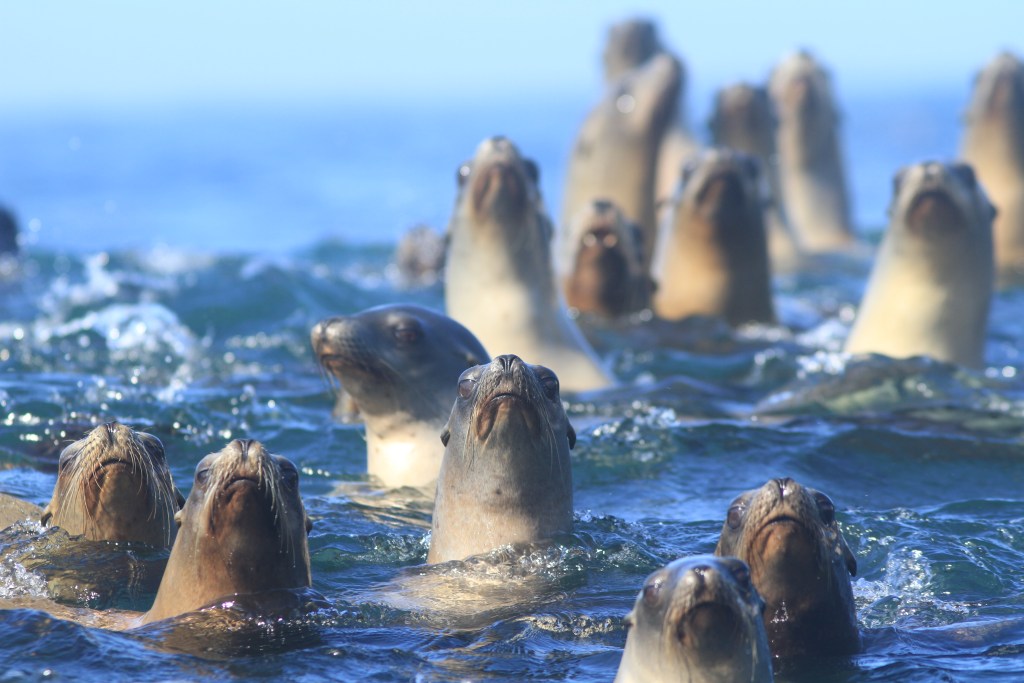
Point Bennett has never been boring, whether observed from its wind-groomed sand dunes or especially from a kayak. Paddling among the food chain offered us a sea level view of the throng of pinnipeds that numbered well into the thousands ― northern elephant seals, northern fur seals, California sea lions, spotted harbor seals, and a few Guadalupe fur seals and stellar sea lions.
Throughout the year, all six species converge at Point Bennett, and on any given day there are roughly 30,000 animals utilizing the long sandspits, coves, and rock outcroppings slathered in seabird guano for hauling out, breeding, and pupping.
Point Bennett was a perpetual cacophony of yelps, snorts, mews, barks, and bellows that carried far beyond the main colony of animals. Its aroma carried even further. There was plenty of entertainment provided by pups that recently graduated from the steep berm that buffers basking pinnipeds from crashing surf and into its aqua marine-colored waters.
There, these wide-eyed youngsters frolicked in the shallows, while body-whomping in the shore break. Resembling rambunctious children like it was their first day at the beach, they were swept up the gritty berm and into the basking hordes, disrupting the piles of midday sun worshipers.
Just east at Adam’s Cove, we watched flotillas of seals and sea lions performing what appeared to be some sort of aquatic ballet. Northern fur seals and California sea lions can thermoregulate while on the water, using their pectoral and tail flippers like solar panels.
While napping on the water, they held their flippers into the air, soaking in the sun. However, northern fur seals took it a step further, bringing their pectoral and tail flippers together forming what biologists call “jugging,” or a “jug handle,” a subtle motion while they relaxed in turbulent seas.
Gone Swimming
I’ve circumnavigated San Miguel Island around eight times, and I always tell myself: “Expect to go for a swim. It’s inevitable.”
Swell, wind, and current converge from three different directions around the island. Sooner or later the conditions were going to send me overboard.
Crook Point on the south side had waves cracking across unpredictable mysto reefs, waves cresting near and far. Paddling just outside the unruly surf, Zack yelled, “Wave!”
I spun my kayak around just as an eight-foot wave pitched in front of me. A yard sale of gear ensued. My kayak got away from me, and I commenced with about a 100-yard swim in open water. It was slow going as I swam with my paddle and drybag in one hand. Even so, an inefficient one-arm side/breaststroke eventually returned me to my kayak.
It’s a wild place, San Miguel Island. In all respects, I wouldn’t have it any other way.
Related Posts


Premier Events

Thu, Sep 17
5:30 PM
Santa Barbara
S.B. Independent: Santa Barbara City Council District 5 Forum

Thu, Sep 17
7:00 PM
Santa Barbara
Téka Brazilian Jazz at The Grand On State
Fri, Sep 18
All day
Solvang
Solvang Danish Days
Fri, Sep 18
12:00 AM
Santa Barbara
Yesterday: A Tribute to The Beatles at SOhO

Fri, Sep 18
7:00 PM
Carpinteria
West Coast Premier: “Gloria’s Old Haunt”
Sat, Sep 19
All day
Solvang
Solvang Danish Days
Sat, Sep 19
9:00 AM
Santa Barbara County
Coastal Cleanup Day

Sat, Sep 19
10:00 AM
Santa Barbara
8th Annual Santa Barbara County Farm Day
Sat, Sep 19
6:30 PM
Santa Barbara
Feng E – Teen Ukulele Sensation at SOhO

Mon, Sep 21
5:30 PM
Santa Barbara
S.B. Independent: Santa Barbara City Council District 6 Forum
Thu, Sep 17 5:30 PM
Santa Barbara
S.B. Independent: Santa Barbara City Council District 5 Forum
Thu, Sep 17 7:00 PM
Santa Barbara
Téka Brazilian Jazz at The Grand On State
Fri, Sep 18 All day
Solvang
Solvang Danish Days
Fri, Sep 18 12:00 AM
Santa Barbara
Yesterday: A Tribute to The Beatles at SOhO
Fri, Sep 18 7:00 PM
Carpinteria
West Coast Premier: “Gloria’s Old Haunt”
Sat, Sep 19 All day
Solvang
Solvang Danish Days
Sat, Sep 19 9:00 AM
Santa Barbara County
Coastal Cleanup Day
Sat, Sep 19 10:00 AM
Santa Barbara
8th Annual Santa Barbara County Farm Day
Sat, Sep 19 6:30 PM
Santa Barbara
Feng E – Teen Ukulele Sensation at SOhO
Mon, Sep 21 5:30 PM
Santa Barbara



You must be logged in to post a comment.