

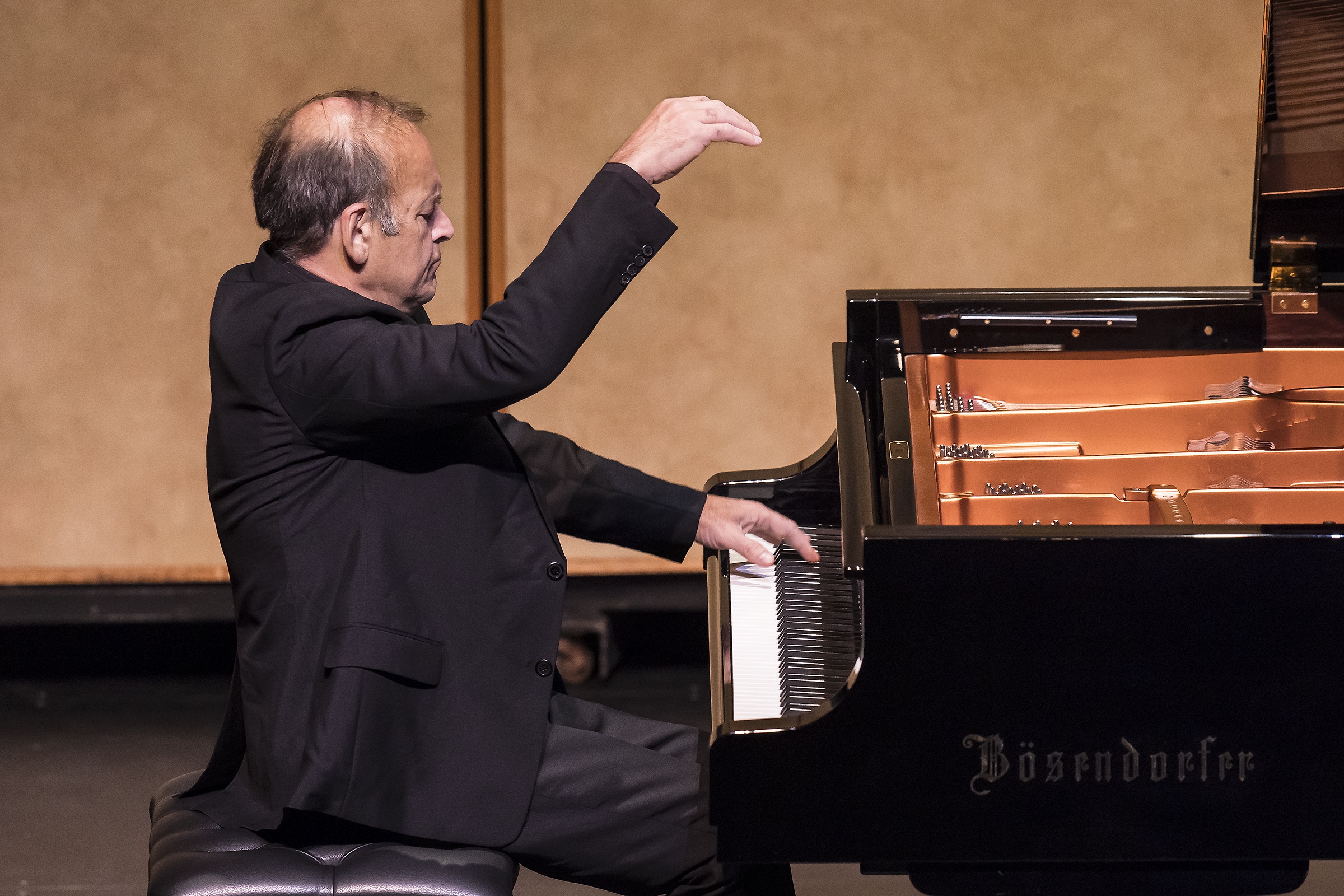
There is a special species of concert programming when a singular focus is trained on a particular composer — provided that said composer has a rich and varied oeuvre and the performer(s) shows a strong and deep relationship with said body of work. A power of compare-and-contrast and overview wisdom comes into play, as witnessed with Garrick Ohlsson’s stellar all-Chopin recital at the Lobero Theatre earlier this year.
The symbiotic effect landed at the Lobero again last week, as Canadian (and worldly) pianist Louis Lortie gave the Ravel-heads among us much reason to cheer and ponder over with his all-Ravel piano program. Just as Ohlsson’s appearance was courtesy of the CAMA’s hosting aegis, Lortie was also in-house as a CAMA guest, making his first appearance with the 106-year-old organization and kicking off its chamber music “Masterseries” component, with the flair and sensitivity due the composer in the spotlight.
At the Lobero, timed with the 150th birthday of the great French master, Lortie — an acknowledged Ravel specialist, just as Ohlsson is a laureled Chopin man — quickly showed his insight and deep understanding of Ravel’s music, from top to bottom. He presented a sweeping range of music, written between 1899 and 1911, opening with the familiar, tender musical graces of “Pavane pour unde defunte (Prelude to the Afternoon of a Faun)” and closing with the mad, twisted waltz workout of “La Valse.”
Ravel remains hard to place neatly in an existing school or -ism. He clearly veered stage left, away from the romantic inclinations of his 19th-century time (he lived from 1875 to 1937) and hovered around the Impressionist style typified by Debussy, without fully committing. Ravel had a distinctive stamp of harmonic and structural ideas in his personalized tool kit, a diversity reflected in Lortie’s sampler plate program.
“Sonatine” has a melodical luster landing in a whirl of notes to close, while “Gaspard de la Nuit” opens with shimmering rays of high notes — like manic butterflies — and a melody in the middle range, with a solemn second movements and a flitting, quixotic end sprint.
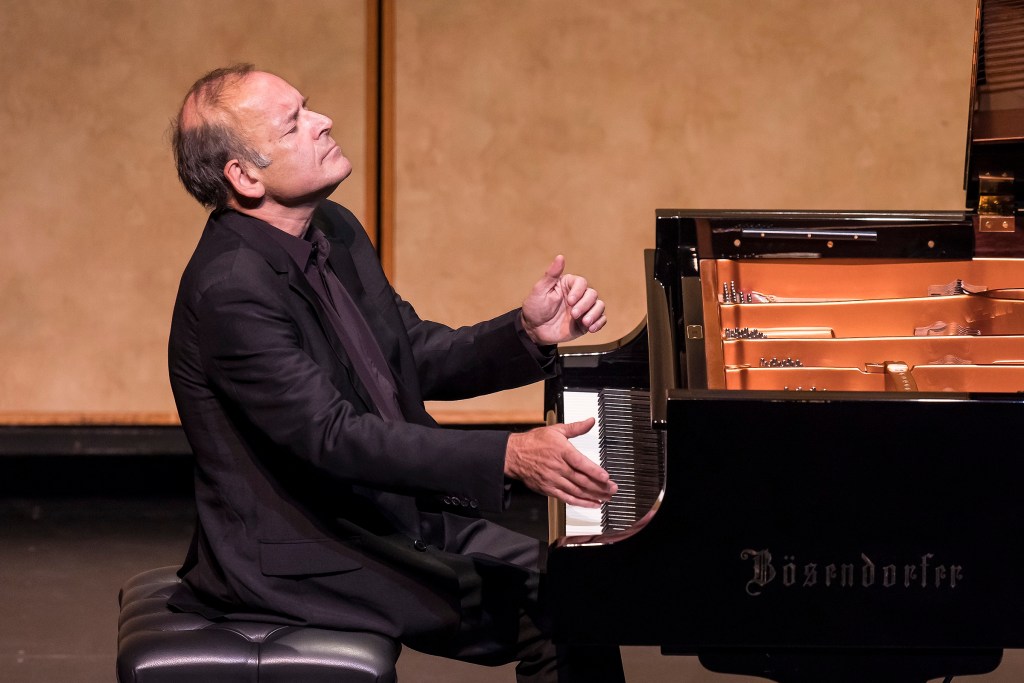
Post-intermission, after the rippling texture and windswept gusts of the compact and more openly impressionistic “Jeux d’eau,” Lortie embarked on waltz time adventures. “Valses nobles et sentimentales” is a mosaic of eight short movements, spinning off from references to Schubert and presenting an episodic range of perspectives on Ravel’s complex musical essence.
And then came the furious and mischievous masterpiece “La Valse,” both a satire and an embrace of the waltz form fading from fashion at the time of its creation (initially in 1911 and finished in 1920). It was originally an orchestra piece, heard locally in performance by the Santa Barbara Symphony in 2023. It was arranged for a piano four hands version and then compacted to a challenging solo piano work. Taking on its huddled and flailing masses of notes is a true feat for a solo pianist, but Lortie was more than up for the multitasking task.
After a relatively straightforward melody rising out of the misty opening, key centers collide and co-exist and things go awry and unravel (so to speak), but with a feeling and a purpose. The rebellious but also giddy effect is sometimes reminiscent of American proto-modernist Charles Ives’s polymorphous inventions.
With “La Valse,” despite its experimental verve, there is a certain mad glee to the enterprise, versus the stern, fierce attack mode of an avant-garde artist. There are those of us who vastly prefer Ravel’s “greatest hit,” Bolero. Could that have something to do with our mental state?
To calm the exuberant audience’s senses, Lortie returned to the stage to issue a sweet Ravel aperitif as an encore, “Ma Mère l’Oye” from his Mother Goose Suite. It was a lullaby-ish farewell even a child could love — not that “La Valse” doesn’t have a child-like abandon and appeal to all ages. In short, Lortie — and Ravel — made a potent and memorable impression.






You must be logged in to post a comment.