

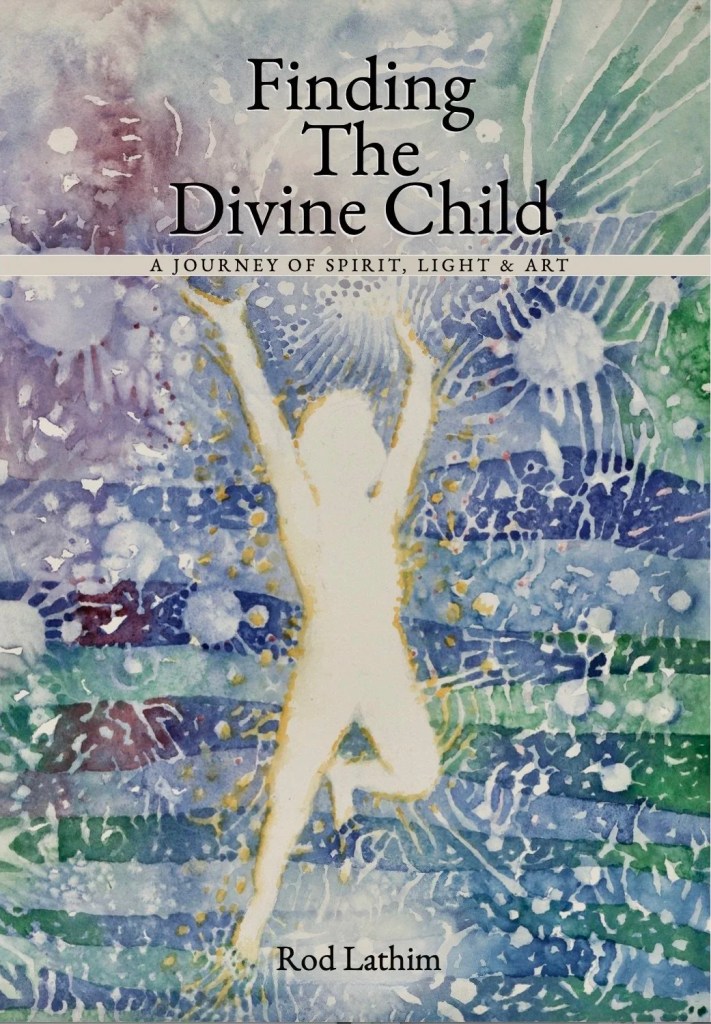
Rod Lathim is known for so many things. A medium is not one of them.
That is, until you read his memoir, Finding the Divine Child: A Journey of Spirit, Light, and Art. The director, producer, and visual artist “lifts the veil,” so to speak, on his spiritual journey with the self-published memoir where he covers his spiritual progress, beginning from his first encounter as a teen while working at The Big Yellow House to his relationship with light articulated in the physical world through his neon sculptures.
For those who have followed along on Lathim’s journey since his Access Theatre days, the memoir’s revelations might come as a surprise. But for the 60+ year old, he’s no longer concerned what others think. “At this point in my life, I want to live an authentic life. I want to be authentic, and I want to be open and honest with people about my beliefs and my experiences,” he says. “I don’t expect anybody to believe anything they don’t want to believe. But if you have had an experience, you’re going to relate to it. I’m not trying to preach my beliefs.
I’m simply saying this is my experience, and if it has any positive benefit to you in your life and your experiences, then wonderful. That’s as far as I go. But it was important for me to speak my truth.”
The beauty of this work is how it reveals all of Lathim’s layers, from his work on the stage, to his initial foray into visual art and how interwoven it all is with his spiritual world. The book takes readers through his spiritual destiny but also enlightens even the most skeptical of readers as to how important positivity, play, and gratitude can impact one’s life. It’s a central theme throughout all of Lathim’s work, particularly as it relates to his most recent solo exhibit, LIT: Love, Illumination, Transcendence, on view through March 1 at Art & Soul Gallery.
After finishing the book, I got a chance to follow up with Lathim to discuss play, staying positive, and the importance of art. This interview has been edited for clarity and length:
Explain what you mean when you talk about working to pull out someone’s divine child.
The way I approach people and problem solving tends not to be from an academic or scientific perspective. I tune into people and their energy and try to learn as much about them as I can from that exchange of energy fields. Human lives are fragile, delicate, and need to be nurtured. We need to be seen. And heard. That has been a big part of my work since my days at the University of Kansas and so many of the projects I’ve been involved with over my lifespan.
I talk a lot about the divine child in each of us. I think part of my mission on the planet is to help people find their own divine child within them and let it out to play.
The importance of play is a central theme in your book. How would you encourage someone to incorporate play into their life?
I believe we were all put here on the planet to learn, to grow, and to experience life in the physical bodies we are given. The older civilization gets, the more complicated life becomes. We are living in a time right now that is very, very challenging, chaotic, and splintered. However, one of the things that keeps me sane these days is staying true to my life’s mission and path. And for me, that means continuing to be creative and expressing myself through the arts. I do believe that the arts will help keep us sane and connected to truth. So, for me that means “playing” to the best of my ability.
Being playful can mean something as simple as sharing a smile with a stranger. It can mean finding reasons to laugh out loud. It can mean reading a great book, taking a hike, listening to music, or being pulled into a great piece of theater.
You talk in many ways about how theater can act as a healing tool. Why is it so important to have those spaces?
The arts have been central to my life. I wholeheartedly believe that arts heal us, nurture us, change us, and in some cases, save us. I have witnessed over and over and over how live theater has impacted lives and changed minds. Theater has enabled people to share their stories and impact the lives of others who relate to those stories. I’ve seen theater empower people through giving them a voice.
You write: “The active sharing of gratitude is one of the most healing tools we have.” How are you practicing gratitude right now in such difficult times?
Change is coming. And one of the best ways we can create that change is by doing good. And we can start right here, in our own neighborhoods, our own community. To look out for one another. Protect one another, speak out for one another. I spend my days … counting my points of gratitude. There is so much around us to be grateful for, and we can’t lose sight of that even in crazy, insane times like this. Make a gratitude list. Review it daily. Stay focused on the good.
Yes, it’s hard in these [times] to focus on gratitude, but it’s critically important.
Pictures make up a large portion of the book. Why was including a visual representation so important to you?
Being visual is a core element to me. [The] images in my book represent the beauty around us. The images also reflect the importance of human connection in my life. When I first visualized this book, I saw it with many, many photos. When I review my life, it’s a collage of images: of people, of moments, of joy, of sorrow.
You talk a lot about all the artforms you’ve used in your career — how did the decision come about to write a book? And again, why now, why tell these stories now?
This book has been brewing in me for a number of years. I have reached an age where I’m taking time to look back and acknowledge the patterns, the influences; connecting the dots of the people who have influenced my life and come into my path in beautiful ways. And it feels absolutely right to be writing about this now. My hope is that the book is uplifting and encouraging to its readers. I think we all need light in our lives.
Lathim will be signing his book on Saturday, February 21, from 3-6 p.m. at Art & Soul Gallery, 1323 State St., artandsoulsb.com. Books are available exclusively at Art & Soul Gallery but will be available at local retailers beginning March 1. An audiobook, narrated by Lathim, will be available in April.










You must be logged in to post a comment.