
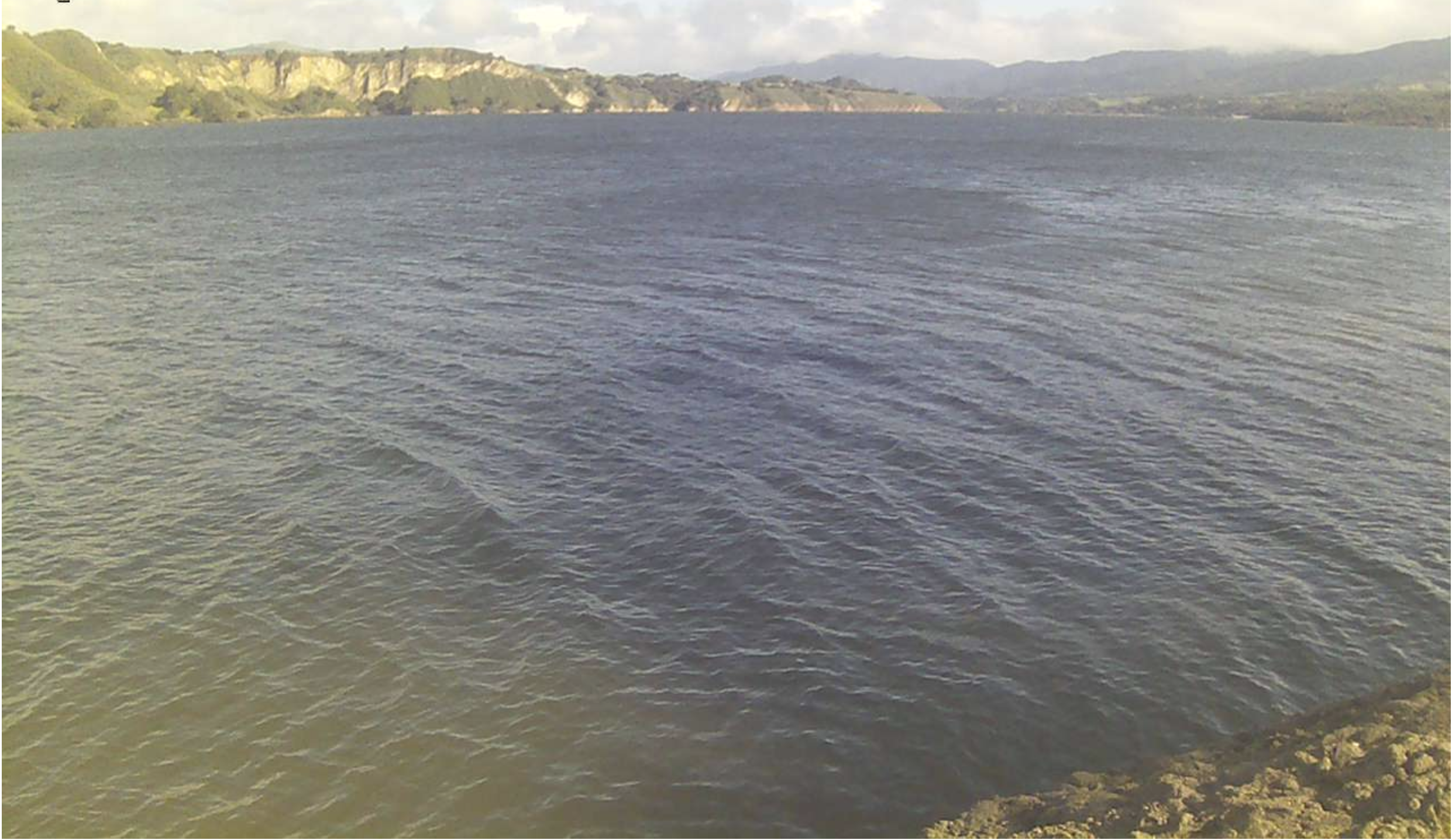
While ski resorts in Northern California are reporting five feet of snow from the weekend’s stormy weather, Santa Barbara County felt more than four inches of rainfall by a chilly Thursday morning. In terms of drought, all that snow adds to the positive water picture of county reservoirs at or more than 100 percent full.
A dry January led to a measurement of California’s snowpack of 59 percent of average at the end of the month, even after the big storms last fall. Traditionally, the heaviest snowfall drops January through March in the Sierra Nevada, where the spring runoff reserve for California mounds up during a good winter.
After February’s blizzards, the snowpack now sits at 69 percent of average, said Jason Ince of the state’s Department of Water Resources (DWR). “However, thanks to three consecutive seasons with above average or near-average precipitation — winters of 2023, ’24, and ’25 — major reservoir across the state are all well above their historical averages and water supplies are generally in positive conditions,” Ince stated.
The same is true for Santa Barbara County, which had near-record rainfall during ’23 and ’24. So far, the county’s myriad rainfall sensors put the raindrops at 192 percent of normal-to-date. In inches as of Thursday, that ranges from 9.88 inches in Cuyama to 47.58 inches at San Marcos Pass for this rain year, which runs from September 2025 to August 2026.
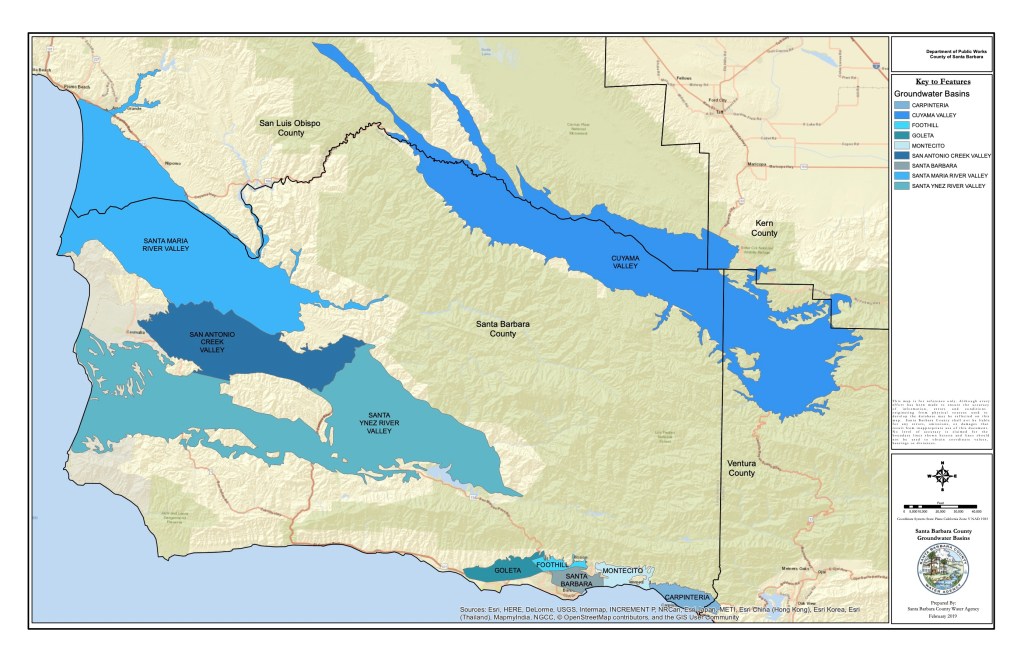
The other factor determining the county’s water picture is the levels of the groundwater basins. The DWR and the Santa Barbara County Water Agency keep tabs on wells that monitor groundwater levels as they rise and recede in about nine major basins around the county. These are as large as 319 square miles of surface area along the Santa Ynez River Valley and as small as 4.9 square miles atop the Foothill Groundwater Basin, located roughly across the southern base of State Route 154.

[Click to zoom] The state’s Department of Water Resources and the Santa Barbara County Water Agency keep tabs on wells that monitor groundwater levels as they rise and recede in about nine major basins around the county, including these five South Coast basins. | Source: Santa Barbara County 2025 Groundwater Basins Summary Report
Though some of the aquifers hold an enormous quantity of water — the capacity of some North County aquifers is measured in the millions of acre-feet — how much can be safely extracted is calibrated. Carpinteria’s groundwater basin has a capacity of about 19,000 acre-feet out of approximately 700,000 acre-feet of total storage, the DWR estimated in 1975. The city, however, reduced its annual draw to 4,000 acre-feet from 5,000 acre-feet recently to improve its water balance.
Given the county’s history of multi-year drought and massive rain dumps, the question is, how long does it take rainwater to infiltrate into groundwater? The answer depends on the geology, fault lines, and barriers among the soils and rock beds overlying the basins. According to tables published by the County Water Agency at the beginning of the water year, two or three years pass before a groundwater basin reflects the big rains.
On the other hand, the long years of drought show an effect that is complicated by groundwater extractions by hundreds of municipal, agricultural, and private wells, not all of which are recorded. The measuring of groundwater level also differs by well depths, which can be in the dozens of feet to the hundreds of feet.
The groundwater-level measurements are taken in the spring, somewhere around April Fool’s. But as of last October, the trends were upward after the long drought between 2012 and 2018 in all the South County aquifers except Montecito. Among the extremely large basins in North County, most of them have increased since the drought, but especially in the Cuyama Valley, decreased well levels occurred in varied places.
Related Posts


Premier Events

Sat, Aug 22
11:00 AM
Santa Barbara
Pacific Pride Festival 2026

Fri, Aug 21
7:00 PM
Carpinteria
Film Screening: “Thelma” – Celebrating National Senior Citizen Day

Fri, Aug 21
7:00 PM
Santa Barbara
Barrel Room Sessions ~ Van Allen Twins

Sat, Aug 22
9:30 AM
Santa Barbara
Drag Me to Pride – Celebratory Group Bike Ride

Sat, Aug 22
10:00 AM
SANTA BARBARA
Medicare 101 – Educational Workshop

Sat, Aug 22
10:00 AM
SANTA BARBARA
Medicare 101 Workshop
Sat, Aug 22
11:00 AM
Santa Barbara
Pacific Pride Festival 2026

Sat, Aug 22
1:00 PM
Goleta
SAMsARA Pours for Paws Adoption & Fundraiser

Sat, Aug 22
2:00 PM
Santa Barbara
Mosaic Magic Community Workshop

Sat, Aug 22
7:00 PM
Santa Barbara
The Rhythm Industrial Complex: Live at Buena Onda

Sat, Aug 22
8:00 PM
Santa Barbara
Teka Plays Brazilian Jazz!
Sat, Aug 22 11:00 AM
Santa Barbara
Pacific Pride Festival 2026
Fri, Aug 21 7:00 PM
Carpinteria
Film Screening: “Thelma” – Celebrating National Senior Citizen Day
Fri, Aug 21 7:00 PM
Santa Barbara
Barrel Room Sessions ~ Van Allen Twins
Sat, Aug 22 9:30 AM
Santa Barbara
Drag Me to Pride – Celebratory Group Bike Ride
Sat, Aug 22 10:00 AM
SANTA BARBARA
Medicare 101 – Educational Workshop
Sat, Aug 22 10:00 AM
SANTA BARBARA
Medicare 101 Workshop
Sat, Aug 22 11:00 AM
Santa Barbara
Pacific Pride Festival 2026
Sat, Aug 22 1:00 PM
Goleta
SAMsARA Pours for Paws Adoption & Fundraiser
Sat, Aug 22 2:00 PM
Santa Barbara
Mosaic Magic Community Workshop
Sat, Aug 22 7:00 PM
Santa Barbara
The Rhythm Industrial Complex: Live at Buena Onda
Sat, Aug 22 8:00 PM
Santa Barbara


You must be logged in to post a comment.