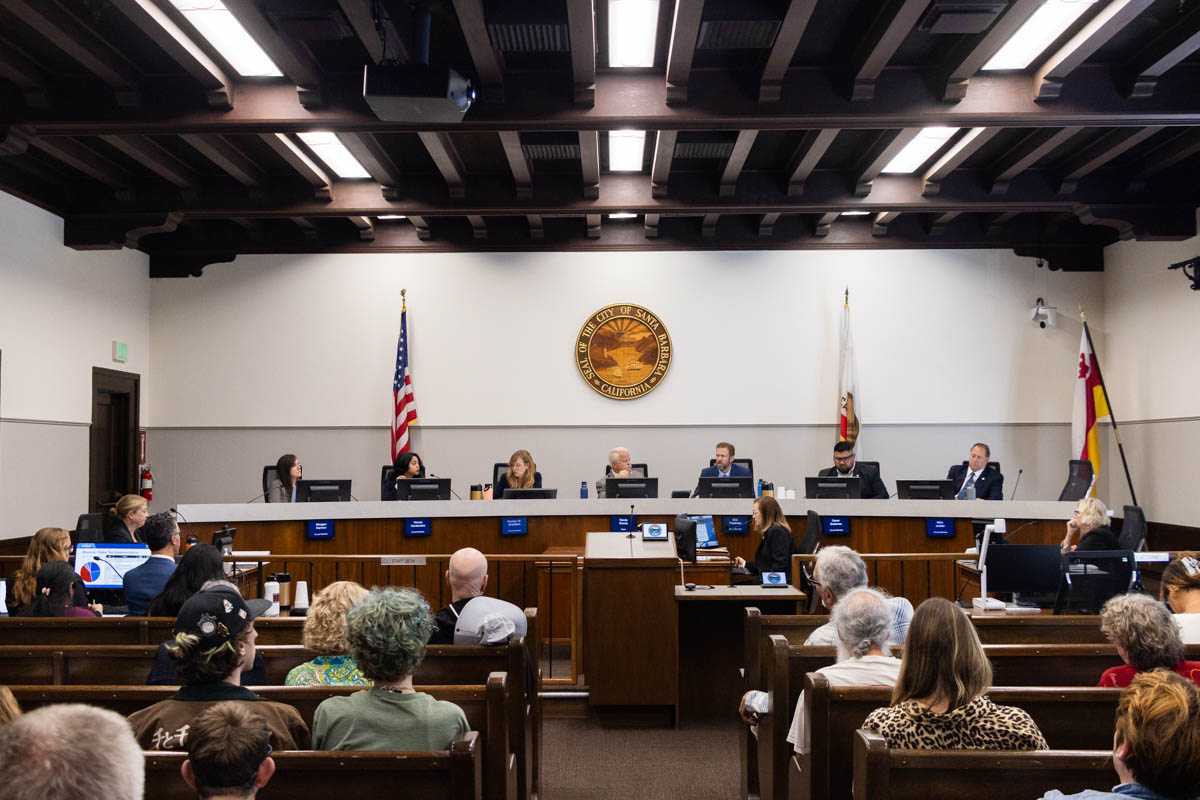
The Santa Barbara City Council received a progress report on the current eight-year Housing Element plan, which outlines how the city will accommodate the state-mandated Regional Housing Needs Allocation (RHNA) of 8,001 units before 2031. This year marked the third year of the current cycle, from 2023 to 2031, and the progress report revealed the city has reached just 10.8 percent of the total target, with a severe shortfall in the lower-income affordable housing categories.
City Planner Jillian Ferguson provided the report on Tuesday as part of an update on the progress of the city’s General Plan and Housing Element. Ferguson’s presentation included a detailed breakdown of the 863 units permitted toward the state’s target goal, nearly 80 percent of which came from “above-moderate” or market-rate units.
While the city has met the state’s requirement of zoning enough parcels to accommodate the RHNA target, the actual production of units has lagged far behind. The city must accommodate the zoning for the units, but must rely on developers to produce the units. The highest performing category over the first three years has been above moderate, with 663 units proposed, accounting for 21 percent of RHNA target of 3,032 market-rate units.
Accessory Dwelling Units (ADUs) accounted for more than half of the 255 total units permitted in 2025, with 141 ADUs receiving building permits in the past calendar year. All of the permitted ADUs have been listed for “above-moderate” rental rates.
Ferguson said the affordable housing categories are “significantly further behind,” with the amount of project proposals falling far below the state’s target of 1,381 units for low-income and 2,147 units for very-low-income in the current cycle. As of December 2025, just 93 units of low-income housing have been proposed (6.7 percent of the RHNA target), and only 38 very-low-income units, or 1.8 percent of the cycle goal.
Rob Fredericks, executive director of the Housing Authority of the City of Santa Barbara, spoke during public comment about the “huge gap” in the production of housing.
“It really gets concerning when you look at affordability,” Fredericks said. “These are not small shortfalls; there are systemic issues in delivering the housing that our community needs most.”
The council did not take action, but councilmembers commented on the shortfall and the need to incentivize the production of housing in all categories. Councilmember Kristen Sneddon said the slow-moving production in affordable housing highlighted the need for more support for the city’s housing trust fund, which could be used to build more subsidized affordable housing projects.
“I don’t think we can afford not to fund it,” Sneddon said of the city’s housing fund. “If we’re not meeting our numbers, or really addressing these issues, it seems to me that having money in that Local Housing Trust Fund is what allows us as a city — because we’re not developers — to help move that move forward.”
Mayor Randy Rowse said the city’s housing problems were complex, and said that the city needed to streamline the process for developers to give them more certainty about potential projects. He also acknowledged that affordable housing would likely have to come through subsidization. “I don’t have the answers,” Mayor Rowse said.
City officials are currently working on other aspects of the Housing Element plan, including updates to the city’s adaptive reuse program, research into an inclusionary housing or in-lieu fee program, and development of a new short-term rental ordinance.