

Good morning, Santa Barbara. Today is 4/20.
What does that mean?
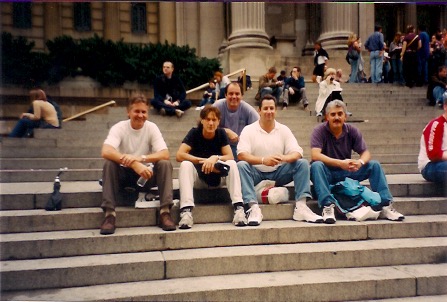
It actually comes down to a handful of boys — at the time — growing up in Marin County in the 1970s.
I had the honor of serving one of them lunch once, when he passed through town with his wife. He told me the story. I didn’t really believe him. Then he gave me his name, pointed me to the receipts, and, as it turns out, he wasn’t bullshitting me.
For decades, “420” has floated somewhere between myth and shorthand — a code, a time, a holiday, a wink. But its origin story is surprisingly intact, still tethered to five friends who used it first as a joke, then as a habit, and eventually, unintentionally, as a cultural phenomenon.
“We were just a bunch of jokesters sitting on a wall,” said Steve Capper, one of the original Waldos, a friend group of Northern California hippies. “Everything was humor. That was the whole thing.”
The wall was real — smack in the middle of campus at San Rafael High School where they went to school in the ’70s. A daily stage for running commentary, impressions, and whatever else five teenagers could spin into entertainment.
Then came the map.
A friend — not a Waldo — brought word that his brother, stationed with the Coast Guard near Point Reyes, had access to an abandoned cannabis patch. The growers, worried about getting caught, had walked away. The coordinates, loosely sketched, were up for grabs.
“We’re like, well, yeah,” Capper said. “It’s free, and it’s a lot of weed. Let’s go find it.”
They needed a time. School let out around 3:10. Practice, study hall — logistics. They settled on 4:20 p.m., meeting at a statue of Louis Pasteur in the middle of campus. “We’d remind each other all day,” Capper said. “420, Louis.”
The “Louis” didn’t last, for they never found the weed. The “420” became a part of their everyday vernacular.
The code slipped past teachers, parents, anyone not in on it. It meant everything and nothing at once: Do you have any? Are you stoned? Want to go?
“It was kind of mental telepathy,” Capper said.
The term might have stayed there — a private joke in Marin — if not for proximity. One Waldo’s father handled real estate for The Grateful Dead, placing the group in and around the band’s orbit: backstage, at rehearsals, inside a community that traveled.
“We were on the guest list,” Capper said. “Backstage, on stage, around the Dead. And we used the term 420 around that community — and that’s a worldwide community.”
From there, it spread the way things did before the internet: through people, shows, flyers, repetition. By the late ’80s and early ’90s, it had leapt from subculture to signal — a time, a date, a shared understanding.
Rolling Stone once described it as “a way to whisper one’s approval of cannabis without letting the authorities onto your actions” — a code with a built-in meeting time, easy to remember, easier to pass along.
The backdrop, of course, was less casual.
Marijuana prohibition in the United States has outlived alcohol prohibition several times over. The 18th Amendment lasted 13 years. Cannabis has been federally classified as a Schedule I substance since 1970 — a category reserved for drugs with “no accepted medical use,” alongside heroin.
California cracked that framework first, legalizing medical marijuana in 1996. Recreational use followed in 2016. Today, more than half the country has some form of legalization, though federal law remains unchanged.
Capper never set out to influence any of that.
“We weren’t activists,” he said. “But it ended up being a catalyst for legalization. It helped break stereotypes, media fear, legislation.”
The joke grew legs. Then it grew policy consequences.
These days, April 20 looks less like a secret and more like a soft holiday — parks, gatherings, a synchronized moment at 4:20 p.m. across time zones. It’s global now, exported far beyond the Marin hillside where it started.
For Capper, though, the meaning hasn’t drifted that far.
“To me and the Waldos, it’s still a funny joke,” he said. “But I just hope every year it’s a peaceful, happy day. Nothing negative.”
Pause.
“Let’s hope today’s a good day.”
Related Posts



Premier Events
Thu, Sep 17
5:30 PM
Santa Barbara
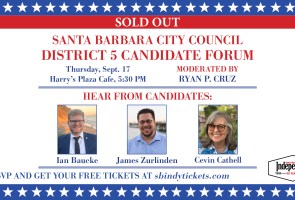
S.B. Independent: Santa Barbara City Council District 5 Forum
Thu, Sep 17
7:00 PM
Santa Barbara
Téka Brazilian Jazz at The Grand On State
Fri, Sep 18
All day
Solvang
Solvang Danish Days
Fri, Sep 18
12:00 AM
Santa Barbara
Yesterday: A Tribute to The Beatles at SOhO
Fri, Sep 18
7:00 PM
Carpinteria
West Coast Premier: “Gloria’s Old Haunt”
Sat, Sep 19
All day
Solvang
Solvang Danish Days
Sat, Sep 19
9:00 AM
Santa Barbara County
Coastal Cleanup Day
Sat, Sep 19
10:00 AM
Santa Barbara
8th Annual Santa Barbara County Farm Day
Sat, Sep 19
6:30 PM
Santa Barbara
Feng E – Teen Ukulele Sensation at SOhO

Mon, Sep 21
5:30 PM
Santa Barbara
S.B. Independent: Santa Barbara City Council District 6 Forum
Thu, Sep 17 5:30 PM
Santa Barbara
S.B. Independent: Santa Barbara City Council District 5 Forum
Thu, Sep 17 7:00 PM
Santa Barbara
Téka Brazilian Jazz at The Grand On State
Fri, Sep 18 All day
Solvang
Solvang Danish Days
Fri, Sep 18 12:00 AM
Santa Barbara
Yesterday: A Tribute to The Beatles at SOhO
Fri, Sep 18 7:00 PM
Carpinteria
West Coast Premier: “Gloria’s Old Haunt”
Sat, Sep 19 All day
Solvang
Solvang Danish Days
Sat, Sep 19 9:00 AM
Santa Barbara County
Coastal Cleanup Day
Sat, Sep 19 10:00 AM
Santa Barbara
8th Annual Santa Barbara County Farm Day
Sat, Sep 19 6:30 PM
Santa Barbara
Feng E – Teen Ukulele Sensation at SOhO
Mon, Sep 21 5:30 PM
Santa Barbara


