
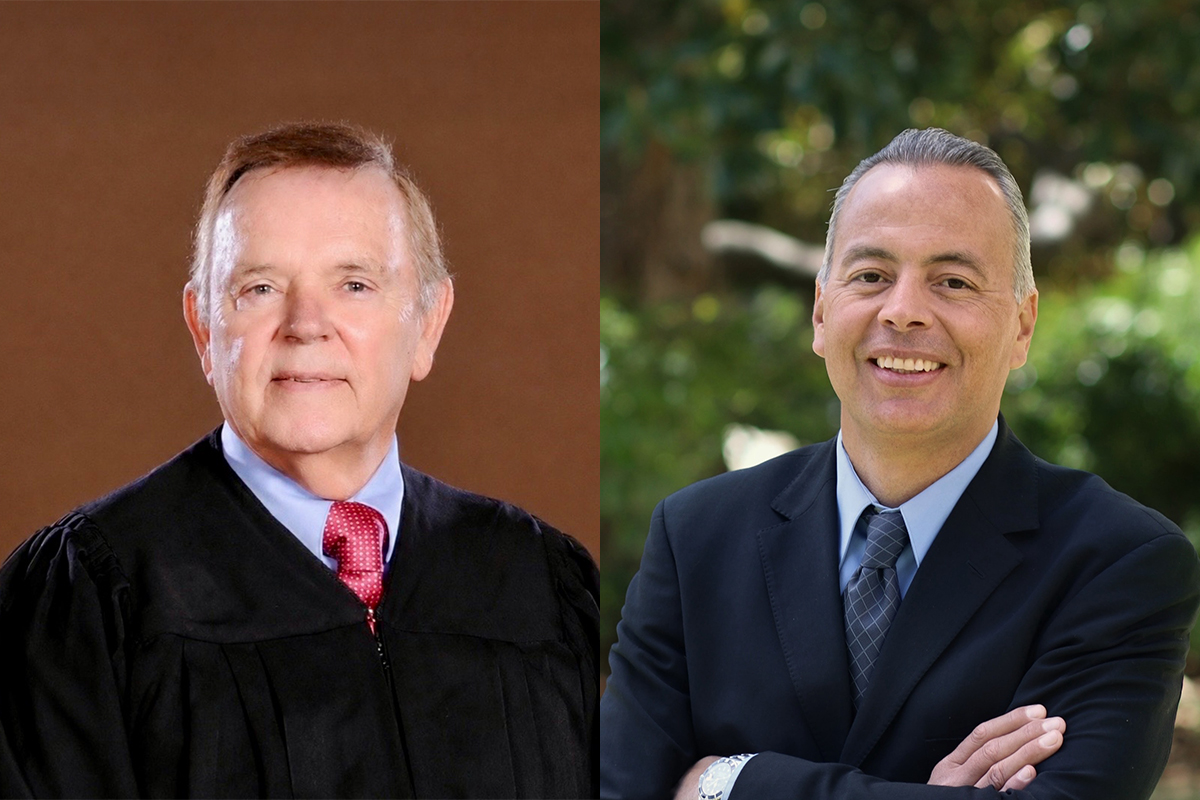
Before he became a judge, Thomas Adams was the lead singer and bass player of the hit folk band The Wayfarers. It was the early 1960s, and the group had just signed with RCA Records and appeared on The Ed Sullivan Show when they went on tour in the Jim Crow South.
There they encountered segregated bathrooms and drinking fountains and what Adams called the “rampant racism” of the region. He remembers storming out of a diner that had given “special” menus to a young Black couple sitting next to him ― a bottle of Coca-Cola was listed for $35, and hamburgers were $120.
“That was my first-ever taste of what I thought was just total unfairness,” Adams said. “I had no idea at the time how that would stay with me year after year after year and affect me to this day.”
Seeking to inject a bit more justice into the world, Adams went on to attend law school, and in 1982, he was appointed by Governor Jerry Brown to be a Santa Barbara Superior Court judge. Over his four-plus decades on the bench, Adams has presided over tens of thousands of cases, from family law matters to grisly murder trials, including the county’s last death penalty case. He’s seen it all.
But this election season, Adams, 85, is facing something new: a challenge to his position. Private attorney Luis Esparza, 46, is running to replace Adams in an extremely rare race that is also seen as a referendum on the racial and generational makeup of Santa Barbara’s judiciary.
In California, Superior Court judges are elected by county voters for six-year terms. If a judge retires, passes away, or vacates their seat in the middle of their term, the governor will appoint a replacement, who must then attempt to retain their seat in the next election.
But far more often than not, and for a number of reasons ― rigorous prerequisites, demanding schedules, and salaries that are often below what attorneys make ― judges run their races unopposed. If no candidate files papers to challenge a sitting judge, the item doesn’t even appear on the ballot.
***
In his 22 years of practice, Esparza has always gone it alone. Instead of joining a big law firm after earning his JD, as many of his USC classmates did, he returned to his hometown of Santa Barbara to build his own business. He doesn’t have partners and, unless he’s preparing for trial, employs no paralegals.
Esparza is bilingual and legally ambidextrous with a range of experience in the criminal, civil, business, estate planning, and probate realms, including highstakes cases involving childhood sexual abuse victims. Ethically, Esparza stresses client-first representation, strict confidentiality, and a willingness to forego self-promotion and profit. He said he’s proud to have “prioritized my moral compass over my pocketbook” throughout his career.
Whereas Adams is a hail-fellow-well-met type, prone to lengthy stories about his life and career, Esparza is reserved and succinct. The son of a concrete mason who modeled hard work, he said his public-service ethos came from his three older sisters ― a teacher, law enforcement officer, and city employee.
Esparza said it’s time for a greater diversity of background and perspective in Santa Barbara Superior Court. He’d like to see its demographics better match the county’s and has ideas to make the system, which is chronically backlogged with cases, run more efficiently. He suggested creating a dispute-resolution “pit stop” to divert potential litigants from filing lawsuits and called for fewer continuances in arraignment court, over which Adams currently presides.
Esparza also said the courts would benefit from more judges coming from private practice, noting that recent gubernatorial appointments, despite rhetoric about a need for professional diversification, have largely drawn from county counsel and public defender offices. Politically, Esparza has been registered “no party preference” since he was 18 and emphasized that trial court judgeships ought to be “truly nonpartisan.”
While Esparza is focusing his campaign on institutional change rather than individual failings, he cited a recent incident involving Adams and a young defense attorney that he said should give voters pause. In 2024, the California Commission on Judicial Performance publicly admonished Adams for yelling at the attorney in frustration and throwing a stack of papers at her.
Adams tells it differently. He says while he was indeed engaged in spirited debate, he dropped the papers from his podium believing there was a table underneath to catch them. Instead, they scattered to the floor. Adams said he immediately wrote letters of apology to both counsels, citing personal stressors (a hospitalized son and the family dog being euthanized that morning), and later developed a friendship with the attorney, including offering her private space in his chambers after she disclosed to him her sudden-onset deafness and the use of hearing aids.
The admonishment in that case was partly influenced by a previous disciplinary action, the Commission noted. In 2023, Adams was cited for comments “that could be perceived as bias, prejudice, or harassment based on sex or gender.”
***
Adams has frequently been asked why, after a lifetime of otherwise respected service, he hasn’t chosen to hang up his robe. “I’ve given real prayerful thought to that, and the answer is I love, love, love what I’m doing,” he said. He believes he can continue to “be the difference” in people’s lives, particularly in his arraignment court.
Adams highlighted small, concrete acts — such as arranging to store a probation violator’s only possession, a 10-speed bicycle, in his chambers during a 30-day jail term — as emblematic of his “golden rule” approach to judging. He also framed his work around Gandhi’s maxim “Be the change that you wish to see in the world,” which he recites daily, and emphasized treating defendants with patience, dignity, and eye-to-eye human connection, including people struggling with addiction and homelessness.
Adams has amassed a lengthy list of endorsements, including a number of current and former judges, Supervisor Laura Capps, Sheriff Bill Brown, and many of Santa Barbara’s top attorneys. They reference how he created the county’s first night court to accommodate working people and started a local Teen Court, a youth diversion program for teens facing first-time misdemeanors and school code violations in which they appear before a jury of their younger peers.
Esparza doesn’t take away from Adams’s achievements or his impressive tenure in a high-pressure job. But as Santa Barbara’s judiciary continues to get older ― two more judges are in their eighties, with three more hitting retirement age ― he feels the time is ripe for new blood. If he succeeds, he said, “it would be arguably unprecedented and historically significant.”
“I know contesting a longtime, highly respected judge isn’t for the faint of heart,” he said. “And it has nothing to do with Judge Adams personally. It’s just time for a change. It’s come. Change is in the air.”
Related Posts




Premier Events

Sat, Oct 03
9:00 AM
Santa Barbara
Fall Plant Sale and Master Gardener Workshop

Sat, Oct 03
7:00 PM
Santa Barbara
Clean Comedy at Carrillo Recreation Center
Sat, Nov 14
7:00 PM
Santa Barbara
Clean Comedy at Carrillo Recreation Center
Sat, Dec 05
7:00 PM
Santa Barbara
Clean Comedy at Carrillo Recreation Center

Fri, Oct 02
5:30 PM
Santa Barbara
Pet Blessing at Trinity Episcopal Church

Fri, Oct 02
8:00 PM
Santa Ynez
Comedian Ron White Performs at Chumash Casino Resort

Sat, Oct 03
9:00 AM
Goleta
Out of the Darkness Suicide Awareness Walk

Sat, Oct 03
10:00 AM
Santa Ynez
Chumash Intertribal Powwow Returns

Sat, Oct 03
10:00 AM
54th Santa Barbara Old -Time Fiddlers’ Festival

Sat, Oct 03
11:00 AM
Santa Barbara
OktoBEERfest at Dutch Garden Restaurant!

Sat, Oct 03
12:00 PM
Santa Barbara
Reclaim Your Radiance Fall 2026 Healing Arts Faire

Sat, Oct 03
12:00 PM
Santa Barbara
CWC Docs: “SURFILMUSIC” (2026)

Sat, Oct 03
2:00 PM
Santa Barbara Public Library
S.B Voting Rights and Election Protection Forum: How You Can Get Involved

Sat, Oct 03
4:00 PM
Santa Barbara
42nd “Sips & Ships” Wine Tasting & Yacht Tour Fundraiser
Sat, Oct 03 9:00 AM
Santa Barbara
Fall Plant Sale and Master Gardener Workshop
Sat, Oct 03 7:00 PM
Santa Barbara
Clean Comedy at Carrillo Recreation Center
Sat, Nov 14 7:00 PM
Santa Barbara
Clean Comedy at Carrillo Recreation Center
Sat, Dec 05 7:00 PM
Santa Barbara
Clean Comedy at Carrillo Recreation Center
Fri, Oct 02 5:30 PM
Santa Barbara
Pet Blessing at Trinity Episcopal Church
Fri, Oct 02 8:00 PM
Santa Ynez
Comedian Ron White Performs at Chumash Casino Resort
Sat, Oct 03 9:00 AM
Goleta
Out of the Darkness Suicide Awareness Walk
Sat, Oct 03 10:00 AM
Santa Ynez
Chumash Intertribal Powwow Returns
Sat, Oct 03 10:00 AM
54th Santa Barbara Old -Time Fiddlers’ Festival
Sat, Oct 03 11:00 AM
Santa Barbara
OktoBEERfest at Dutch Garden Restaurant!
Sat, Oct 03 12:00 PM
Santa Barbara
Reclaim Your Radiance Fall 2026 Healing Arts Faire
Sat, Oct 03 12:00 PM
Santa Barbara
CWC Docs: “SURFILMUSIC” (2026)
Sat, Oct 03 2:00 PM
Santa Barbara Public Library
S.B Voting Rights and Election Protection Forum: How You Can Get Involved
Sat, Oct 03 4:00 PM
Santa Barbara

