
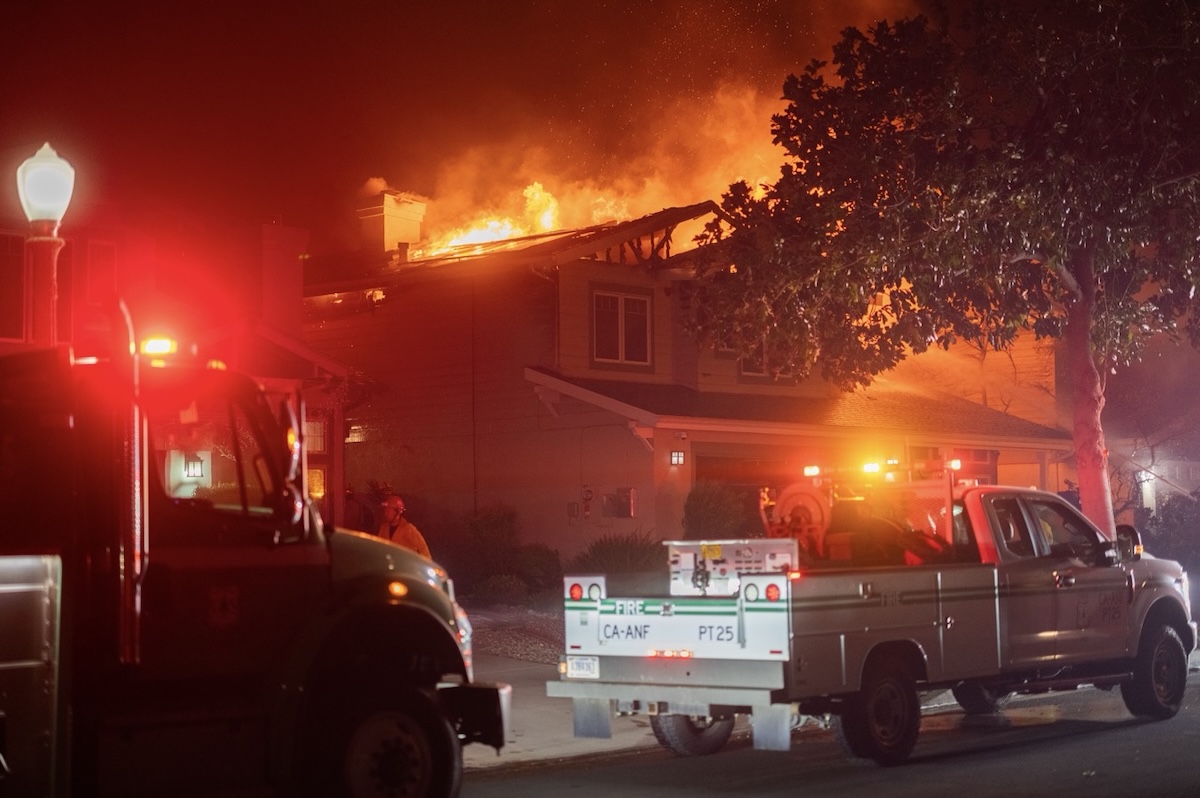
When the Eaton Fire broke out at 6:11 p.m. on January 7, 2025, Los Angeles firefighters were already contending with the Palisades Fire, which had started at 10:20 that morning and quickly expanded more than 200 acres. When he heard the callout for Eaton that evening, L.A. County fire investigator Captain Rick Yartz made his way to the command post in Altadena and was introducing himself to the battalion chief within the hour. Early the next morning, he and the other investigators were hiking into Eaton Canyon to begin assessing the electrical transmission towers that Altadena residents described arcing just before flames were seen glowing in the chaparral.
Yartz’s step-by-step account is related in the initial investigation report of the Eaton Fire, which was released on May 22, 2025. His supplemental report came out on July 22 after equally detailed examinations were made of spherical globs of metal that Yartz and a number of investigators found on and at the base of a tower in the canyon. One of those examinations was an x-ray diffraction analysis conducted by a research company in Goleta, which helped investigators find that Southern California Edison equipment was the source of the Eaton Fire. In the report, the Goleta company’s name is redacted.
Edison has stated that it agrees its equipment may have started Eaton Fire. Prefacing his remarks by saying, “Our hearts are with the Altadena community,” Edison spokesperson David Eisenhauer said, “We have taken our potential role in the start of this fire seriously from the beginning. As we’ve previously said, SCE believes that it is likely that its equipment was associated with the ignition of the Eaton Fire.” The company has established a Wildfire Recovery Compensation Program that it claims is “comparable to settlements reached in past wildfire litigation.”
Nineteen people died in the Eaton Fire, which consumed more than 14,000 acres of the San Gabriel Mountains and blew into the cities of Altadena and Pasadena. Embers were flying two miles, driven by forceful Santa Ana winds onto a landscape parched for rain. More than 9,400 structures were destroyed and more than 1,000 damaged. The fire burned for 24 days. Thousands of people were and remain displaced from their homes.
As smoke and ash were falling, an interview team talked with residents close to the ignition spot. One described seeing the fire start and showed them video of “two bright blue and white flashes … An orange glow is seen as if it were dripping fire or glowing material … towards the ground.” He had set up a camera to watch to the north of his home after 1993’s Kinneloa Fire, which cost three people their lives.
The group of five “origin and cause” investigators from CalFire and L.A. County Fire soon headed into Eaton Canyon, examining the pattern and direction Eaton Fire took, slowly notating their way to the towers in question. They spent a week and a half searching the area, using their eyes, experience, metal detectors, and magnets, putting into evidence boxes “a beaded metallic-like substance” found on a tower frame and other bits of metal.
In an electrical arc of a high-voltage transmission line, the energy released is fearsome, one that would melt metal. Linking the silver-colored blobs to Edison’s equipment is no doubt what the x-ray diffraction examination in Goleta and metallurgy test in Signal Hill were for, but citing pending litigation and continuing investigations, CalFire and L.A. County Fire would not identify the companies involved in the testing beyond their locations. Nor would they release their reports. The metal failure analyses were finalized a few days after the investigation report was released, an odd sequence of events L.A. County Fire was not able to explain before deadline.
The testing was no simple matter, the supplemental report describes. Gross examinations of the tower and equipment attached to it started in July, but they wanted to do an electron microscope scan. The piece of evidence was so large that the closest scanner big enough was in Bowling Green, Kentucky. The exam took place in late December, and the tower was then returned to a warehouse in Azusa, California, with the chain of custody maintained along the way, Yartz reported.
The electrical power had surged and flickered before the fire, according to several residents. As well as examining the fire-origin site and describing people they’d encountered — including an Edison vice president, New York Times reporters, and a closely hovering helicopter — the investigators also described a tour of an Edison substation in Eagle Rock, five miles away.
One of the towers at Eagle Rock was the last in the Mesa-Sylmar circuit, the same set of transmission lines implicated in the Eaton Fire. It was out of service, but a connecting line had suffered faults around the time of the fire. A fault can occur for any number of reasons — a tree branch on the line, a buildup of dirt and dust, the effects of high winds — but the system automatically starts and stops to re-energize the line in case the fault is just a transitory one. Though this line ended up de-energized, the interaction of a fault, a line without power, and an electrical arc is still being looked into, Eisenhauer said.
For now, the investigation team believes the electrical arc formed on an out-of-service Edison tower, Captain Yartz wrote. “These arcing events ejected hot metal particles that fell to the receptive fuel beds consisting of dry vegetation below … causing the Eaton Fire,” he concludes.
Related Posts

Premier Events
Tue, Sep 22
1:00 PM
Santa Barbara
“The Lost Weekend” – The Photography of May Pang

Wed, Sep 23
7:30 PM
Ojai, CA
Laurie Anderson at the Libbey Bowl

Thu, Sep 24
5:30 PM
Santa Barbara
Book Talk and Reception: Annabelle Gurwitch on Her New Memoir
Thu, Sep 24
7:30 PM
Santa Barbara
SB Blues Society Presents Nick Moss Band w/guest

Fri, Sep 25
3:00 PM
Santa Barbara
Family Movie Night at the Eastside Library: “Encanto”
Fri, Sep 25
7:00 PM
Santa Barbara
Patio Sessions at Carr Winery Presents: The Genuine Article

Mon, Sep 28
5:30 PM
Santa Barbara
S.B. Independent: Santa Barbara City Council District 4 Forum

Tue, Sep 29
7:00 PM
Santa Barbara
Birds of California’s Channel Islands – Lecture and Book Signing

Wed, Sep 30
12:00 PM
Santa Barbara
Origins of Fashion in France: Zoom Lunch & Learn

Wed, Sep 30
5:30 PM
Santa Barbara
S.B. Independent: Santa Barbara City Mayoral Forum
Tue, Sep 22 1:00 PM
Santa Barbara
“The Lost Weekend” – The Photography of May Pang
Wed, Sep 23 7:30 PM
Ojai, CA
Laurie Anderson at the Libbey Bowl
Thu, Sep 24 5:30 PM
Santa Barbara
Book Talk and Reception: Annabelle Gurwitch on Her New Memoir
Thu, Sep 24 7:30 PM
Santa Barbara
SB Blues Society Presents Nick Moss Band w/guest
Fri, Sep 25 3:00 PM
Santa Barbara
Family Movie Night at the Eastside Library: “Encanto”
Fri, Sep 25 7:00 PM
Santa Barbara
Patio Sessions at Carr Winery Presents: The Genuine Article
Mon, Sep 28 5:30 PM
Santa Barbara
S.B. Independent: Santa Barbara City Council District 4 Forum
Tue, Sep 29 7:00 PM
Santa Barbara
Birds of California’s Channel Islands – Lecture and Book Signing
Wed, Sep 30 12:00 PM
Santa Barbara
Origins of Fashion in France: Zoom Lunch & Learn
Wed, Sep 30 5:30 PM
Santa Barbara

