

2025 saw Santa Barbara’s real estate market continue to defy gravity. Prices climbed, sales increased, and buyers continued competing for homes in one of California’s most desirable communities. Twelve months later the picture is more complicated, and the numbers tell an interesting story.
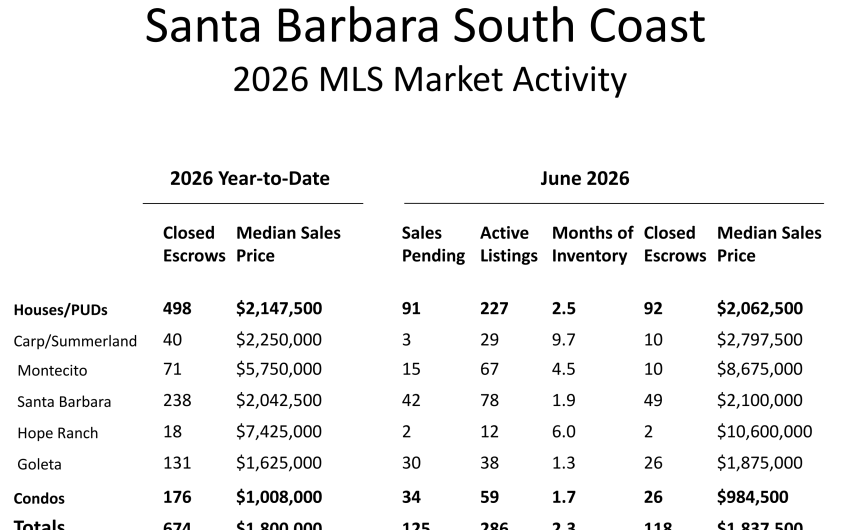
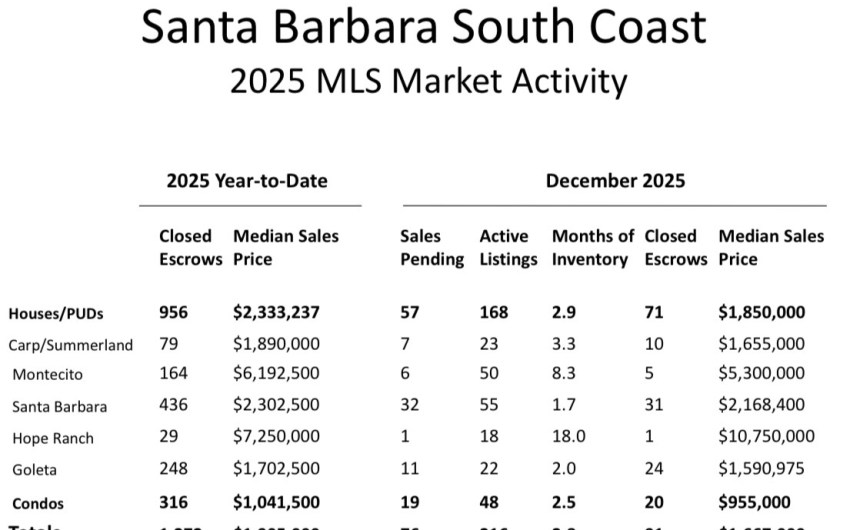
Through September 2026, South Coast home sales increased 8.5 percent over last year, with 769 homes changing hands. Yet the median sales price declined 11.4 percent to $2,115,000. Excluding Montecito and Hope Ranch, the decline was a more modest 6 percent to $1,900,000. Condominium sales increased 10.2 percent, while their median price remained virtually unchanged.
The Story Behind the Numbers
How can more homes be selling while median prices are falling? A closer look at the types of properties changing hands offers an important explanation.
A stabilizing interest rate environment through mid-2026, finally enticed long sidelined buyers back into the market, particularly in the lower-to-middle price tiers. This unleashed a wave of pent-up demand for entry-level single-family homes and condominiums, shifting the overall mix of what actually sold. Comparing the twelve months ending September 30, 2025, with the following 12 months ending September 30, 2026, reveals the significant shift in the composition of home sales. The number of home sales priced below $2 million increased from 34 percent to 46 percent of all transactions, a substantial 12-percentage-point gain. Transactions between $2 million and $5 million declined from 46 percent to 38 percent, and those above $5 million fell from 20 percent to 16 percent.
Interestingly, and by comparison, total dollar sales volume tells a somewhat different story. Properties below $2 million increased their share from 14 percent to 20 percent, while those between $2 million and $5 million declined from 37 percent to 32 percent. Yet homes above $5 million continued to account for nearly half of all sales dollars, 49 percent in 2025 and 48 percent in 2026. So, while transactions have shifted toward lower-priced properties, luxury homes continue to represent nearly half of the market’s total dollar volume.
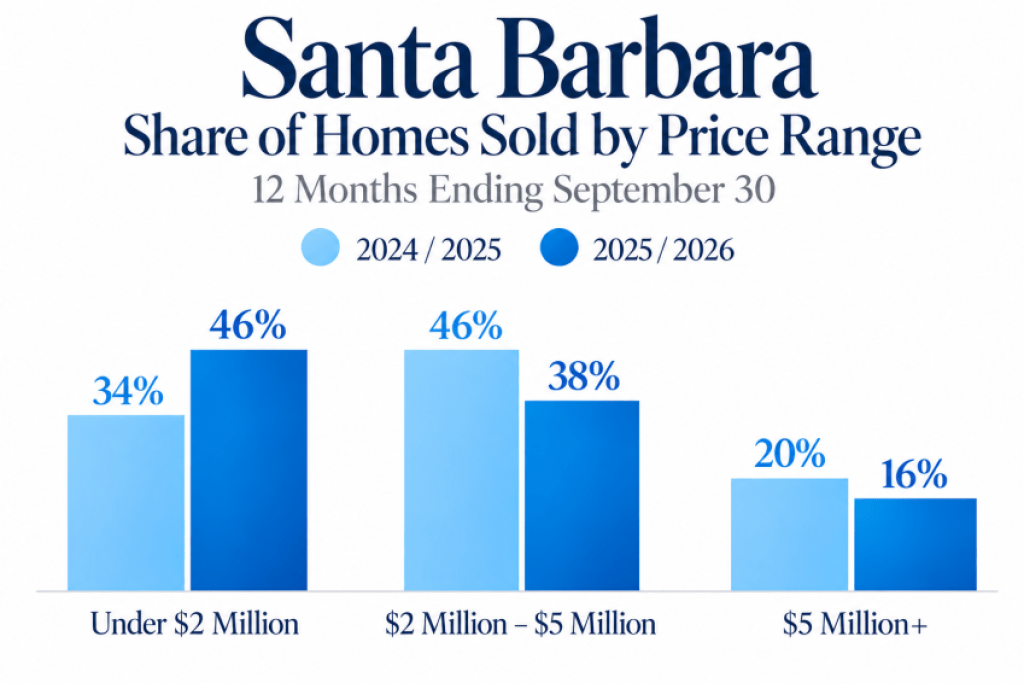
Why does this matter? The median sales price represents the midpoint of all transactions, not the change in value of any particular property. When a larger proportion of sales occurs at lower price points, the median can decline even if comparable homes haven’t experienced equivalent depreciation. That doesn’t mean prices aren’t softening. They are. But the reported 11.4 percent decline in the overall median should not be interpreted as an 11.4 percent loss in property values, in general.
What we’re seeing on the ground reinforces this distinction. Well-priced, beautifully updated homes in desirable locations still attract multiple offers and sell above asking price. Meanwhile, properties requiring substantial improvements, offering less than desirable locations or finishes, or carrying unrealistic asking prices at the start are more likely to linger on the market and require reductions. In short, as prices are softening, we are seeing the market become increasingly selective rather than declining uniformly. And that selectivity is an important reminder that even a market as desirable as Santa Barbara responds to changing economic conditions.
Insulation Is Not Immunity
The 2008 financial crisis is a prime example that our market is not immune to corrections. While it’s true that local demand and limited housing supply continue to provide support to our local housing market, the economic pressures affecting real estate nationally cannot be dismissed. The lesson worth remembering is that shifts in buyer confidence, inventory, and sales activity often precede more pronounced changes in reported prices. Although today’s market is showing signs of softening rather than the widespread weakness seen in the rest of the country, continued economic uncertainty could place additional downward pressure on home prices.
National Pressures, Local Consequences
Inflation, borrowing costs, and economic uncertainty remain significant obstacles to housing affordability. As of October 15, Freddie Mac reported an average 30- year fixed mortgage rate of 7.40 percent, compared with 6.27 percent one year earlier. On a $1 million mortgage, monthly principal and interest at 6 percent would be approximately $5,996. At 7.40 percent, that payment rises to $6,924, nearly $930 more each month, or over $11,100 annually. For buyers already stretching to enter the market, the difference is substantial. And the higher financing costs can influence how much buyers are willing or able to offer.
International conflicts, tariffs, labor shortages, rising construction costs, and political uncertainty create additional pressures which affect consumer confidence and long-term financial decisions.
Further Challenges Closer to Home
Santa Barbara County unemployment increased from 3.7 percent in May of this year to 4.6 percent in August, according to the Pacific Coast Business Times.
Meanwhile, recent significant changes in local housing regulations could affect investment decisions and property values. On October 6, Santa Barbara’s City Council adopted rent-stabilization rules limiting annual rent increases to 60 percent of CPI or 3 percent, whichever is lower. The city announced its 2027 allowable rent increase is 2.2 percent, compared with the current statewide AB 1482 cap of 8.6 percent. For a property renting at $5,000 monthly, that’s an increase of $110 per month under Santa Barbara’s rules versus $430 per month under the statewide cap — a $3,840 annual difference. For owners facing increasing insurance, maintenance, and operating costs, limits on rental-income growth may influence investment returns and, ultimately, property values.
The Council also advanced short-term rental regulations on October 6, with final adoption scheduled for October 27. These addresses where vacation rentals and home-shares may operate and will further limit short term rentals in Santa Barbara. Like the new rent rules the short-term rental regulations will likely impact investment returns and ultimately property values.
Both city initiatives are intended to improve housing availability and affordability. Their long-term effects, however, remain to be seen.
When Weather Becomes a Real Estate Consideration
The National Oceanic and Atmospheric Administration (NOAA) anticipates a strong El Niño this winter, increasing the likelihood of wetter-than-average conditions on the South Coast. Although damaging storms are not inevitable, the forecast makes preventive maintenance particularly important.
Roofs, gutters, window seals, and drainage systems deserve attention. Water intrusion can damage stucco, framing, and foundations, often before problems become apparent. With buyers increasingly attentive to property condition and potential repair costs, addressing maintenance concerns before listing can strengthen a seller’s negotiating position.
The Next Chapter: What Will Shape 2027?
Santa Barbara’s limited supply, lasting desirability, substantial homeowner equity, and significant share of all-cash transactions remain important strengths, and I don’t believe a dramatic correction is imminent. But neither should we assume our market is insulated from broader economic realities. The increase in sales demonstrates that buyers remain willing to act when they recognize value. The difference today is that value requires more careful consideration.
For sellers, successful outcomes increasingly depend on realistic pricing, strong presentation, and an understanding of truly comparable sales—not yesterday’s expectations.
For buyers, moderating prices and changing market conditions may create opportunities to negotiate purchase prices, repairs, financing assistance, and terms that were difficult to obtain during the pandemic boom.

For investors and property owners, evolving regulations make it increasingly important to assess income potential, expenses, and alternative ownership strategies. The emergence of TIC’s (Tenancies-in-Common) on the South Coast may help multifamily owners unlock property value while creating more accessible opportunities for first-time buyers and downsizers (scan the QR code below to learn more about TIC’s).
Real estate has long been an important vehicle for building generational wealth. Its greatest opportunities often belong to those who understand changing conditions rather than simply expecting the past to repeat itself. In a market where conditions are no longer moving uniformly upward, the experience and judgment of a knowledgeable local Realtor becomes especially valuable. Neighborhood trends, individual property characteristics, financing, and regulations can make the difference between a missed opportunity and a well-informed decision.
Perhaps Santa Barbara’s next chapter won’t be defined by how quickly prices rise, but by how thoughtfully buyers, sellers, and investors recognize — and respond to — the opportunities ahead.
Data for this article was compiled by the Santa Barbara Multiple Listing Service and analyzed by members of the Statistical Review Committee of Santa Barbara Association of Realtors. Writer Annette Vait is a seasoned Real Estate Broker-Associate at Berkshire Hathaway HomeServices California Properties. Reach Annette at (805) 886-1926 or AnnetteVait@BHHSCal.com










You must be logged in to post a comment.