

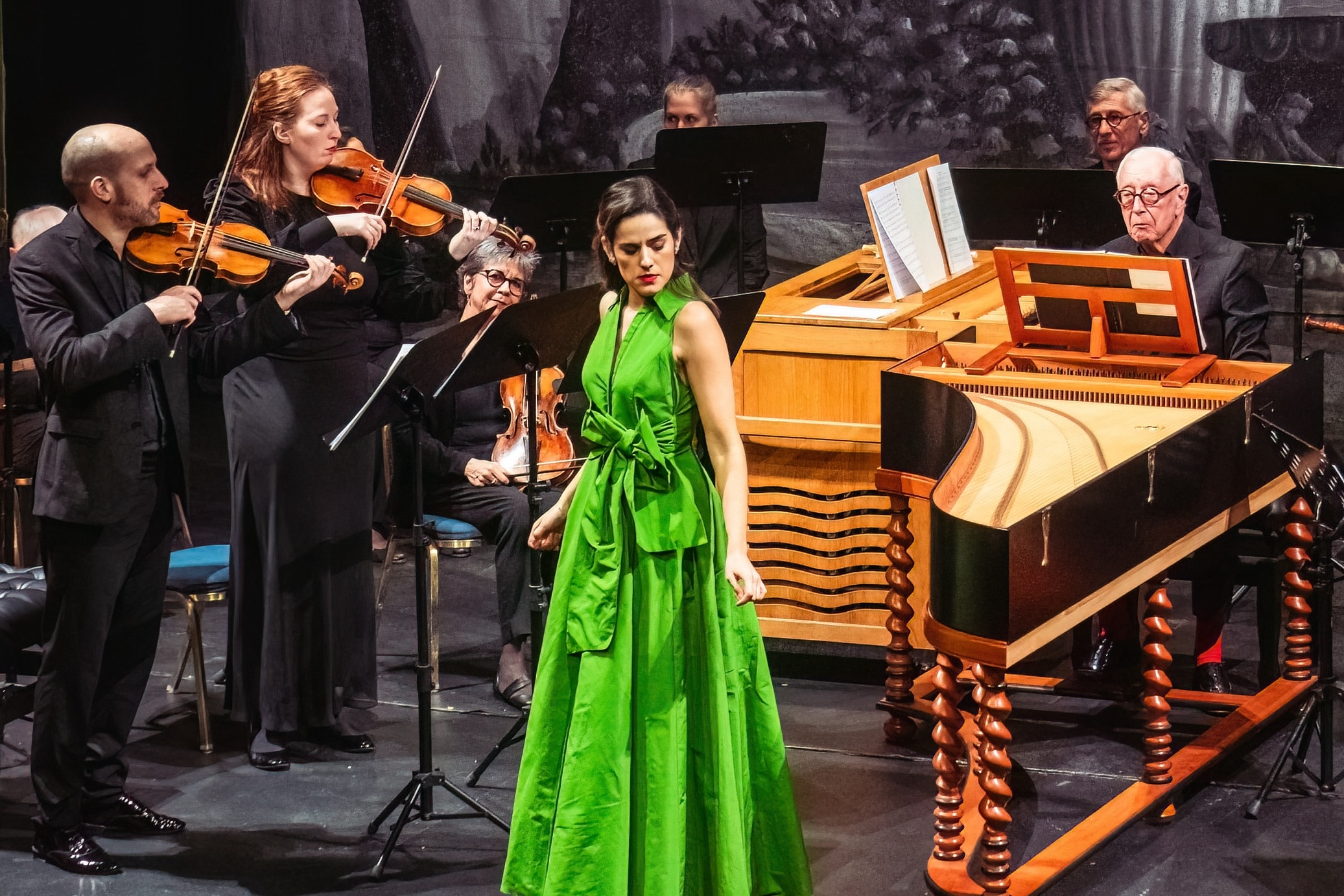
Baroque music of a high order has been sneaking into the 805 ear-space this fall. Two weeks ago, the Santa Barbara Master Chorale devoted its program to one of Britain’s towering but currently too-rarely performed composers, Henry Purcell — in the cheekily branded concert “Purcell-a-palooza.” The Baroque-centric “palooza” spirit continues on Sunday, November 15 at the Lobero Theatre, when the spotlight turns to another 17th-century master, the Italian composer Claudio Monteverdi, credited with virtually inventing opera in the modern sense.
The all-Monteverdri program comes to us in good and reputable hands, via the French early music group Les Arts Florissants, as part of the classical component of UCSB Arts & Lectures’ season.
Dating back to its founding by conductor William Christie in 1979, and with an extensive discography going back to 1982 up through this year’s release Bach: Kothen, a life in music vol. 3 (hear here), Les Arts Florissants has become one of classical music’s most renowned champions of the Baroque music cause. Centered in the Philharmonie de Paris, the group takes its moniker from Marc-Antoine Charpentier’s opera Les Arts Florissants, written in 1685.
Christie is still centrally involved in the group as artistic director, although he shares leadership duties with British tenor Paul Agnew. In addition to its regular performance and touring life, the ensemble performance space, the extravagant garden on an estate in Thiré, in the Vendée, which Christie became obsessed with and, in 1985, created a garden environment now given the imprimatur as a “Remarkable Garden” and place in the Inventory of Historic Monuments. The ensemble performs in this lavish English garden, amid the topiary and manicured modules and mazes, as part of its overall aesthetic routine.
As a novel addendum to the Santa Barbara stop by Les Arts Florissants, the Santa Barbara Botanic Garden was the site of a Baroque garden party in late October, dubbed Musique au Jardin, with music — Baroque, naturally — provided by Les Plaisirs Champêtres.
Now Les Arts Florissants has its programmatic sites set on Monteverdi (1567-1643), viewed as a vital link in the bridge between the Renaissance to the Baroque period of the 17th century. Although much of his actual music is lost to the world, his trove of existing scores includes a large number of madrigals (the source of the group’s current tour and its Lobero stopover).
On a larger scale, he also is known for such epic liturgical collections as Vespro della Beata Vergine (Vespers for the Blessed Virgin) and three operas, the popular L’Orfeo, and later Il ritorno d’Ulisse in patria and L’incoronazione di Poppea. Polished instrumental and choral forces will converge at the Lobero, over the course of a dozen madrigals.
Agnew, who organizes and directs the Monteverdi program, pointed out the visionary nature of the composer’s achievements, and what makes his music a pivotal source of inspiration, even four centuries later.
In an interview, he noted that “there’s a moment, about halfway through Monteverdi’s book five (of madrigals), where he introduces the continuo of the harpsichord. Once you get the harpsichord, you can have just one singer singing. And once you have one singer singing, then you can have one singer replying to another singer. And that’s really the birth of dramatic music.”
In Monteverdi’s music, he asserted, “all the secrets are there. If you’re going to interpret Bach or Handel, you can apply all of those rules which start at the beginning of the 17th century to everything you do afterwards. All the secrets are already there in Monteverdi.”
To coin and borrow a phrase, the Lobero show might be called a “Monteverdi-a-palooza.”
Info here.
Related Posts



Premier Events
Sat, Nov 07
10:00 AM
Santa Barbara
11th Annual Santa Barbara Mural Bike Ride
Sat, Nov 07
10:00 AM
Carpinteria
Carpinteria Arts & Crafts Faire

Sat, Nov 07
10:30 AM
SANTA BARBARA
New Parent Resource Fair with SBPL
Sat, Nov 07
1:00 PM
Santa Barbara
Fall Plant Sale 2026

Sat, Nov 07
2:00 PM
Santa Barbara
Storytelling for the Screen: “Licorice Pizza” (35mm)
Sat, Nov 07
7:00 PM
Santa Barbara
SBMM Launches New Unscripted Voyages Improv Series
Mon, Nov 09
6:00 PM
Santa Barbara
Chaucer’s Books Author Talk-D.J. Palladino “Spake as a Child”

Wed, Nov 11
11:00 AM
Santa Barbara
S.B. Veterans Day Ceremony: Honoring Our Men and Women in Uniform

Thu, Nov 12
7:30 PM
Santa Barbara
UCSB Theater and Dance Presents All My Sons
Fri, Nov 13
6:00 PM
Santa Barbara
Fall Opening Party at SBMA
Sat, Nov 07 10:00 AM
Santa Barbara
11th Annual Santa Barbara Mural Bike Ride
Sat, Nov 07 10:00 AM
Carpinteria
Carpinteria Arts & Crafts Faire
Sat, Nov 07 10:30 AM
SANTA BARBARA
New Parent Resource Fair with SBPL
Sat, Nov 07 1:00 PM
Santa Barbara
Fall Plant Sale 2026
Sat, Nov 07 2:00 PM
Santa Barbara
Storytelling for the Screen: “Licorice Pizza” (35mm)
Sat, Nov 07 7:00 PM
Santa Barbara
SBMM Launches New Unscripted Voyages Improv Series
Mon, Nov 09 6:00 PM
Santa Barbara
Chaucer’s Books Author Talk-D.J. Palladino “Spake as a Child”
Wed, Nov 11 11:00 AM
Santa Barbara
S.B. Veterans Day Ceremony: Honoring Our Men and Women in Uniform
Thu, Nov 12 7:30 PM
Santa Barbara
UCSB Theater and Dance Presents All My Sons
Fri, Nov 13 6:00 PM
Santa Barbara


