

One of Ronald Reagan’s first acts when installed as California governor was to engineer the firing of Clark Kerr as president of the University of California. Kerr had led the great expansion of the university, doubled the number of campuses, and authored the Master Plan for Higher Education, which envisioned universal access to higher education in California. Reagan campaigned for governor by promising to clean up Berkeley, which he depicted as a hotbed of hippie depravity and communist subversion, blaming the faculty in general and Kerr in particular.
Ironically, Kerr’s reputation had been greatly tarnished by his role, as president, in trying to blunt the free-speech movement. His firing, however, was widely understood as furthering the right-wing assault on the UC. A large convocation honoring him at Berkeley’s Greek Theater was addressed by Earl Warren, beloved former Republican governor and Supreme Court Chief Justice. Warren had graduated from Cal nearly 60 years earlier, and as governor had done much to promote its enormous growth in size and stature. He said that day:
“The University from its beginning planted its seed in every aspect of life in California, and today its roots are deep and pervasive in the economic, political, and social structure of the state. The genius of this great system has been that the education it affords is free and available to all.”
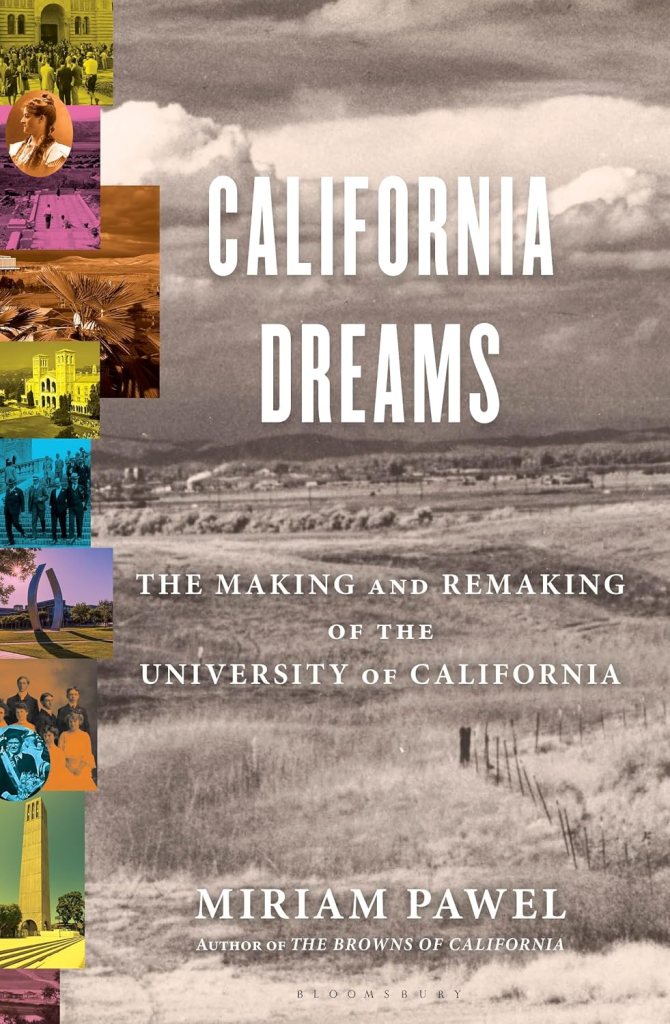
Those words could serve as the epigraph for Miriam Pawel’s masterful new history of the University of California. The founders of the university believed that a superior institution of higher education was key to making a great state of California, provided it was politically autonomous, with a student body representative of the state’s population, including women, and tuition free. Pawel shows how standards have never been completely realized in practice, but the vision has enabled the UC’s continuing resilience and remaking.
Miriam Pawel is, these days, the leading chronicler of California history. Her award-winning books — two about the farmworkers and Cesar Chavez, and The Browns of California: The Family Dynasty that Transformed the State and Shaped a Nation — are now followed by California Dreams: The Making and Remaking of the University of California. Each of these is a narrative of a particular case, but she has a remarkable knack for weaving the particular into a larger historical context. And in each case, the history is anchored by stories of characters who embody her themes.
There are five anchoring figures in California Dreams. One of them is Clark Kerr, about whom there is much writing, including his own — but Pawel’s account of his entire career is eye-opening. Kerr’s life involved great achievements in discovering levers of power to envision and build big institutions, while dealing with powerful elites whose values were much at odds with what he himself believed he believed.
Kerr started out as a Berkeley student, and the stories of four other UC students anchor the history: Millicent Washburn Shinn, who was the first woman to get a PhD at Cal; Kenneth Bailey, a student jock at the new L.A. campus, who was UCLA’s first PhD; David Masumoto, who escaped the family farm to be radicalized at Berkeley and, as a graduate student at Davis, learned how and why to return to farming; and Jose Alamillo, son of Mexican immigrant workers, recruited by affirmative action outreach to UC Santa Barbara, who became a leading Chicano Studies teacher and historian. Each of these characters’ lives helps Pawel tell the story of the UC campuses they frequented, and each story offers evidence for the transformative potential of higher education for individuals’ life courses and the community at large.
Jose Alamillo was a student I mentored. Full disclosure: I learned the value of that mentorship when Miriam and Jose visited me to talk about his experience and how it would be featured in Pawel’s history. Affirmative action in UC was ended by Governor Pete Wilson and his Regent appointee Ward Connerly, thereby setting back the effort to enable UC to fulfill the founding vision of universal access. But some of us, faculty and staff, helped design a new admissions model at UCSB that eventually led to a remaking of admissions policy for the system as a whole. It’s a model that bases UC qualification for admission on students’ class standing in their individual high schools rather than on their SAT scores. Read this book to learn more about that and what it accomplished — and about other crises that were existential threats to the university.
The California dreams expressed at the university’s founding have never been fully realized. Miriam Pawels’s history explores some of the inherent contradictions underlying this deferral. Her version highlights resilience and remaking and hope. Can daring dreams to provide opportunity for all to rise really ever come true?








You must be logged in to post a comment.