Question: ‘Weren’t there ostrich farms around here at one time?’
-Elizabeth Hodes
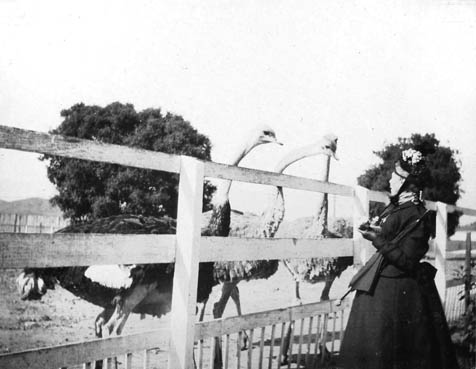
Believe it or not, ostrich farming has a South Coast history that goes back well over 100 years. Then, after a multi-decade hiatus, it enjoyed a renaissance of sorts in the 1980s, centered in the Santa Ynez Valley.
In the second half of the 19th century, ostrich farming became a major industry in South Africa. Since there were climatic similarities between that region and Southern California, it was felt that perhaps the industry could take root here as well. The first experiment with the large birds in California took place in 1885, when an Englishman, Edwin Cawston, imported 52 birds from South Africa and set up shop in Pasadena. His success inspired others, and soon ostrich farms dotted the landscape, including operations in Anaheim and San Diego. The South Coast soon followed suit.
In September 1889, two transplanted Englishmen, Harold Perry and Claude Lillingston, opened their ostrich farm at the eastern end of the Carpinteria Valley. They imported two birds from South Africa and purchased a number of others from Cawston’s Pasadena farm. In order to drum up interest in the enterprise, they arranged to display two of the ungainly birds at the fairgrounds in Santa Barbara, undoubtedly giving locals their first chance to view these exotic creatures. The exhibit created quite a stir, for ostriches grow between seven and nine feet tall and weigh more than 300 pounds.
Ostrich plumes were in great demand during this period. Tail feathers were used for fans, the wing feathers and the smaller feathers of the breast and back to adorn women’s clothing. Great care had to be taken when removing the feathers from the great birds. Ostriches were tremendously powerful; reportedly a well-aimed kick could kill a horse. Crews of three would lead the bird to a large harness where it was immobilized and a stocking was placed over its head to quiet it. Still, it could be a challenge; one bird was nicknamed Fighting Bob by the press because of the trouble it gave the plucking crew.
Ostriches were not fussy eaters; one account reported nails, rolled newspapers, ladies’ hats, and a lighted pipe all going down the birds’ gullets. Generally, though, their diet consisted of grain, vegetables, and some fruits. The gravel they ate aided digestion. Newborns grew rapidly, gaining as much as a foot in height per month in the first six months. About $30 in feathers could be “harvested” from each adult bird each year, and ostriches could live well beyond 50 years. The feathers were sent off to be dyed and then shipped to markets throughout the world. A pair of breeding adults fetched around $300.
The Carpinteria operation was less than successful and soon moved to Goleta. In 1908, a farm opened at the intersection of State and Islay streets, with birds brought in from Arizona. This farm lasted until World War I, and changes in fashion effectively brought an end to the early history of the local ostrich trade.
Breeding farms again sprang up in the 1980s in this area, as cattle ranchers attempted to escape depressed beef prices. At the height of the market in 1992, a breeding pair of ostriches could bring as much as $50,000-$60,000. Overproduction caused the bottom to fall out of the breeding market with prices falling to around $5,000 per pair in 1996. Many of the smaller ostrich ranchers fell by the wayside, despite state tax breaks and a slight increase in demand for ostrich meat. In the mid 1990s, ostrich steaks sold locally for $10-$12 a pound, while European markets commanded as much as $20-$27 a pound.
There is still an ostrich farm in operation near Buellton, but the golden age of Santa Barbara ostrich farming is long gone. It has been more than 100 years since curious passersby could marvel at these huge, exotic birds roaming the grounds at State and Islay streets.