• CREATE AN ACCOUNT
  • LOG.IN
  • CONTENTS
  • CLASSIFIEDS
  • ARCHIVE
  • INFO | ADVERTISING | CONTACT US

  • Home
  • News
    • News Main Page
  • A&E
    • A&E Main Page
    • Movie Times
    • TV Listings
    • A&E Blog
    • Art Galleries
    • Best Bets
  • Opinion
    • Opinion Main Page
    • Blogs
    • Columns
    • Voices
    • Letters
    • In Memoriam
    • Obituaries
  • Events
    • Today
    • Search
    • Submit
    • Best Bets
  • Living
    • Living Main Page
    • Outdoors
    • Travel
    • Sports
    • Peeps
  • Food & Drink
    • Food & Drink Main Page
    • All Restaurants
    • Delivery
    • All Bars & Clubs
    • Drink Specials
    • Open Now
  • Sports
  • Outdoors
    • Outdoors Main Page
    • Outside Insider
    • Spotlight On
    • Features
  • Classifieds
    • Real Estate
    • Jobs
    • Autos
  • Obits
    The four-year-old condor was healthy and one of the more dominant ones in its age group, suggesting great breeding potential.

    Joseph Brandt, U.S. Fish & Wildlife

    The four-year-old condor was healthy and one of the more dominant ones in its age group, suggesting great breeding potential.


    Condor Found Strangled

    Endangered Bird Gets Caught in Recreational Rope in Los Padres National Forest

    Wednesday, July 15, 2009
    By Matt Kettmann (Contact)
    Article Tools
    Print friendly
    E-mail story
    Tip Us Off
    iPod friendly
    Comments
    Bookmark This
    del.icio.us. del.icio.us.
    Digg! Digg!
    furl furl
    google google
    newsvine newsvine
    reddit reddit
    technorati technorati
    Facebook Facebook
    Yahoo! My Web 2.0 Yahoo!

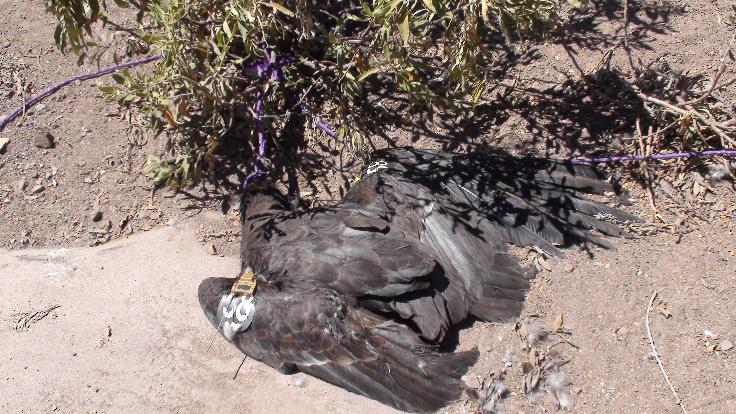
    A healthy, four-year-old California condor known as #358 was found dead on Monday in the Los Padres National Forest. Its neck had become tangled in a rope apparently used by hikers to scale a waterfall along Tar Creek, just north of Fillmore in Ventura County.

    “It’s a popular recreational area, and it also happens to be a year-round source of water for condors,” explained U.S. Fish & Wildlife spokesperson Michael Woodbridge on Tuesday. He said it appeared as if the bird had been checking out the rope, and then somehow got caught. “They’re naturally curious birds,” said Woodbridge. “When people leave stuff out, they’re going to explore that.”

    Condor #358 was found strangled this week by a recreational rope atop Tar Creek Falls, just north of Fillmore in the Los Padres National Forest.
    Click to enlarge photo

    Joseph Brandt, U.S. Fish & Wildlife

    Condor #358 was found strangled this week by a recreational rope atop Tar Creek Falls, just north of Fillmore in the Los Padres National Forest.

    The bird was found by a hiker who called authorities on Monday at about 10 a.m., and the USFWS sent out a team to retrieve the bird. They found the condor near the top of a 200-foot waterfall, with its neck caught in an eight-millimeter rope that was tied to a small tree in the chaparral scrub and frayed with repeated use over the years.

    Though Woodbridge couldn’t say definitively that this was the only condor ever killed by recreational equipment since the recovery program began in the 1980s, he said, “I don’t know of any cases offhand that are similar.” He did, however, say it reminded him of recent cases in Bakersfield where endangered kit foxes are getting themselves caught and injured in volleyball and soccer nets. Typically, wild condors - whose population dwindled to less than 30 birds in the 1980s - die from lead poisoning after eating on the remains of animals hunted with lead bullets. Less commonly, the birds may die by being shot, flying into power lines, or contracting West Nile virus.

    The 200-foot waterfall along Tar Creek is a popular recreational spot, but also a year-round source of water for condors.
    Click to enlarge photo

    Joseph Brandt, U.S. Fish & Wildlife

    The 200-foot waterfall along Tar Creek is a popular recreational spot, but also a year-round source of water for condors.

    The death leaves 361 condors in existence, including 188 wild condors, 94 of which are in California. The good news, said Woodbridge, is that it wasn’t a breeding condor. “It would have been a greater loss if this was a breeding adult bird, but it wasn’t at a breeding age yet,” said Woodbridge. However, the bird had no problems, wasn’t sickly, and had no problems with humans. On top of that, Woodbridge explained, “He was actually one of the more dominant birds in his age class.” Dominance often predicts how successful an individual bird will be in future mating, said Woodbridge, who explained, “We had pretty high hopes of him having a long productive life in the wild.” Unfortunately, condor #358 has now been sent off to the San Diego Zoo for a necropsy.

    “Anything left there can have an effect on condors. People need to make sure to take that out of the backcountry,” warned Woodbridge. “The bottom line is pack out your stuff.”

    Related Links

    • Condor Gallery from Bitter Creek
    • Condor Gallery from Hopper Mountain
    Story Help (Click-ability)
    Double-clicking on any word or phrase in this story will open a reference window with definitions and links to other reference material.

    Comments

    Discussion Guidelines

    "die from lead poisoning after eating on the remains of animals hunted by lead bullets." This is not true. The studies that have been done show that lead from sources other than lead hunting bullets were more prevalent in condors with high lead levels. Wheel weights were very common in condors with lead poisoning, for example.

    Please do not give credence to the political shibboleth that hunting ammo was the primary source of lead poisoning of condors by blindly repeating this as if it were true. The science did not show that. Outlawing lead hunting ammo was primarily political posturing.

    Becky (anonymous profile)
    July 15, 2009 at 9:27 a.m. (Suggest removal)

    Thanks for your comment, Becky.

    From my extensive research over the past 10 years and numerous interviews with scientists, it seems that the ammo is a major player in condor deaths, but I am open to other evidence.

    Can you direct me and the other readers to the studies you mention?

    Matt (Matt Kettmann)
    July 15, 2009 at 10:26 a.m. (Suggest removal)

    We need volunteers to help us prevent this from happening again. If you're interested in helping us clean up harmful and dangerous trash from California condor habitat, please send an email with your full name, address, and phone number to info@LPFW.org and we will add you to our notification list for future cleanup projects.

    We are organizing several cleanups not just at this Tar Creek site, but other sites throughout the Los Padres National Forest. We're a nonprofit organization that works in conjunction with USFWS, USFS, and other agencies to protect condors from microtrash. We've already removed nearly 1,000 pounds of it from four other sites around the area and need all the help we can get to tackle these new sites. You can read about our previous cleanups at http://www.LPFW.org/news/0810microtra...

    Thanks in advance for your help.

    The Los Padres ForestWatch Team
    info@LPFW.org
    (805) 617-4610 ext.11

    ForestWatch (anonymous profile)
    July 15, 2009 at 5:11 p.m. (Suggest removal)

    The condor reported dead was not #358 but rather #58. I just saw this bird along with four other Condors just weeks ago. Here is a link to picture of the bird when it was alive:
    http://staplescenter.smugmug.com/phot...

    It really bothers me that people leave ropes and stuff in these parts of the country. My friend and I cleared out some nylon straps that were attached just below where this Condor died. One condor was pecking at the nylon strap just before we cleared it out. I hope by doing so we saved some Condors lives.

    fjones71 (anonymous profile)
    July 16, 2009 at 7:20 a.m. (Suggest removal)

    No, it is #358. The large #58 is just part of the marking. There is another mark on the bottom of the tag that denotes the additional number #3.

    Matt (Matt Kettmann)
    July 16, 2009 at 10:03 a.m. (Suggest removal)

    Becky is right, ammunition lead is not as great a threat as are power lines, towers in general, and "microtrash" as noted by the Los Padres Forestwatch team above are far as actual sources of mortality. More condors, including nestlings, have been recorded to have died from any of the one related causes above in California than lead proven to have come from ammunition.

    Pesticides are even a problem, though apparently in the Big Sur population. Shell thinning has been a concern for several years from DDT-like residues coming from food sources somewhere.

    Just ask the folks you are talking to as to what has been reported by the condor program participants as to actual mortality versus "inference".

    Birder

    Birder (anonymous profile)
    July 16, 2009 at 11:06 a.m. (Suggest removal)

    Very sad story.

    As for the lead, here's a recent CNN_technology Sounds to me from what I've read that removing lead from the environment is a good thing. That there are greater threats to the condors than lead bullets is not an argument against banning some of the threats.

    The arguments on both sides of the question involve some political posturing; all disputes that involve law-making do.

    citti (anonymous profile)
    July 16, 2009 at 11:16 p.m. (Suggest removal)

    FYI: A day's worth of panel discussions at the American Ornithologists Union's 2005 conference drew a picture of lead poisoning in wild condors from the results of various public and private researchers' work. Among the results: Lead ammunition is the "predominant source of lead poisoning in Calif. condors," according to Don Smith and Molly Church, UCSC Environmental Toxicology Lab, who studied lead isotope tracers on lead found in 26 dead condors.
    From the Arizona Fish & Game researchers, who looked at a much smaller wild condor population (the first captive was released in 1996) found that seven of 12 dead condors died of lead poisoning, and lead fragments in deer carcasses during hunting season was a major contributor. No researcher claimed that lead ammunition was the sole cause of of condor deaths, and some noted that there were other, environmental sources of lead. But the scientific evidence presented four years ago showed that lead ammo was (and is) a chief factor in condors' lead ingestion and poisoning. It will be useful to compare the Calif. birds' blood lead levels before and after the introduction of the new state law banning use of lead ammo in the condors' feeding range.
    I agree with Citti that when we're investing tens of millions in a program to reintroduce wild condor populations in only is common sense to minimize or eliminate man-made threats to that population

    viccox (anonymous profile)
    July 18, 2009 at 2:45 p.m. (Suggest removal)

    Log in to comment

    Forgotten your password?

    Sign up

    EVENT CALENDAR

    Previous Month | Next Month

    Today's Events Best Bets Submit an Event

    Local Weather

    Currently:
    Fog
    Temperature:
    55.0°
    Wind:
    0 N

    Surf Report
    • Specials
    • InPrint
    • Top Emails
    • Wedding Guide 2010
    • SBIFF 2010
    • Best Of 2009
    • 2010 Election Coverage
    • Blue Green Guide 2010
    • Summer Adventure Guide 2010
    • Local Heroes 2009
    • Calendar of Fundraisers
    • Local Bands
    • UCSBigger
    • Art Without Limits Offers Apprenticeships
    • Gut-Check Time
    • Is There Life After Dog?
    • Ray LaMontagne Gets Spacious on God Willin’
    • S.B. Wine Industry
    1. Who’s Watching Huguette’s Millions?
    2. Egg Recall
    3. Santa Bruta
    4. Seeing the Vultures Through the Trees
    5. Blum Takes Off Gloves
    6. Santa Barbara Bank Closes $500 Million Deal
    • CREATE AN ACCOUNT
    • LOG.IN
    • CONTENTS
    • CLASSIFIEDS
    • ARCHIVE
    • INFO | ADVERTISING | CONTACT US
    Google
     
    Independent.com Web
    Copyright ©2010 Santa Barbara Independent, Inc. Reproduction of material from any Independent.com pages without written permission is strictly prohibited. If you believe an Independent.com user or any material appearing on Independent.com is copyrighted material used without proper permission, please click here.
    This is our Privacy Policy.