

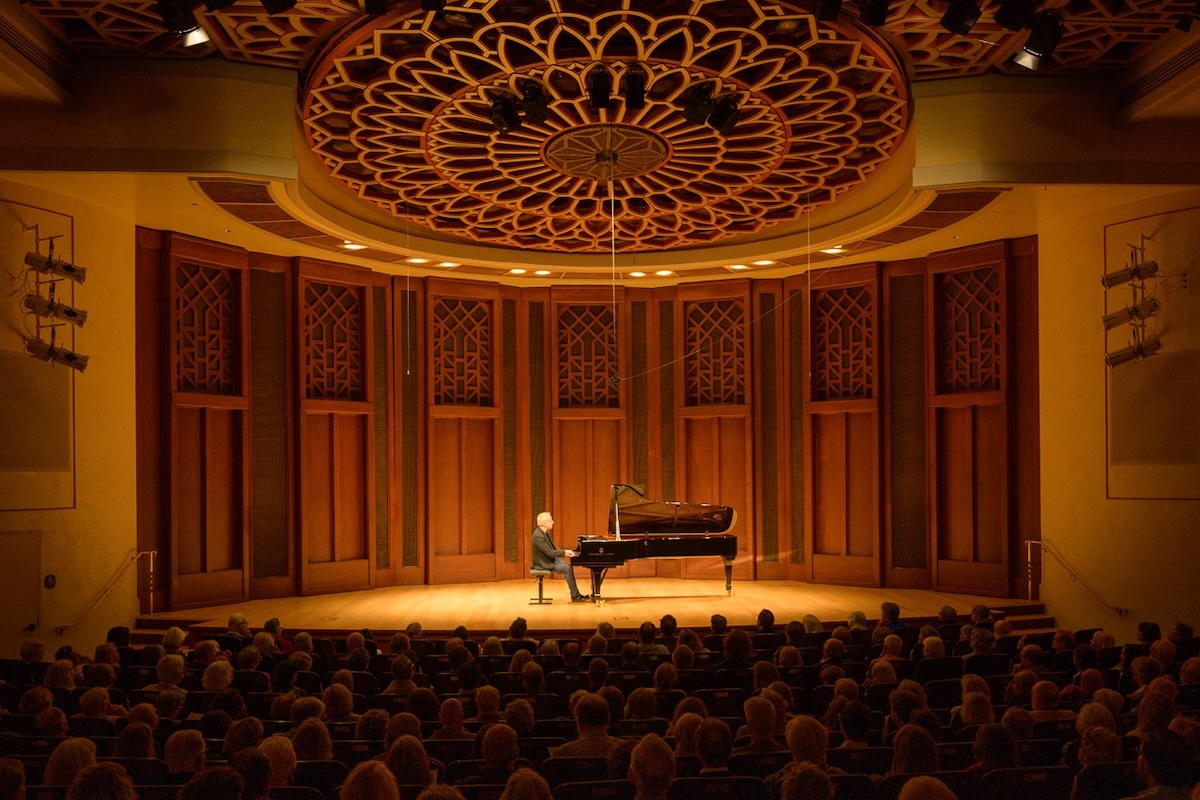
When Jeremy Denk plays, and speaks, people listen. That Denk think-and-play tank was in effect for a special three-night stint at Hahn Hall last week, to full and deep-listening audiences. What resulted was possibly the highlight of the current Music Academy season and clearly one of the classical music high points of Santa Barbara’s classical music year.
The subject of veneration and real-time analysis — Beethoven piano sonatas, five of them and with a special emphasis on his last two. On night one of these double barrel events — Denk seems allergic to the word lecture and preferred to call these “fireside chats” — he confessed that this project was partly selfish, part of his deep dive research for a book on Beethoven’s powerful finale and crowning touch of his sonata oeuvre, “No. 32, Opus 111.”
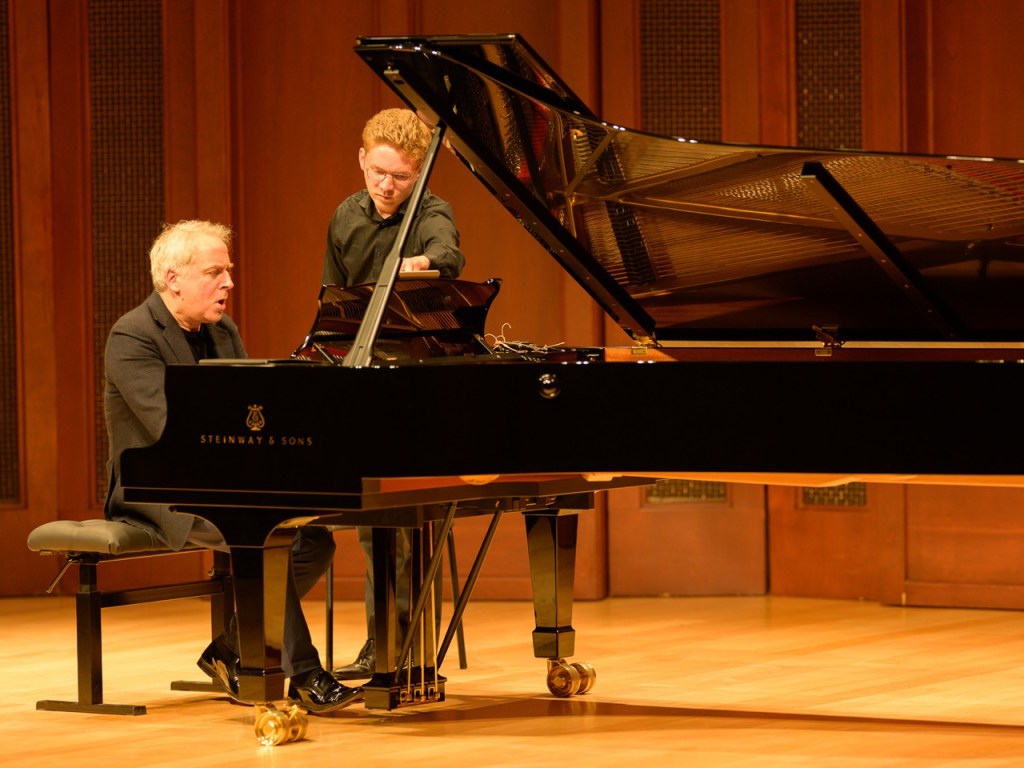
Selfish or not, the miniseries was tantamount to a profound encounter from the listener side, through both the wit and wisdom of his almost sportscaster-like detailing of different “plays” in the scores and his expected brilliance of touch, dynamic nuance and thorough grasp of the bigger structural picture of each score.
We’ve come to know and love the Denk think tank phenomenon in this town. A world-renowned pianist also respected for his articulate and witty observations about music and other matters, Denk has brought his skills and playful intellect for several summers to the Music Academy of the West, where he is a celebrated faculty member. Last summer, the subject of one of his deep dives was Charles Ives’ iconic — and iconoclastic — ”Concord Sonata,” after a moving encounter with Bach’s “Well-Tempered Clavier, Book 1” the year prior. And in February, Denk whetted our Beethoven-ian appetite with a “fireside chat” and performance of the composer’s “Sonata No. 32,” as part of the Academy’s off-season “Maricopa” series.
In terms of the supplementary and sometimes playfully audacious non-Beethoven music in the margins, those schemes were alternately inspired and fuzzy. Sadly, he chose to ixnay the two 20th-century pieces originally on the docket — Frederic Rzewski and the great Hungarian composer György Ligeti. Those younger sounds could have made for a ripe and evangelistic crossover of old to new, as happened when Denk performed a memorable Campbell Hall recital juggling Beethoven, Bach, and Ligeti in 2013.
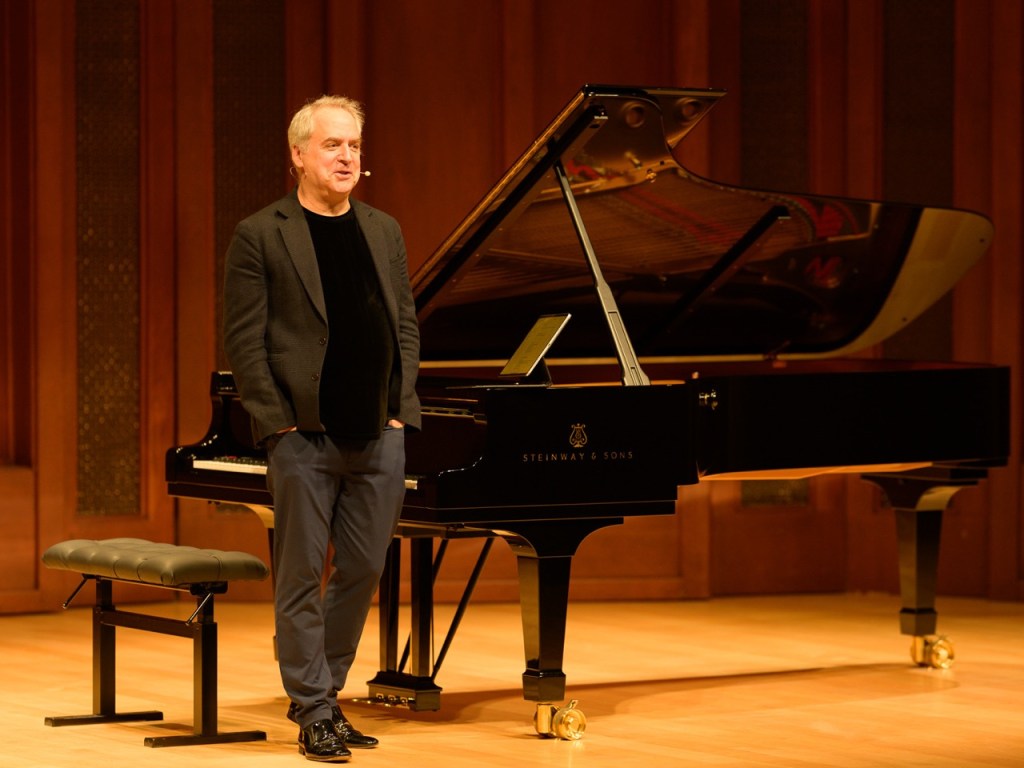
At the Hahn last week, on night one, Denk unveiled the fascinating and far too obscure etudes of early 19th-century female composer Hélène de Montgeroult (1764-1836) — remember that name! — an influence on Beethoven, Schumann, and Mendelssohn, among others. Schumann’s clearly Beethoven-flavored “Fantasie in C, Opus 17” opened the second night. However, the center did not hold on night three, when he attempted to channel Nina Simone on the standard “Just in Time,” as arranged by stellar jazz pianist Ethan Iverson, but Denk’s attempt felt stiff and swing- challenged. A boogie-woogie spin on Wagner’s “Liebestod” felt like a silly and sacrilegious parlor game A stride piano spin on Wagner’s “Pilgrim’s Chorus” felt like a silly and sacrilegious parlor game…reminiscent of Uri Caine’s jazz/classical “mucking with the Masters” projects. [Thanks to a keen-eyed reader for pointing the error of our Wagner reference.]
But then the Denk magic and mastery saved the night, as he plunged into the various little dark and light folds, rivulets and stirring emotive crests of number 31.
Although the centerpieces of the recent three-night survey were Sonata numbers 31 and 32, Denk established a broader comparative contrast and music/life overview by including the earlier No. 17, rightfully subtitled “Tempest,” and No. 16, a kinder gentler counterbalance to the tempestuous model. Of the latter piece, Denk commented that in it, “the silly and the sublime and the ridiculous and the beautiful are mixed together, as they are in life.”
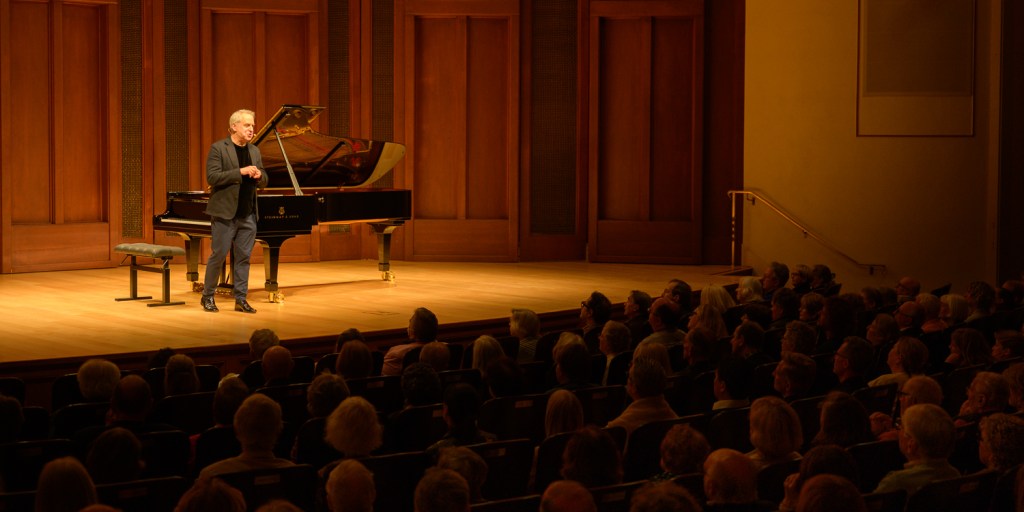
Program-wise, he eased into the survey with the mid-period No. 27 and closed the series with the satisfyingly resolute number 31, with its ecstatic culminating fugue gone wild. Number 32 was the focus of the second night, given its due tighter focus and lengthier blow-by-blow liner notes treatment.
Denk observed that, by this point in his troubled life, Beethoven was completely deaf and beholden only to his own creative desires, and that “the piece raises a middle finger to all that was around him, as if to say ‘I’m not going to make anyone happy’ and yet also says ‘I love all of you deeply.’ It’s a paradox.” He later added that “very few artists are able to convert their anger issues into great art,” before diving into his eloquent expression of this work of great art.
Denk’s Herculean and epic effort paid off beautifully. Beethoven, we know you more deeply now, or so we’ve been nimbly led to believe by your interpreter in the 805.










You must be logged in to post a comment.