When it comes to appreciation for the distinctive Italian director Paolo Sorrentino, I was late to the party but became a card-carrying party member on impact. It happened at the 2014 Santa Barbara International Film Festival’s screening of his Oscar-winning film The Great Beauty, where I was entranced by its wild Fellini-esque spectacle (“Fellini-esque,” as in a sensory cinematic feast slyly blended with lyricism and social/philosophical commentary). I went on to admire his follow-up film Youth, his outlandish poke-at-the-Pope HBO series The Young Pope, and his strange 2011 film This Must Be the Place, with Sean Penn as a lipsticked, aging goth-y rock star in a tailspin, on through to last year’s Neapolitan coming-of-age tale Parthenope.
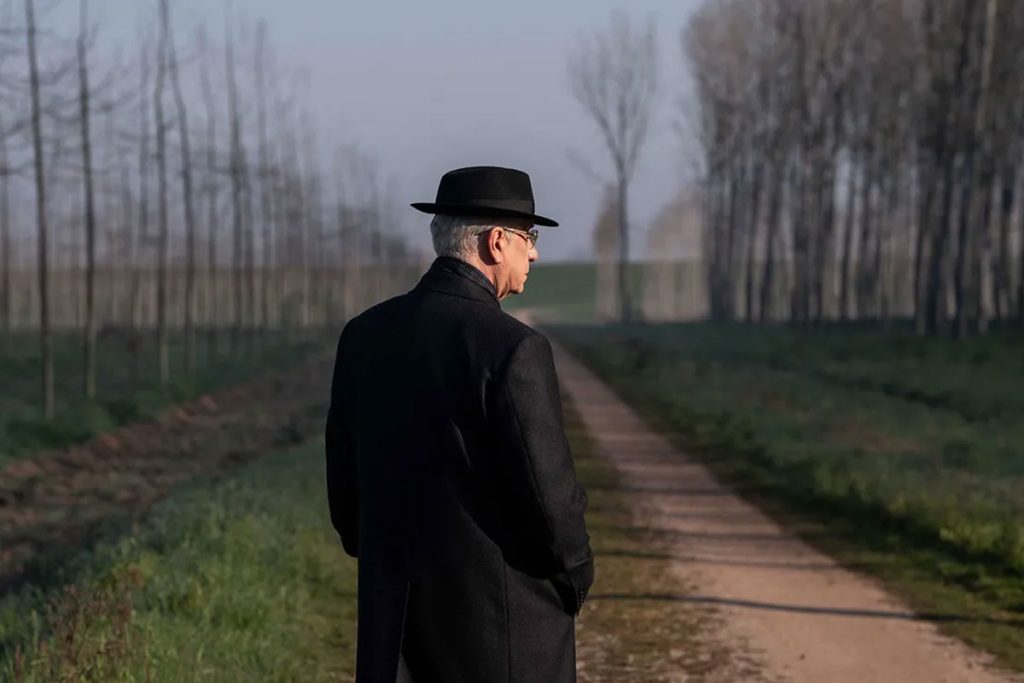
Now comes La Grazia, another jewel in the Sorrentino oeuvre, but a jewel of a more understated kind. In his filmography, there is an almost contrapuntal link between the young Pope, brash and iconoclastic, and, in the latest film, the old president, in melancholic and nostalgic reflection. La Grazia translates to “the pardon,” a term with more than one reference point in writer-director Sorrentino’s story. President Mariano de Santis (the subtly wondrous Toni Seville, also in The Great Beauty) is facing the end of his tenure, and among the final acts in his lame duck period are the consideration cases up for pardons and pondering a bill for euthanasia — also a kind of pardon.
On the president’s own personal front, there is the matter of pardoning his late, beloved wife, Aurora, who had betrayed him 40 years earlier, and now taunts him from the beyond. She serves as a strong character in absentia in the film, seen only through her colorful wardrobe and as the source of de Santis’s neurotic memory trolling.
The landscape of La Grazia’s visual and dramatic world is based on interiority, related to both the character’s interior mental/emotional state and the dark, abidingly sumptuous confines of his presidential palace. As artfully conveyed through Sorrentino’s cinematic palette, the prevailing atmosphere is potentially claustrophobic, but cushily appointed, with the president remaining sequestered on the grounds and dodging the hurly burly of the outside urban world.
There are notable exceptions, as when he visits a prison to interview a pardon case, and when he appears at the La Scala opera premiere, and is bathed in affectionate crowd ovation. He also ventures out “via screens,” basking in a contemporary dance performance with loud house music (contrasting the film’s sparing use of a film score). He also checks in with an astronaut caught in his own sequestered environment, a space station, who cries and then laughs at his gravity defying tear. Naturally, the image reflects back on the president’s own interstate.
His small circle of confidants and friends includes his wise daughter (Anna Ferzetti) and his acerbic art critic friend Coco (Milvia Marigliano), whose role in his life thickens along with the plot. Another ally is also a reflective power figure, from across town, the Pope (Rufin Doh Zeyenouin). (It should be noted, a black pope — again, with Sorrentino’s against-type papal characterizations.) In one of his counsels for de Santis, the Pope comments, “You know what you need? Grace.”
In effect, the long, patient narrative arc of the film slowly tracks our protagonist’s process of coming to terms with the end of his political term, the wrestling of demons, and a new resolution of spirit. As he puts it, at an age when passion is scarce, he has grace, and “grace is the beauty of doubt.”
For fans of quietly powerful cinema and drama, not to mention Sorrentino fans old and new, La Grazia stands out as recommended watching in this densely populated cinema season.
La Grazia is currently playing at the SBIFF Rivera Theatre. See trailer here.