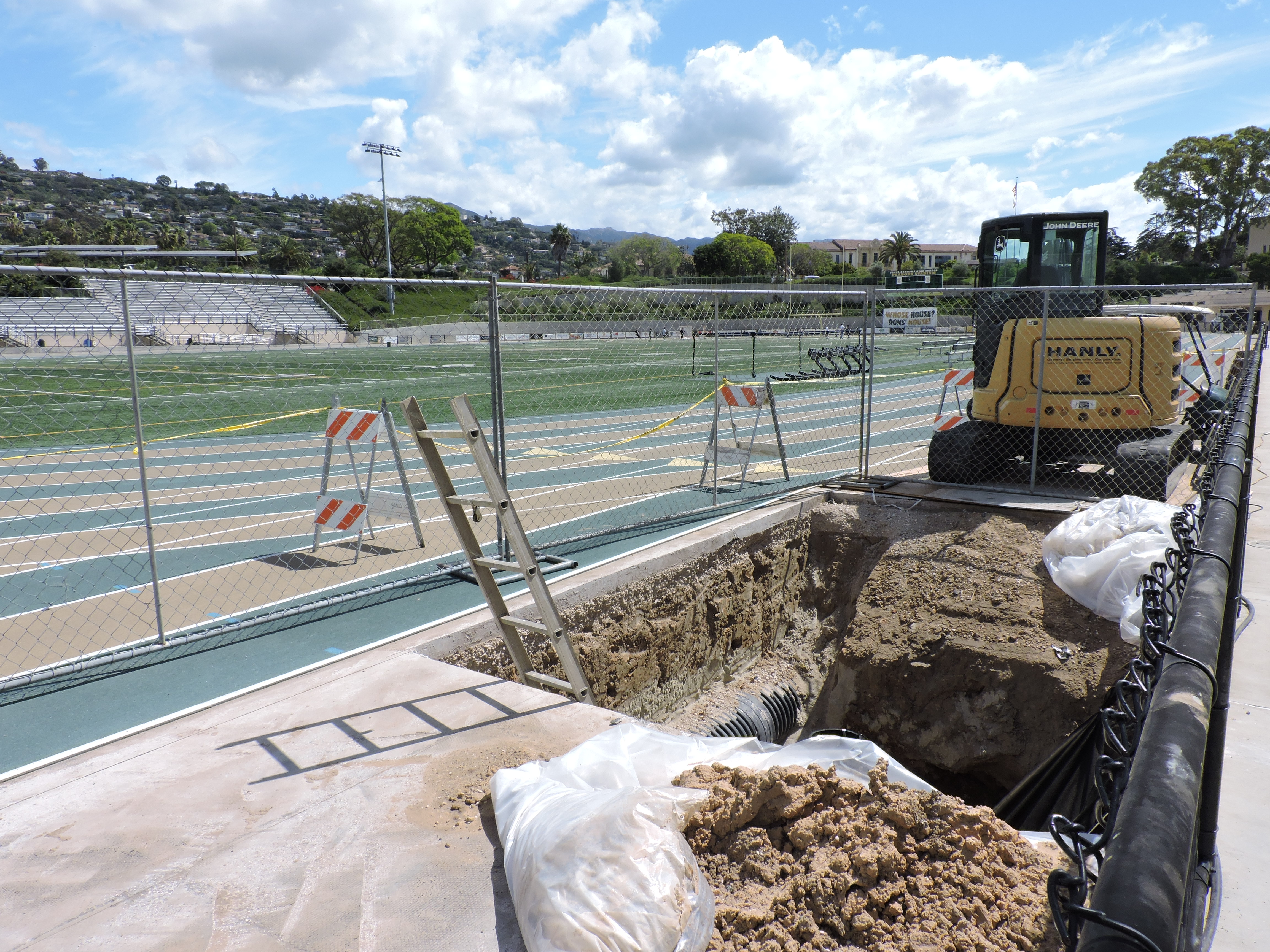
Santa Barbara High School’s track has been sinking, resulting in a large hole that’s swallowed two of the lanes next to the bleachers.
It’s a real problem for the school’s track team. The school has not been able to host any meets at home this year due to the cavernous disruption.
In 2023, athletic director Todd Heil first alerted the school district to a “dip in the track.” The district paid $16,000 to flatten it out and replace it. But then, in 2024, it started dipping again.
What was originally thought to be mild erosion due to runoff from intense rains in 2022 and 2023 — the school is part of a stormwater drainage area — actually turned out to be a crack in the drain pipe running underneath the track, the district discovered.
Over the course of the four-year, $39 million renovation of the school’s Peabody Stadium — and the new Cunningham Track — the track was subject to multiple inspections, said Steve Venz, chief operating officer. The stadium reopened in 2021.
“The way that whole area is designed to drain water, it’s an important factor when we’re doing building in that area — we take all of that into account,” he said.
During renovations, it took $9 million alone to replace the “failing” underground storm drain that funnels runoff from more than 200 acres along the Riviera, according to previous reporting by the Independent. The Foundation for Santa Barbara High School originally wanted a regulation track-and-field facility to replace the stadium’s cracked asphalt — which hadn’t seen a meet since 1996 — but the “drainage issue put the whole project at risk,” and upped the costs, the Foundation’s campaign chair Greg Tebbe told the Independent in 2017.
But the mysterious crack — the district is currently unsure what caused it — was unexpected. Over the past two years, water seeping from the pipe was eroding the foundation beneath the turf, causing the track to sink. Now, it’s a 13-foot-deep hole in the ground, after the district had to excavate the track to start on the repairs.
The drainage’s extensive repairs include creating a structure around the pipe to prevent it from sinking and block any more water from seeping in. Right now, the district is completing as much of the repair work as they can before they must cover the hole back up for graduation at the stadium in June. The rest of the heavy repair work will be done over the summer.
Venz estimates it will cost at least $250,000 — which he said the district’s insurance may be able to cover, as the warranty with the original construction company has expired.
“We are being wise about it,” Venz said, to ensure they get to the heart of the problem and avoid disrupting graduation. “We didn’t want to immediately start tearing the thing up and digging in.”
In the meantime, the school’s track team still uses the track for practice, steering clear of the hole. After a year away, the school is expected to begin hosting meets again next year.
Editor’s note: This story was updated to reflect that the hole was not a real “sinkhole” as originally reported, but a depression due to an underground leak.