


The original version of this newsletter was sent out on Tuesday, May 12.
Sign up for All Booked, our bi-monthly newsletter exclusively for book lovers.
Hello, fellow bookworms!
This week, Emily Vesper brings us a collection of novellas that, despite their shorter length, will open doorways into other worlds: Marco Polo telling tales to an emperor; a veteran finding his way in a small English town; a priest’s final words on his deathbed. I know plenty of readers (and I’ve been guilty of this myself) who raise a skeptical eye to novellas, doubting how deep a story can possibly go with such a limited page count. But after these reviews, I’m more than tempted to pick these ones up myself.
Happy reading!
— Tessa, allbooked@independent.com
Far be it from me to praise a book for being brief. With modern life seemingly designed to mangle our attention spans, spending days, weeks, or even months with a single story feels mindful and meaningful. But I can’t deny it: there’s something seductive about the novella. In recent months, without quite meaning to, I’ve found myself devouring one bite-sized book after another. They’re easy to reach for in a rut, or when you don’t know what you want to commit yourself to; they’re a palate cleanser of sorts, after you finally finish that maximalist doorstopper or that sweeping historical epic. I started and finished one on a single train ride to Los Angeles. I started and finished one in my backyard, over coffee, before noon. I read another over a week of lunch breaks at my restaurant job. The possibilities are grand.
“Novella” isn’t a genre; the works classed under this (admittedly broad) category are as diverse as any selection of books. But the best novellas have this in common: They are as complex, rich, and rewarding as a great full-length novel. Some were so immersive and dense that I came away feeling like I’d read something much longer. Others used the constraints of the form to playful, unexpected effect. In any case, I’ve concluded that novellas are a lovely way to try something new, perhaps something challenging or different from what I typically read. Here are a few of my favorites!
Invisible Cities by Italo Calvino, translated from Italian by William Weaver
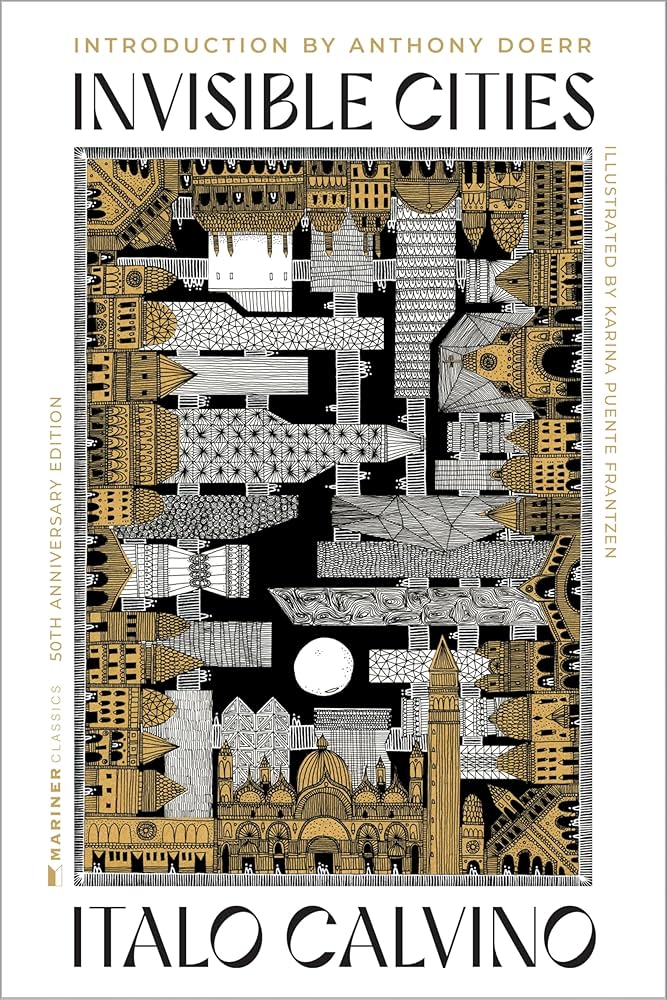
Marco Polo regales the emperor Kublai Khan with his description of fantastical cities near and far. Invisible Cities is, in large part, a collection of these vignettes rather than a traditional narrative, and it’s hard for me to impress upon you just how brilliant these entries are: at once clever, funny, whimsical, melancholy, poignant, surreal, humane. It soon becomes clear that questions of place — what makes a city itself, what makes it distinct from any other city — have everything to do with the lives of a place’s inhabitants. So the book, often described as a “fictional travelogue,” is ultimately a meditation on human experience, exploring the nature of communication, culture, desire, memory, and time.
It’s ambitious and high-concept (when a friend asked me about what I was reading, the first thing I could think to say was, “It’s about everything!”) but Calvino is a master writer, storyteller, and thinker; to say he pulls it off would be the understatement of the century. Invisible Cities took complete hold of me. It’s luminous, affecting, and profound. And for all my raving, let me be clear that while it grapples with complicated ideas, it’s a delight to read, playful and charming, almost intoxicating — not some opaque, heady slog. The first book of Calvino’s I read, it stunned me, unlike anything else I’d encountered.
“Every time I describe a city I am saying something about Venice,” says Marco Polo, who cannot help but understand all cities in relation to his own, his home, a “first city that remains implicit.” And so, while reading, I could not help but think of Santa Barbara, my implicit city: its superficial beauty, its conflicts and exchanges, its secrets, its shortcuts, its illusions, its crowds, its disappointments, its charms, its utter strangeness. And I could not help but be moved.
A Month in the Country by JL Carr
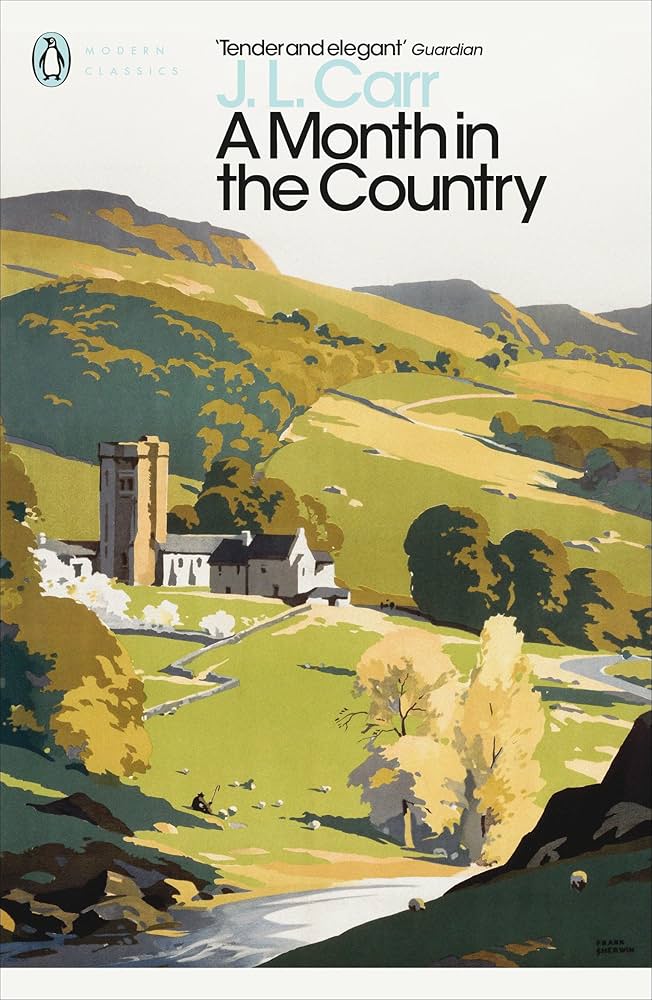
It’s August of 1920; World War I veteran Tom Birkin arrives to the small English village of Oxgodby wounded, penniless, and unmoored. He’s accepted a gig restoring a medieval mural, obscured under centuries of whitewash, found in the local church. Over the course of a month, Tom uncovers the painting with methodical care and secular reverence. He befriends several village residents and Charles Moon, a fellow veteran and out-of-towner hired by the church to locate a long-lost grave.
It’s a simple story. Add the fact that Tom is narrating from some date in the distant future, and that’s basically it. In the wrong hands this could be maudlin, twee, or just boring, but Carr’s novella, clocking in at a little over a hundred pages, is a thing of understated beauty.
Tom has experienced some of the most extraordinary trauma the world has to offer (Passchendaele) and some of the most ordinary pain (a broken relationship). His slow, steady work on the mural gives him a sense of purpose and even transcendence that cuts through the haze of his suffering; his relationships with the townspeople also prove quietly restorative. Carr’s story, rendered in lyrical prose and lush, atmospheric detail, is a testament to the power of art and to the meaning that can be found in the most mundane aspects of daily life. (As such, I would recommend it to fans of Stoner, which Tiana Molony wrote a fabulous review of recently!)
The book has a bittersweet feeling: Tom is recalling a time forever lost to him, inaccessible except in memory. The novella asks: How should we move through our days, knowing that everything changes? How might we find happiness and meaning, knowing that happiness and meaning are not promised to last?
By Night In Chile by Roberto Bolaño, translated from Spanish by Chris Andrews

Father Sebastián Urrutia Lacroix is on his deathbed. By Night In Chile takes the form of his feverish final monologue, in turns confessional, paranoid, defensive, and guilty. “I have always been on history’s side,” insists Urrutia, a conservative Catholic priest, literary critic, and failed poet. But his rambling account reveals his years entangled with the fascist elite during the Pinochet regime: Urrutia tutored the Chilean dictator in Marxism (so the General might better understand his enemies) and partied with the right-wing literati above a torture site.
I’m on a Bolaño kick, and this is the book that got me hooked on him. The late Chilean writer is best known for the extremely long novel The Savage Detectives (which you should also read) and the even longer 2666, but he also wrote quite a few short stories and novellas (and tons of poetry, his apparent true love). In By Night In Chile — the last work he published before his untimely death in 2003 — his muscular erudition and his characteristic obsession with poetry and literature are on full display. It’s provocative, haunting, and hypnotic.
This is a story about conscience and complicity, and a story about the relationship of literature to history. Oftentimes, we’re presented with images of artists as a progressive vanguard, these romantic, countercultural heroes. But here, Bolaño is interested in the failure of art (and the failure of the individual) to confront the immensity of human brutality and suffering. He asks what it means to be a witness, and what literature is worth in the face of it all.
In doing so, he threads the needle, producing this athletic, incredible novella that speaks both acutely and broadly. By Night In Chile is firmly anchored in the specific history of 20th-century Chile, offering a searing account of the country’s political transformation. But it also echoes instances of fascism and repression that precede and follow the Pinochet regime. If you read this one today, I think you’ll be at once enamored with Bolaño’s mesmerizing storytelling and troubled by the book’s resonance with the present.
—Emily Vesper
FROM OUR PAGES
We’ve had some great author visits and interviews recently, so don’t miss out. Here is some of our book-related coverage from the last two weeks! Read all this and more at Independent.com.
“Take-One: The Santa Barbara Literary Festival Delivers” by Leslie Dinaberg
“Share Your Story: The Strangers Project Debuts at Art & Soul Gallery for Santa Barbara Literary Festival” by Meaghan Clark Tiernan
“UC Santa Barbara Exhibition Explores the Many Lives of Shakespeare’s Texts” by Johannes Steffens
UPCOMING BOOK EVENTS
Below, you will find a few bookish events coming up in Santa Barbara. If you are hosting a bookish event in Santa Barbara, be sure to submit the event to our online events calendar.
S.B. Eastside Library Bilingual Songs & Stories for Kids
Tuesday, May 12, 11 a.m. | Eastside Library
Book Talk at the Santa Barbara Woman’s Club: Two Eras, One Author by Jinny Webber
Tuesday, May 12, 2 p.m. | Rocky Nook Park
Godmothers Gather: Stephanie Fairyington & Jane Ward, Ugly: A Letter to My Daughter
Tuesday, May 12, 6 p.m. | Godmothers
S.B. Central Library Comic Chaos Club
Wednesday, May 13, 4 p.m. | S.B. Central Library
Blue Whale Reading Series
Wednesday, May 13, 5:30 p.m. | Unity of S.B. Chapel
S.B. Central Library Romance Book Club
Wednesday, May 13, 5:30 p.m. | S.B. Central Library
Chaucer’s Books: In Conversation: Reyna Grande, Migrant Heart
Wednesday, May 13, 6 p.m. | Chaucer’s Books
Godmothers Gather: Erin Walsh, The Art of Intentional Dressing: Your Essential Style Guide for Manifesting a Magnetic Life
Wednesday, May 13, 6 p.m. | Godmothers
Solvang Library Book Talk & Signing: Krystle Hickman, The ABCs of California’s Native Bees
Wednesday, May 13, 7 p.m. | Solvang Library
Chaucer’s Books: Literary Journal Release & Reading: Mysterious Ways
Thursday, May 14, 6 p.m. | Chaucer’s Books
Godmothers Gather: Bobby Stuckey, Caroline Styne, and Heidi Merrick, Friuli Food and Wine
Thursday, May 14, 6 p.m. | Godmothers
Godmothers Gather: Sean Collyns, Your Soul Is the Source of Your Power
Friday, May 15, 6 p.m. | Godmothers
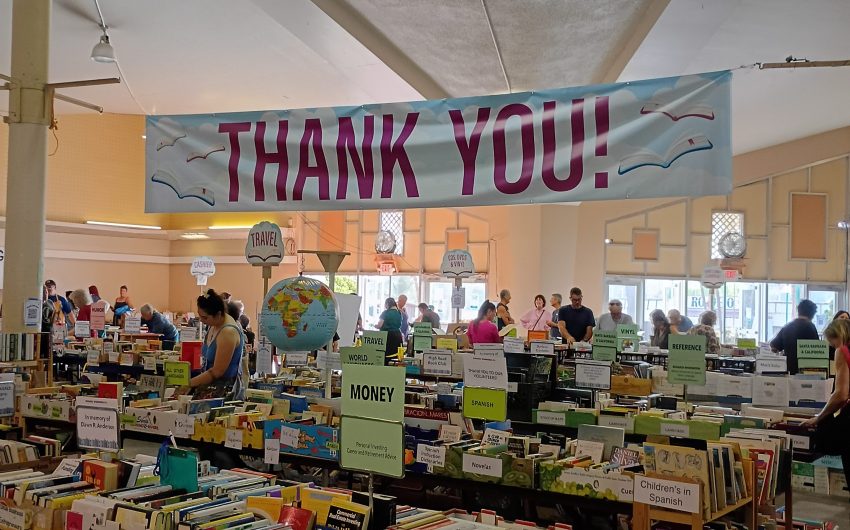
Buellton Library Big Used Book Sale
Saturday, May 16, 10 a.m.-2 p.m. | Buellton Library
Storytime at the Sea Center
Saturday, May 16, 10:30 a.m. | S.B. Museum of Natural History Sea Center
SBMM Artist Walkthrough of Aquean and Book Signing
Saturday, May 16, 12:30 p.m. | S.B. Maritime Museum
Godmothers Gather: Chloe Warner & Elise Loehnen, This Must Be the Place: Homes with Atmosphere
Saturday, May 16, 6 p.m. | Godmothers
Goleta Valley Library Poetry Club
Sunday, May 17, 2 p.m. | Goleta Community Center
S.B. Eastside Library Bilingual Songs & Stories for Kids
Tuesday, May 19, 11 a.m. | Eastside Library
Tom Selleck in Conversation with Ted Danson
Tuesday, May 19, 7:30 p.m. | The Granada Theatre
Chaucer’s Books: Poetry Event: A Feast for Santa Barbara
Wednesday, May 20, 6 p.m. | Chaucer’s Books
Godmothers Gather: Oneika Mays & Jen Pastiloff, Sit with Me: A No-BS Journey to Mindfulness and Meditation
Wednesday, May 20, 6 p.m. | Godmothers
Parallel Stories: Memory Rehearsal by Eleni Sikelianos
Thursday, May 21, 5 p.m. | S.B. Museum of Art
Storytime at the Sea Center
Saturday, May 23, 10:30 a.m. | S.B. Museum of Natural History Sea Center
Solvang Library Magpie Book Club
Saturday, May 23, 1:30 p.m. | Solvang Library
Book Signing: Max Talley, Santa Fe Psychosis
Saturday, May 23, 3 p.m. | Tecolote Book Shop
Storytime at the Sea Center
Sunday, May 24, 10:30 a.m. | S.B. Museum of Natural History Sea Center
S.B. SPOTLIGHT
We at the Independent get many books sent to us by area authors, sometimes too many! It’s practically impossible for us to read and review them all, but just because we are busy bees does not mean that they aren’t worth the attention. In an attempt to not completely drop the ball, we have compiled a list of books here that are either written by a Santa Barbara author, feature someone in our community, or have another tie to Santa Barbara.
If you are a local author and would like us to feature your book in this section, please email allbooked@independent.com with the subject line “S.B. Spotlight.”
Book Reviews Courtesy of CALIFORNIA REVIEW OF BOOKS*
Thanks to the generous contributions of David Starkey, Brian Tanguay and their team of reviewers at California Review of Books, we are able to provide a steady stream of book reviews via our content partnership. Recent reviews at Independent.com include:
The Complete Notebooks by Albert Camus, translated by Ryan Bloom; review by David Starkey
Leila & Khaled by Nyla Matuk; review by Brian Tanguay
*At the present time, all of the Independent’s book reviews are provided in collaboration with California Review of Books (calirb.com).







You must be logged in to post a comment.