

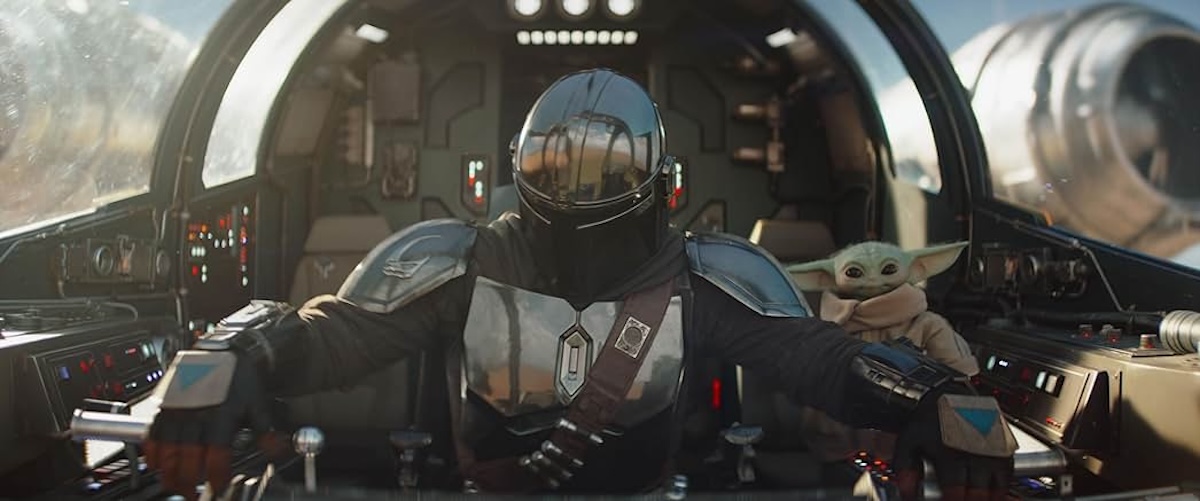
May the 4th be with us. That rallying cry was recently heard widely in public, on the lips and in the posts of the massive legion of Star Wars fans in our midst, in anticipation of the first new film in the franchise since the 2019 pandemic. For one very local example of Star Wars lore, the cheeky punk band Nerf Herder takes its name from an obscure reference in the franchise.

With the landing of Star Wars: The Mandalorian and Grogu, number 13 in the filmography going back 50 years, there is more ripe fodder for fans to talk and post about.
Not to belabor the personal angle, but I was one of those geeks — more generally cinephile-oriented than sci-fi obsessed — who trekked down to the Grauman Chinese Theater in Hollywood with pals to catch George Lucas’s new sensation in the summer of ‘76. And it was sensational, although I’ve only seen a few of the subsequent models in the series. This makes me a Star Wars agnostic: let that be a disclaimer for the review to follow.
The sound bite upshot on the latest? CGI- and AI-fueled carnage and excessive action trump narrative, character development, or empathy, in the main. But somehow, the entertainment popcorn factor works, at least in part. Or maybe that’s just the Star Wars–starved moviegoer impulse at work.

The basic plot finds Mandalorian bounty hunter Din Djarin (Pedro Pascal, who only liberates his handsome mug from his stern silver helmet late in the film) and his adorable pint-size Grogu (created via animatronics and puppetry) on a mission to rescue the enslaved Rotta the Hutt — the kindly son of the uber-evil Jabba. (Interesting that Rotta is played by Jeremy Allen White, who brings along the conflicted heroism of his roles as Bruce Springsteen and Carmy Berzatto in TV’s The Bear.
This was a film that might have been destined for the small screen. Jon Favreau, director and co-writer, moved over from the Marvel Universe and helmed the Disney TV series The Mandalorian, the intended fourth season of which morphed into the current big-screen model. In some ways, the film’s diminished expectations and finished project have the feel of compromised TV values in terms of ambition, forethought, and production.

At the sometimes sentimental (and happily so) core of the chase-and-shoot-em-up mayhem is the tight father-son-like relationship of the protagonists, the Mandalorian and the Grogu, who miraculously dodge the blur of violent weaponry and ammo aimed at them. When Djarin is incapacitated by poison — after proving himself invincible in all other conflicts and bullet showers— Baby Yoda works his magic, validating Djarin’s “the old protect the young and then the young protect the old. That’s the way it is.”
Amidst the sprawl and squall of the film’s CGI orgy, one of the surprise delights is suddenly hearing Martin Scorsese’s familiar N.Y.C.-caked voice in the cameo role as the four-armed Hugo Durant, a nervous and fast-talking street vendor. Small pleasures such as this spice of the joint, if too sparse.
Early in the film, a character grittily issues the telling mantra “long live the Empire,” which, in real-world, real-industry terms, could translate to “long live the franchise.” And its health meter is in good standing, with a Ryan Gosling–starring model slated for release next May, and more to come. The force is still very much with the indomitable monster that George Lucas unleashed upon the known universe, even if the latest entry doesn’t quite make the grade.





You must be logged in to post a comment.