This article was originally published in UCSB’s ‘The Current‘.
If your community was threatened by a wildfire, would you be able to quickly evacuate? A new study from the UC Santa Barbara reveals that the number of roads out of a community may be one of the strongest predictors of wildfire fatalities, and that a surprisingly specific threshold separates high-risk communities from safer ones.
Publishing in Proceedings of the National Academy of Sciences, researchers at UCSB’s National Center for Ecological Analysis and Synthesis (NCEAS) and Bren School of Environmental Science & Management compiled the most extensive georeferenced wildfire fatality dataset to date, covering 342 deaths across the United States from 2008 to 2024. They found that fatalities drop sharply as communities gain more outward road access, but only up to about six exits. Beyond that point, additional roads offer little further protection.
“The threshold near six exits held remarkably consistent across geographies and communities of different sizes,” said lead author and NCEAS researcher Caitlin Fong. “That tells us it’s a structural constraint, not a demographic one. Road redundancy is what saves lives.”
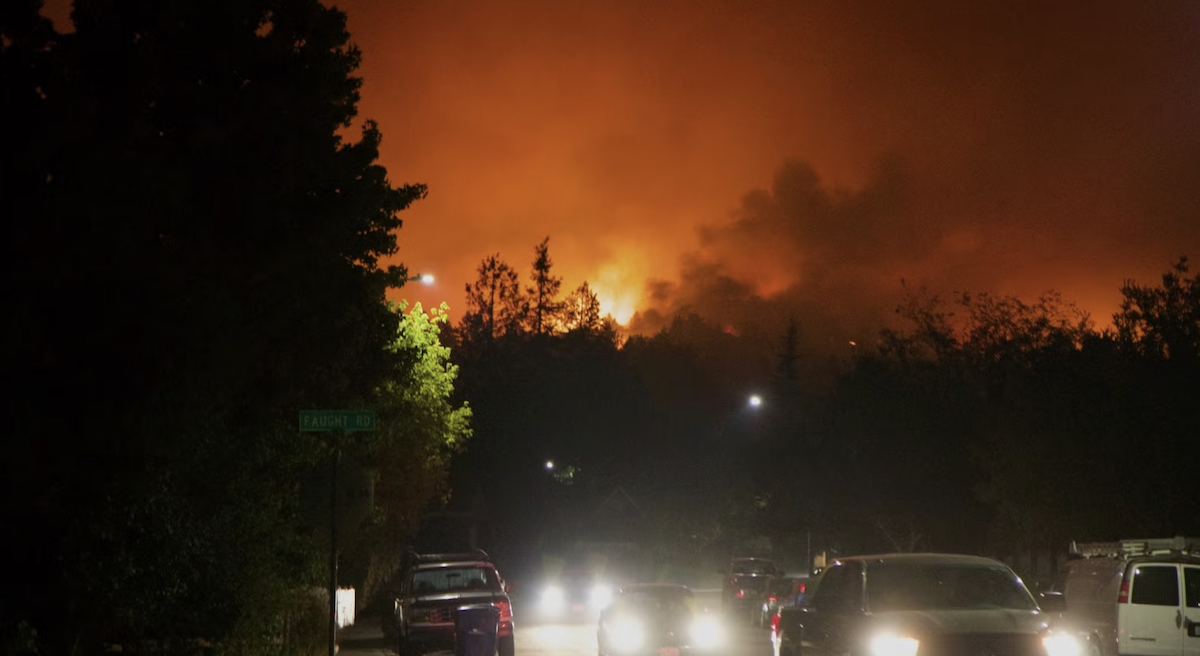
The pattern is visible in some of the country’s most devastating fires. In the 2018 Camp Fire, 66 of 86 total fatalities occurred in Paradise, California — a town with six outward roads that offered limited functional redundancy as fire and gridlock converged. In 2023, 102 people died in Lahaina, Hawai’i, a town with just four exit routes. In Berry Creek, California, 13 people were killed during the 2020 North Complex Fire; the community had only two exits.
To assess the scale of the problem nationally, the research team combined egress data for every U.S. community under 50,000 residents with wildfire hazard maps and census population counts. Their findings are striking:
● 17.7 million people live in communities below the critical six-exit threshold
● 2.5 million of those people live in communities that also face high wildfire hazard
● 528 communities have no major road exits at all — spread across 41 states
● High-risk hotspots exist not only in the West, but also in Oklahoma, Florida, and Hawai’i — states not typically central to national wildfire policy
“Seventeen million Americans are living in communities that, by this measure, are not designed to survive a fast-moving wildfire,” said co-author Max A. Moritz, UC Cooperative Extension Wildfire Specialist for the state of California. “That should be a wake-up call — not just for California, but for every state that thinks wildfire isn’t their problem yet.”
The researchers emphasize that road-building alone is not a complete solution — steep terrain, ecological constraints and cost make new roads impractical in many places. They point instead to three complementary approaches: expanding egress infrastructure where feasible, improving early warning systems and evacuation behavior, and investing in pre-planned shelter-in-place options like Temporary Refuge Areas for when evacuation fails.
The team’s risk maps, covering all small U.S. communities, are publicly available and designed to help planners, emergency managers, and policymakers prioritize where to act first.
“People think of wildfire as a Western problem,” said co-author Benjamin Halpern, director of NCEAS. “But we found communities with dangerous combinations of limited roads and high fire risk in places that don’t get a lot of attention. And as climate change expands fire hazard, that gap is only going to grow.”
This research is part of the Wildfire Resilience Index, a project dedicated to building data-driven tools to help communities understand and build wildfire resilience. An interactive map of community egress and wildfire hazard across the United States is available. Learn more at wildfireindex.org.
The study was funded by the Gordon and Betty Moore Foundation.