

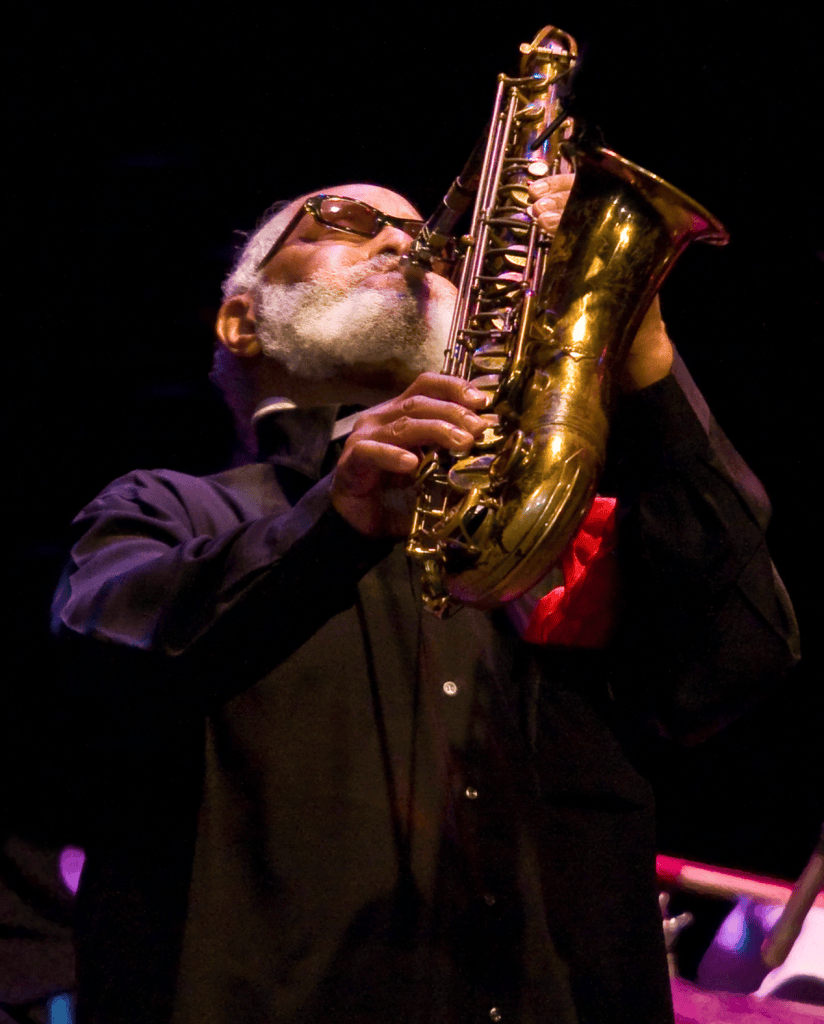
For obvious reasons, I’ve been binging music by the mighty and humble genius that was Sonny Rollins, who passed away at 95 on May 25. Trying to sum up “Hawk’s” status and contribution to jazz history, in which he is in the uppermost echelon, is basically an impossible task. A reasonable place to start in understanding his legacy is by listening to the recent era-crossing compilation Remembering Sonny Rollins (listen here), one of many Rollins Roundup packages available for living ears.
Other choice albums of note in his six-decade discography: Saxophone Colossus, his commanding and fittingly named 1956 album; The Bridge, with guitarist Jim Hall, which commemorates his post-junkie period of practicing and regaining strength by playing under the Williamsburg Bridge; Tenor Madness, with his eminent comrade John Coltrane; The Solo Album, in which he, equipped with only his horn, demonstrated the ensemble inside his head; and, bringing up the rear, his final studio album, Sonny, Please.
That album was released in 2006, the year of his first of two poetic powerhouse concerts in Campbell Hall, with a welcome return in 2009. In 2006, the first standing ovation for the two-hour show came when the master took the stage. On those memorable nights at the Campbell, we recall epic — but never too long — solos that seemed to microcosmically summarize jazz history, a history he was a major part of. I heard similar epic and epiphanic solos at festivals in Monterey and Toronto, and at the Roman amphitheater venue of the Vienne Jazz Festival in France. Those moments bubble up and stand apart happily from my jazz-packed memory banks.
But these are all just details and doorways into the man’s legacy. How to convey his artistry and his personalized language of questing?
When our kids were young, my wife was helping out in the classroom with art lessons and one day brought along Rollins’s best-known classic, the renewably joyous “St. Thomas” for creative inspiration. One of the children’s faces lit up, and he rightly, grinningly described it as “tropical music!”
The Harlem-born Rollins, whose mother was, in fact, from Saint Thomas, could go tropical with ease. He could also go hard bop and balladic glow and full-body solo mode, the outskirts of avant-garde; he could go Way Out West with “I’m an Old Cowhand,” and any which way his muse’s winds blew. He was the full package, solid and complete, and yet ever malleable, open to the moment.
In one of the interviews I did with Rollins, in the lead-up to his 2009 show in town, he asserted that “jazz is just so life-affirming. You can just do so much. It’s really the music of today and tomorrow. There’s no doubt about it. I can’t wait to get to my horn.
“After we get through talking, it’s time for my practicing. People say to me, ‘Gee, you still practice every day?’ And I say, ‘Yeah, I still practice every day,’” he said, with a laugh. “‘There is no end to trying to get better musically. Yes, I still practice every day.’ People can’t understand things like that.”
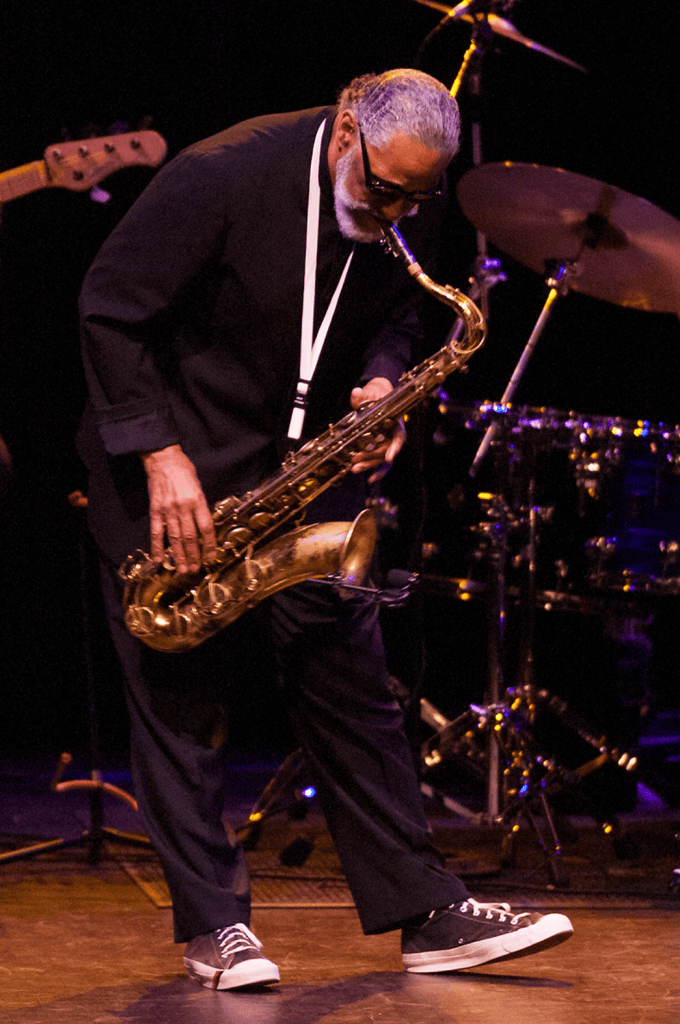
Maybe some people think you should be cruising by now, I suggested.
“Right. They think I should be out on the tennis court or out playing golf. That’s sort of an offensive thing to me. In fact, I know some great musicians…. I don’t know, I can’t be critical, but how can you waste your time when there’s music to be made?”
In a 2002 interview, we discussed the balancing act of jazz’s intellectual element and its accessibility to reach beyond the jazz insider audience. He told me, “I’d like people to be somewhat uplifted and entertained, in quotes, as well as getting something intellectual out of the music. It’s one of those things. I’d like to be able to do both. I think, through the third-world music that I’ve been playing, that gives me a bridge to be able to get to people who I might not ordinarily get to, and maybe convert some people.
“But then again, to me, jazz doesn’t have to be straight-ahead playing, with fast changes and this kind of stuff. That is jazz, but jazz doesn’t have to be only that. Jazz is much more than that, in my view. I’m glad that when people see me, they feel that they’re getting entertained in a way. That can be such a demeaning word, I hate to say it…”
The e-word?
“I certainly don’t set out to entertain. I don’t want to do that. But in the course of what I’m doing, if they feel entertained or they feel positive vibrations, that is more the way I’d like to see myself, as giving them uplifting, positive vibrations. There’s nothing wrong with that. Well, that’s me. I’m not putting it on. I’m just being myself and going through a performance. I hope it’s okay, but this is what I do,” he laughed.
A world without Sonny Rollins is a world without one of the last remaining undisputed jazz giants from the golden era. Let us pay due respect and listen up. Binging is allowed.





You must be logged in to post a comment.