

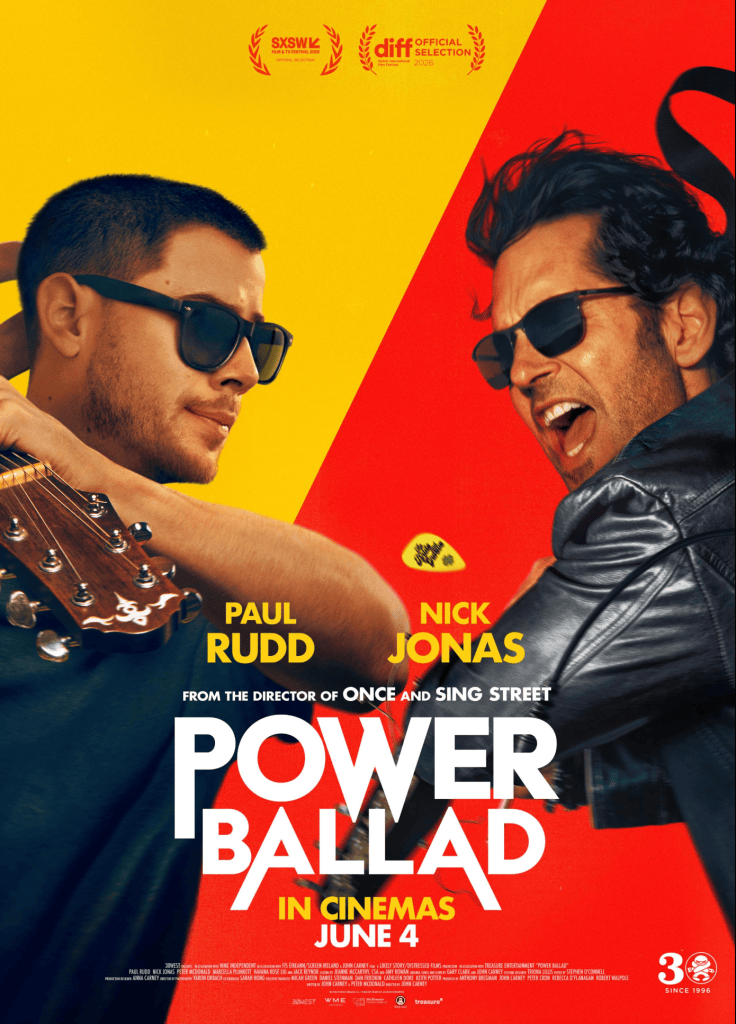
Paul Rudd is not just America’s funny man and sexiest man alive for a year anymore. As of his role in the new film Power Ballad, Rudd impressively struts his stuff as both a convincing serious actor and a more than decent singer, at least by wedding band standards. There he is on the big screen, as Rick Power, an American living in Ireland, fronting the wedding circuit band called Bride and Groove, belting out the likes of “The Boys are Back in Town” and “Summer of ’69” for dance-feverish wedding parties.
But, like many a working musician, he harbors bigger dreams of stardom and hit-making, which he got a taste of years earlier, before the business of family rearing interrupted his show biz ascent. A new possible avenue to music industry success and global ears comes through a chance meeting with a reforming boy band star, played and sung by an actual Jonas brother, Nick. That’s where the plot thickens and the music industry morality play begins.
And that’s where we recognize the music movie touch and obsession of Irish writer-director and formerly frustrated musician himself, John Carney. Almost famously, Carney created an indie film sensation nearly 20 years ago with his low budget/high box office charmer Once, about a singer-songwriter-busker, and went on to plow similar music-related storyline fields with Begin Again — with Mark Ruffalo and Keira Knightley — and Sing Street, in 2016. Between then and now, he has been busy working on TV’s Modern Love, but the director — himself a musician before turning to cinema, and co-writer of the film’s signature song, “How to Write a Song Without You,” returns to his old flame of a subject, and scores.
With Power Ballad, Carney leans on his natural and heart-on-sleeve storytelling gifts, grounded in the hot-then-cold relationship of the aspiring musician Rudd and the pop star between roles, searching for the song that will save his career. As recovering boy band star Danny Wilson, Jonas is a reasonably good actor, until the façade cracks during an emotionally intense confrontation with Rudd’s character, whose basic song idea he has shamelessly plagiarized and turned into a career-saving hit. As stated in the heat of that dramatic fight, the question of being “real” vs. a narcissistic pop star detached from mortal concerns and ethics becomes a presiding theme, suddenly rising to the surface.
Now having tasted success and the machinations of working in Hollywood and criss-crossing from Ireland to America for his productions, Carney has been in the belly of the beast. In his latest film, Carney levels a few blows against the ingrained moral turpitude and sometimes mobster-like tactics of the music industry at its higher levels. From the angle of artistic practice, he also deals with the slippery business of creative collaboration and credit due for intellectual property, and the inequities of power, usually favoring the rich and famous.
Surprisingly, although Power Ballad has wooed many critics and normal film-going citizens, it hasn’t caught on with the citywide release crowd. Maybe Dad Rock and power ballad fodder aren’t high on the public hit list these days. But the film, intriguing as recommended Rudd fare and with an agreeably sentimental gooey center, takes its rightful place on a list of fairly recent music films worth watching and listening to — Song Sung Blue, Her Smell, and Lurker among them (not to mention the more biopic-y spotlights on Springsteen and Dylan).
Speaking of earwormy power ballads, the song at the center of the film, “How to Write a Song Without You,” holds up under multiple plays and stubbornly refuses to leave you when you leave the theater. Which version is more “real?” You be the judge: Nick Jonas version here, Paul Rudd version here.










You must be logged in to post a comment.