
The “monsoonal flow” bringing slightly humid heat to Santa Barbara is pushed by a ridge of strong high pressure circling clockwise from the Midwest, across Mexico, and up the coast, dragging humidity with it. Similarly, the big El Niño forecast for this winter comes from afar, the waters of the tropical Pacific Ocean which have become extra-heated this year.
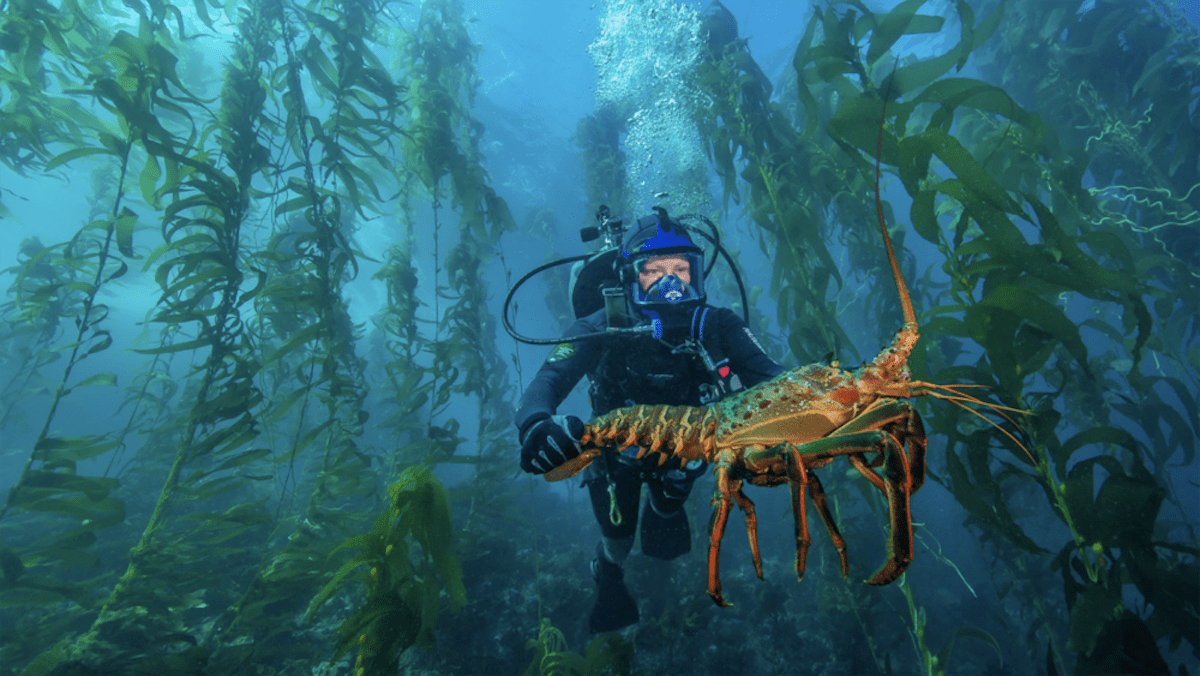
In Santa Barbara, the system named for the Christ child can bring anything from torrential rain pounding the hillsides to relatively arid conditions. Most predictable are the marine effects: more lobsters and tuna but fewer sea lion pups and blue whales in the waters surrounding the Channel Islands.
An El Niño starts its life in the central Pacific, where the waters that stretch nearly halfway around the planet, or more than 12,000 miles from South America to Indonesia, warm up beneath the equatorial sun. Comparatively, the Atlantic Ocean is a mere 2,848 miles at the equator. This very large mass of warm Pacific Ocean influences the weather worldwide as it heats the air above it.
For decades, a string of buoys has taken a number of measurements, among them ocean drift speeds, salinity, and temperature at the Pacific equator, explained Qinghua Ding, a climate scientist at UC Santa Barbara. While temperatures this year have risen by as much as 4.8° Fahrenheit above normal, more important for an El Niño are the winds.
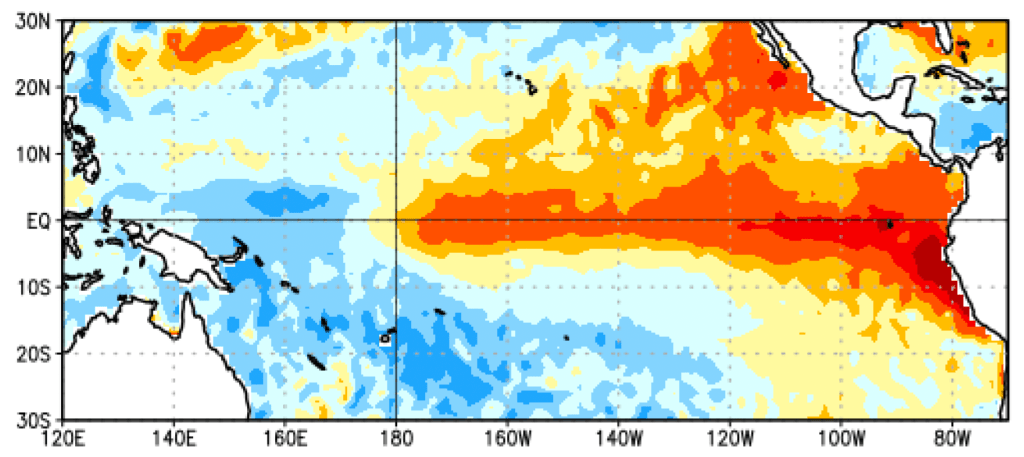
The trade winds are today wafting toward South America, keeping the warm surface water against the coast. From there, the waters migrate north toward California and south toward Chile. The heat gives the cold water in the deeps little chance to surface, which they normally would do when the winds blow in the other direction, or to the west — the cold, nutrition-laden waters can then upwell and feed the coastal Americas.
Weather mavens are calling the hotter water cause for a “super” El Niño, or what the more disciplined meteorologists at the National Weather Service (NWS) call “strong to very strong” weather patterns from October through February. As to rain and storms, Robbie Munroe, a meteorologist at the NWS offices in Oxnard, stated that winter storms could grow stronger as they tap into the energy in the warm waters. More powerful storms would deliver big surf, beach erosion, and rip tides, as well as rain and thunderstorms.
His caveat was the El Niño of 2015-16. It too demonstrated “very strong” above-normal ocean temperatures across the equator, “but a ridge of high pressure protected Southern California for most of the winter. Though there were active storms, they pivoted toward Northern California and the Pacific Northwest,” Munroe said. The rainfall total across Santa Barbara County was 69 percent of normal that winter.
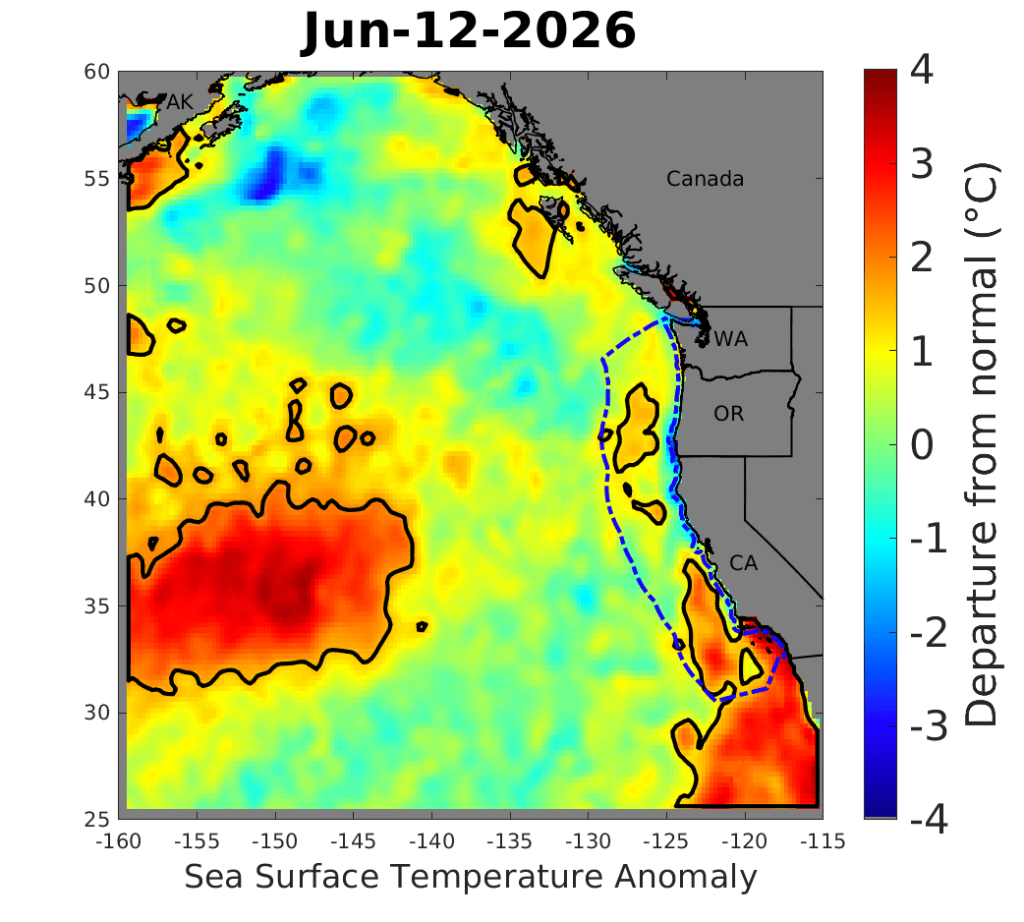
One wild card in the mix is what the weather service calls The Blob, which it records at a marine heat wave site known as the Blobtracker. Currently, two Blobs sit off the West Coast, one they’ve been tracking since May 2025 and the other since May 2026. The Blob that formed this year lies about 600 miles west of San Francisco.
Researchers have tracked marine heat waves by boat, buoy, and satellite since 1982, documenting a Blob maybe twice a decade. However, since 2019, one or two of these huge pools of warm water has formed and then cooled every year.
The Blob identified in December 2025 remains just off the Baja and Alta California coasts, raising water temperatures by roughly 4°F. Known as NEP2025b, this Blob has grown to 1.4 million square miles, an area larger than the country of India.
In light of this year’s El Niño, the Blob that spanned 2013-15 is worth noting. It started in late 2013, and grew larger and relatively “hotter” through 2014 and most of 2015, said Dr. Andrew Leising, a NOAA oceanographer. On average, across its 756-day lifespan, the Blob grew about 4°F warmer and had spikes as high as 7°F. It was similar in size, if not duration, to the 2025 Blob, but slightly cooler. A dry El Niño followed in 2015-16.
“We face similar conditions this year as we head into the current El Niño, with a history of warmer-than-normal conditions due to ‘blob’-like marine heat waves leading into what is shaping up to be likely a ‘very strong’ El Niño,” Leising said.
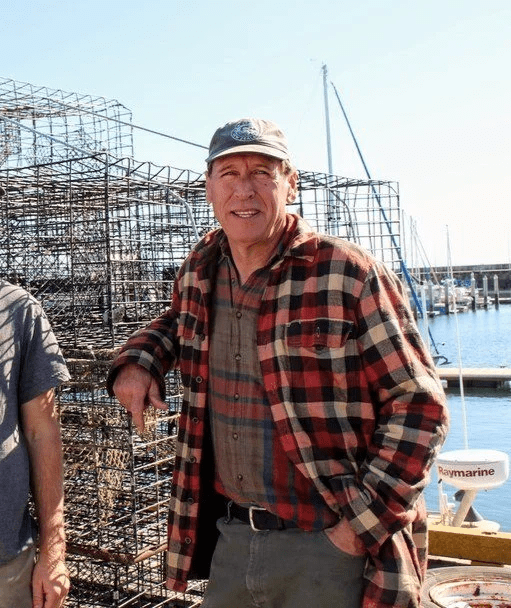
Counterintuitively, the Blobs are unrelated to El Niño. But when the warm waters persist from Blob to El Niño times, marine life can suffer. The warm conditions in 2013-2015 seriously damaged kelp forests off Northern California. A fisherman in Santa Barbara, Chris Voss, recalled that sea star wasting disease was centered around warm waters at the time, causing mass dieoffs. It reminded him of abalone withering disease, which closed that fishery in the 1990s.
In the case of the sea stars, a bacteria overpopulated their gut and made them unable to gain nutrients from their food; as a consequence, their limbs literally fell off. Among abalone, it was also a bacterial infection that caused their foot to wither and lose their grip on their rocky homes. Both infections were made worse by warmer water. Algal blooms containing toxic domoic acid also thrive in the warming waters, poisoning sea lions, an indicator species for a red tide.
No one watches the weather as closely as those who make their living from a boat. Chris Voss has fished all his life and is currently the president of the Commercial Fishermen of Santa Barbara. While a warmer Pacific has its downsides, it also has its upsides. Lobster season runs from October to March, much the same time period as this year’s El Niño. Voss remembered the 2014-15 lobster season as a good one with the warm waters increasing the 10-legged critters’ activity and growth.
Likewise, past El Niños have brought yellowfin closer to shore, chasing prey species seeking coastal upwelling. Tropical species like yellowbellied sea snakes and whale sharks have also come closer to shore, said scientists at an El Niño talk given at the Aquarium of the Pacific in June. And though sardine and anchovy almost vanished from Southern California waters during the 2014 heat wave, their larvae flourished off Oregon and Washington for the first time in years.
Voss anticipates that local conditions might offset the heated waters in the outer Pacific: “Strong sideshore winds bring upwelling along the coasts, and the many, many cloudy days have kept Santa Barbara cooler than the rest of the country.”
The band of cooler water along the coast is the upwelling dynamic that comes with Santa Barbara’s strong northwest winds. It’s what drives the nutrient cycle — the plankton and kelp that underpin all sealife. Voss observed, “Warmer water, when it comes to shore, is usually clear. It has low nutrients in it.”
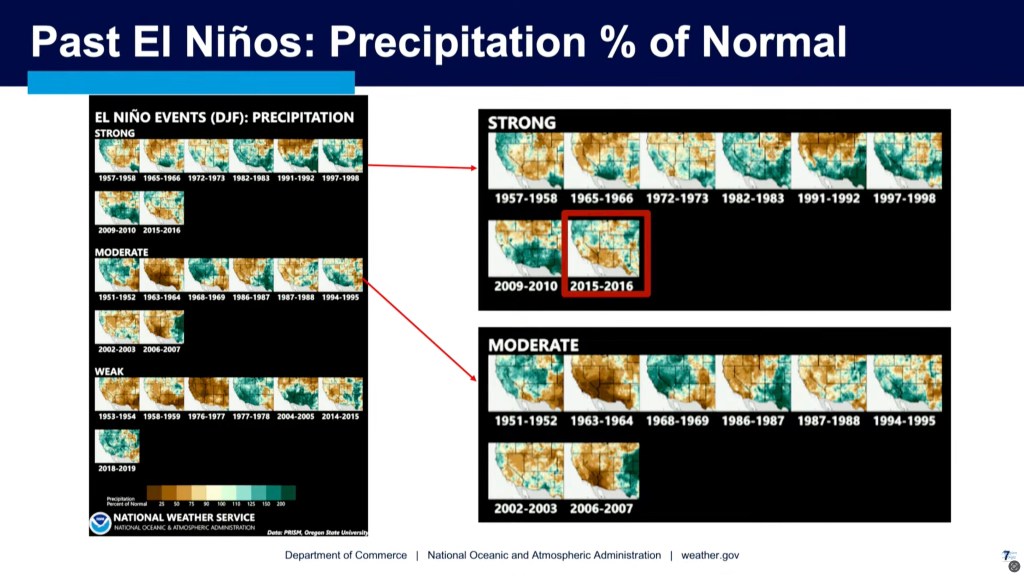
Heavy rainstorms along the coast may be unpredictable, but what is more certain for weather forecasters is what happens to the east. Those areas have the highest odds for big rains, said Ariel Cohen, an NWS meteorologist who spoke at the Aquarium of the Pacific. While it would be wet across the southern United States, the greater tendency for rainy, cold conditions would be in the southeast, Texas to Florida. It was a pattern that also created dry weather across Australia, northern South America, but rain across eastern Africa.
“It varies significantly across the globe,” Cohen said. “A strong El Niño advisory, still, doesn’t mean rain everywhere, but it significantly tilts the odds.”
For the fishermen, “without necessarily good reason,” Chris Voss said he was optimistic. “The length and amount of cloud cover and local conditions may protect us here to some limited degree,” he opined.
Though the science on El Niño is only about 60 years deep, Qinghua Ding chanced a forecast, despite the odds. He thought the weather this winter would be “a little above normal, a little wet, but not that wet.”
Related Posts


Premier Events
Sun, Oct 25
11:00 AM
Santa Barbara
Free Family Day: Día de los Muertos

Sun, Oct 25
12:00 PM
Fields of Funk

Sun, Oct 25
2:00 PM
Santa Barbara
Halloween Pooch Parade
Sun, Oct 25
3:30 PM
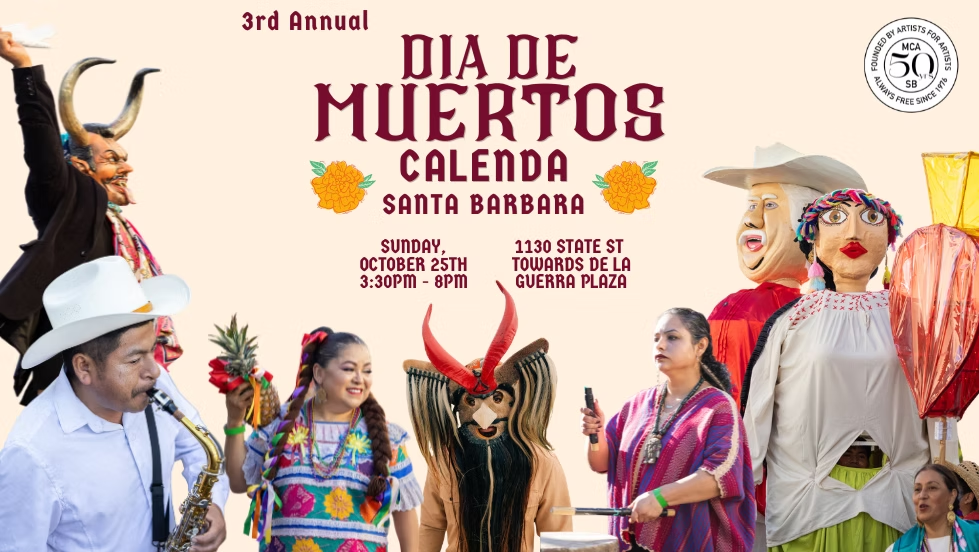
Dia de Muertos Calenda 2026
Sun, Oct 25
4:00 PM
Santa Barbara
S.B Revels Annual S.B Harbor Sing

Sun, Oct 25
7:30 PM
Santa Barbara
Comedy is a Drag Halloween Spooktacular
Mon, Oct 26
5:00 PM
Montecito
Halloween at The Speakeasy at San Ysidro Ranch
Mon, Oct 26
6:00 PM
Santa Barbara
Chaucer’s Book Talk & Signing with Jennifer Chassman Browne “See Us, Know Us: Profiles of Disability”

Wed, Oct 28
5:00 PM
Santa Barbara
Fundraiser for Domestic Violence Solutions
Wed, Oct 28
7:00 PM
Santa Barbara
Reel Rock 20 Climbing Film Tour
Sun, Oct 25 11:00 AM
Santa Barbara
Free Family Day: Día de los Muertos
Sun, Oct 25 12:00 PM
Fields of Funk
Sun, Oct 25 2:00 PM
Santa Barbara
Halloween Pooch Parade
Sun, Oct 25 3:30 PM
Dia de Muertos Calenda 2026
Sun, Oct 25 4:00 PM
Santa Barbara
S.B Revels Annual S.B Harbor Sing
Sun, Oct 25 7:30 PM
Santa Barbara
Comedy is a Drag Halloween Spooktacular
Mon, Oct 26 5:00 PM
Montecito
Halloween at The Speakeasy at San Ysidro Ranch
Mon, Oct 26 6:00 PM
Santa Barbara
Chaucer’s Book Talk & Signing with Jennifer Chassman Browne “See Us, Know Us: Profiles of Disability”
Wed, Oct 28 5:00 PM
Santa Barbara
Fundraiser for Domestic Violence Solutions
Wed, Oct 28 7:00 PM
Santa Barbara


You must be logged in to post a comment.