

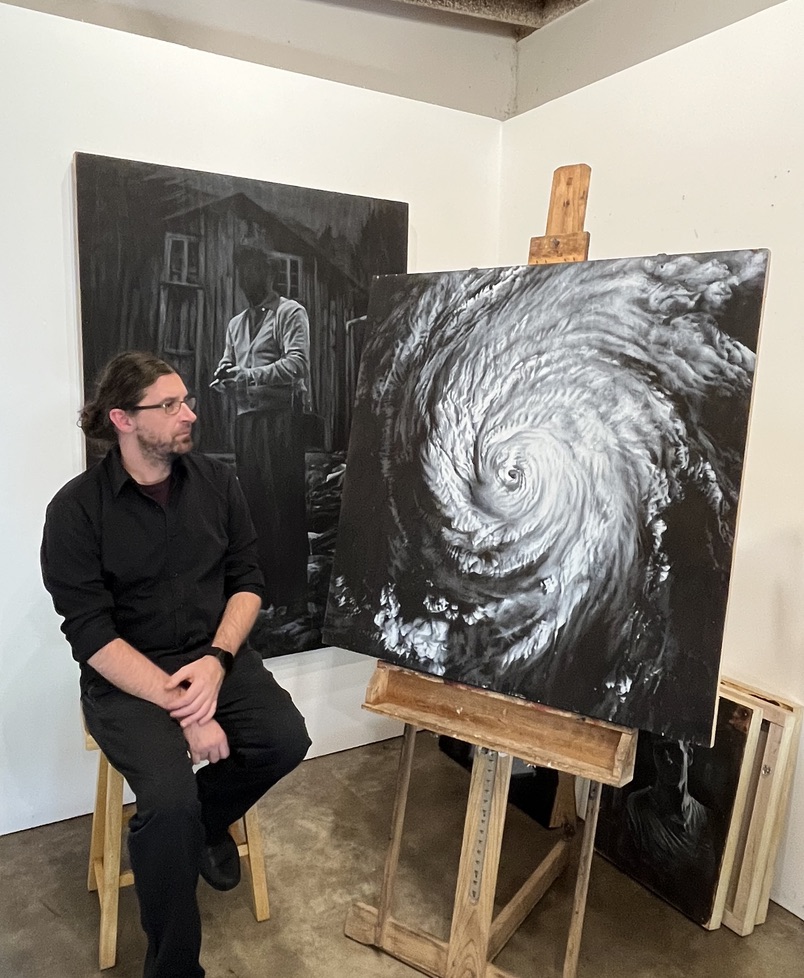
Working from photographs of family members and natural disasters, Tom Pazderka creates ash paintings that explore loss and the precariousness of existence. Based in Ojai, he has exhibited internationally for the past 20 years and is a featured artist with RubensteinContemporary.
I recently interviewed Tom in anticipation of his solo exhibition, All That Remains, at the Foxworthy Gallery at Allan Hancock College, on view from August 24 to October 2.
You’ve been painting with ash for about 10 years. I’m curious how that opened new possibilities.
There was a period when I got deeply into plant alchemy. I was really interested in it as a practice that brings together the practical with the abstract. The ash is a bit of a holdover from that time. I was studying what ash is, what it means, and its constituent parts — what it is physically and what it is abstractly or symbolically.
You get a sense of your physical process when viewing your paintings. You see drips running down the burned surface; you see gradations of gray ash and pigment.
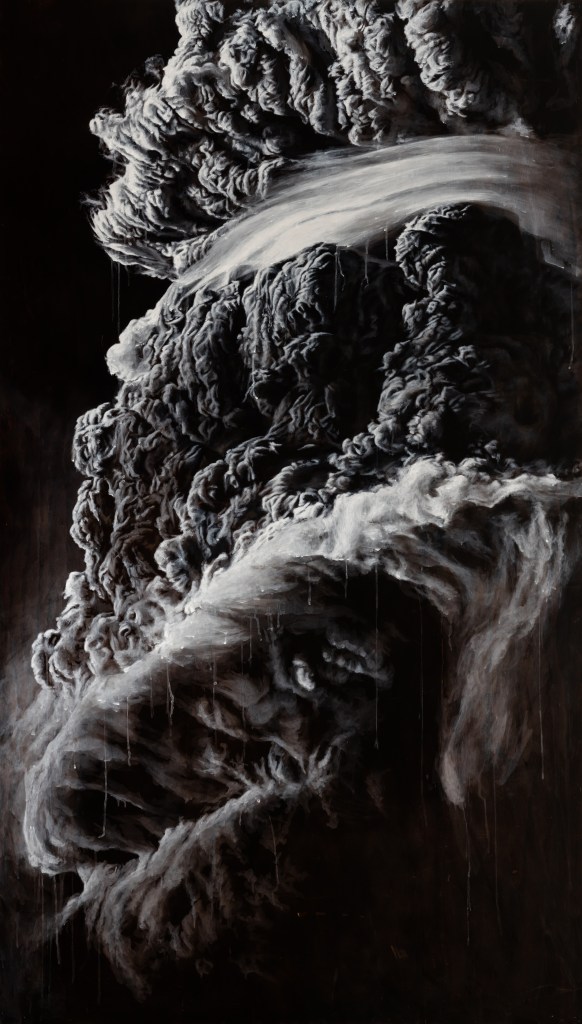
My interest has always been how to make something that is not only materially interesting but conceptually engaging.
The Nostalgie series became an exploration of material and its theoretical underpinnings. The first ash cloud paintings were, for all intents and purposes, an aesthetic experience. Once you see overwhelming natural phenomena, they have a powerful visual impact.
I’ve been through plenty of natural disasters, close calls of all sorts. On a symbolic level, I relate to disaster through the nature of entropy. The overt destruction you see in nature feels a bit like what psychoanalysis describes as the unconscious or the repressed, something that’s always inherent or latent in nature, suddenly coming to the surface.
What drives you to make work that engages with catastrophe?
You could think of what I do as aestheticizing disaster. If you’re in the middle of a disaster, you’re not having an aesthetic experience; you’re having a disaster experience.
For someone to understand something at a deeper level, the aesthetic experience has to come first so deeper analysis can begin. I experienced the ash clouds at a distance. By aestheticizing it, even a little, I’m creating a doorway into the experience.
You seem to approach your painting practice as an artist-observer, which is connected to a long tradition of making sense of the world through aesthetic experience. In the Family Album series, you use your family photos as an entry point to explore identity. Why did you repaint them?
There are a number of reasons. Some are conscious, and others are subconscious.
I would spend hours looking at them, partly because there are only so many. You don’t have this huge amount of photos that follow these people day by day, month by month, year by year. Instead, you have one snapshot from 1965, and then another from 1973.
I also think timing had a lot to do with it. I started the series in 2018, which was the year my mother moved back to Europe, to the Czech Republic. She had lived here since the early 1990s. At the time, I didn’t consciously connect those events, even though I had been looking at our family photographs for years. I’d never really felt compelled to paint them until then.
Looking back, I think it marked a transformation. It made me think about what it meant to be an immigrant, here with the family and on the cusp of starting something new, and then what it means when it ends.
So, with your mother’s move, did that experience of being on the cusp of something new feel like it ended for you as well?
I see it more as a point of departure for questioning the dynamic of who I am. The word immigrant carries so much, but I’d never really thought of myself that way. The label immigrant gets imposed on you. I’m a naturalized citizen now, but for years I had a green card that literally identified me as a “legal alien.” That’s your status.
So, the family album isn’t simply an exploration of my family’s history. I know my family’s history isn’t that interesting to everyone else. What it opens up are larger questions: Who are you? How are you perceived by others?
“Mother and Child” depicts you being held intimately by your mother, and it’s reminiscent of historic depictions of the Madonna of Tenderness.
The images of my mother and me are complicated, as they often are. There was something about the way the photograph was framed, and about her expression and my expression. It reminded me of Renaissance art. It struck me that someone took this photograph in the 1980s and basically recreated an archetype on film.
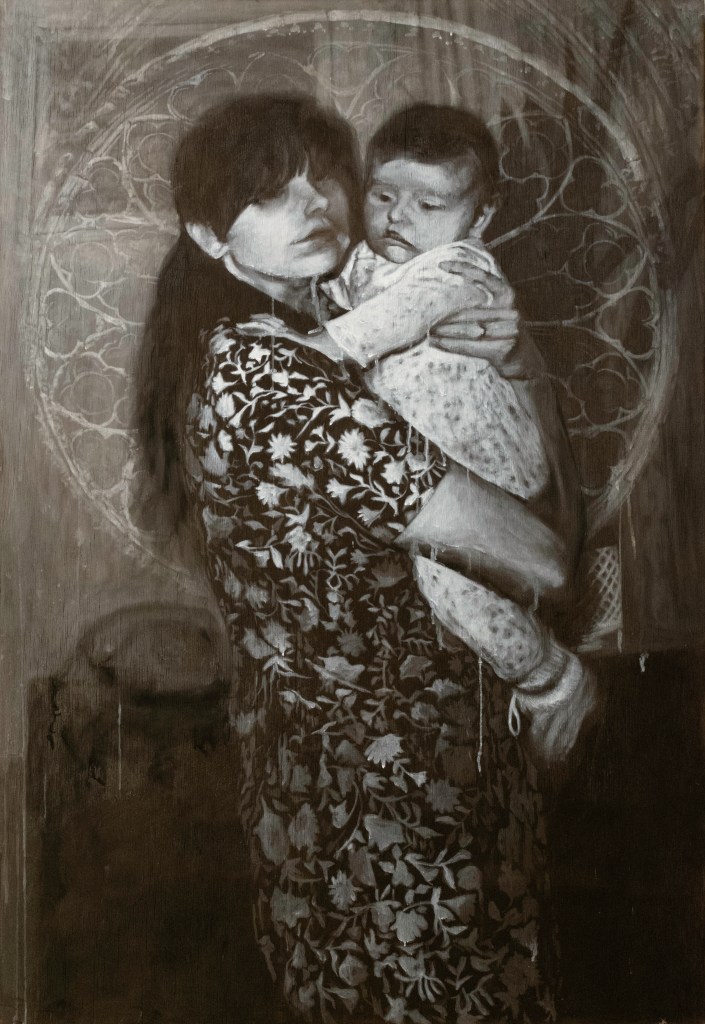
It’s also about connecting to a larger narrative — the broader symbolism of painting itself. Through my work, I want to feel connected to the history of art in that expanded sense. At the same time, it’s a way of connecting with my own family and my background.
What’s interesting is that the cheeks aren’t touching. I feel like that’s strangely symbolic. In many ways, we’re not actually connected anymore. My mother is in Europe, and I’m here.
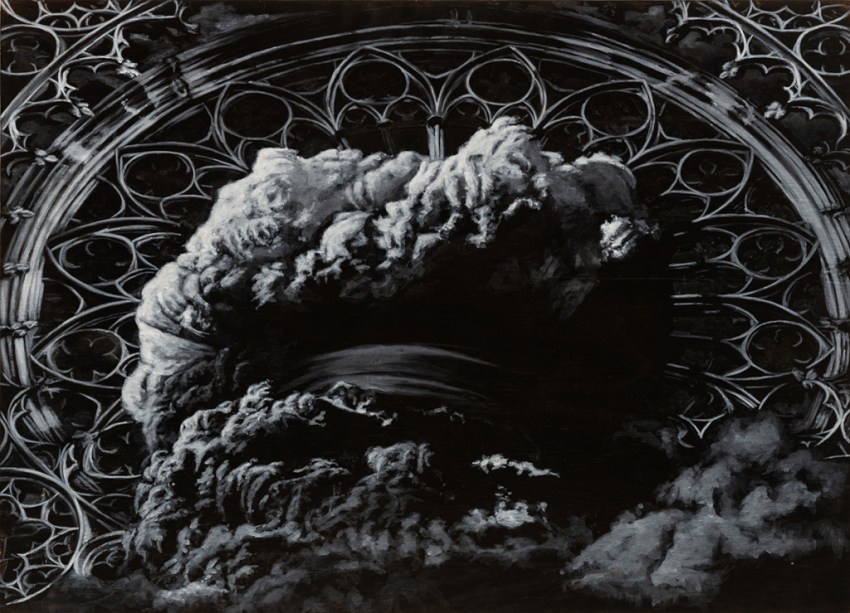
Talk about the rose window, which appears in both the Family Album and Nostalgie series.
I was deeply affected by the Gothic architecture of Central Europe and all these places with their severe, angular architecture, the stories surrounding them, and the heavy history. I spent much of my childhood running away from certain things, and then my adolescence and adulthood reconciling that. The Gothic window has become a symbol for that.
The rose window is actually rooted in the organic world — nature channeled through human aesthetics. It also appears with the ash clouds. If you really look at how clouds form, they follow many of the same principles as rose windows. I’ve read a lot about how nature operates mathematically, and those patterns exist everywhere.
There is a haunting quality to your painting, and the subjects, whether ash clouds or family, seem to exist in a transient state. Is that an intentional visual strategy?
They’re kind of like ghosts. Some of the paintings I’ve made are almost purposefully done that way. Part of it is simply aesthetic. But it’s also because I understand the entire scope of the world and human existence as essentially transient. On the scale of geological time, we’re here for just a split second, and then we’re gone. Understanding that, I think, is part of confronting your own mortality. In some ways, that’s the narrative behind the work, because the only way you’re really going to come to terms with your own mortality is through your own personal experience with it.
The goal was always to make something visually engaging that also offers a way into difficult subject matter.
All That Remains is on view August 24–October 2, at the Ann Foxworthy Gallery, Allan Hancock College (800 S. College Dr., Santa Maria). An Artist Talk & Reception will be held on Wednesday, September 2, 4-7 p.m. Seehancockcollege.edu/gallery/index.php
Related Posts
Premier Events

Sat, Oct 03
9:00 AM
Santa Barbara
Fall Plant Sale and Master Gardener Workshop

Sat, Oct 03
7:00 PM
Santa Barbara
Clean Comedy at Carrillo Recreation Center
Sat, Nov 14
7:00 PM
Santa Barbara
Clean Comedy at Carrillo Recreation Center
Sat, Dec 05
7:00 PM
Santa Barbara
Clean Comedy at Carrillo Recreation Center
Thu, Oct 01
11:00 AM
Santa Barbara
In Studio: Julie Anderson Mathias

Thu, Oct 01
7:30 PM
Santa Barbara
Robert Plant with Saving Grace and Suzi Dian

Fri, Oct 02
5:30 PM
Santa Barbara
Pet Blessing at Trinity Episcopal Church
Fri, Oct 02
8:00 PM
Santa Ynez
Comedian Ron White Performs at Chumash Casino Resort
Sat, Oct 03
9:00 AM
Goleta
Out of the Darkness Suicide Awareness Walk
Sat, Oct 03
10:00 AM
Santa Ynez
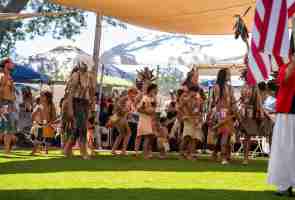
Chumash Intertribal Powwow Returns

Sat, Oct 03
10:00 AM
54th Santa Barbara Old -Time Fiddlers’ Festival

Sat, Oct 03
11:00 AM
Santa Barbara
OktoBEERfest at Dutch Garden Restaurant!
Sat, Oct 03
12:00 PM
Santa Barbara
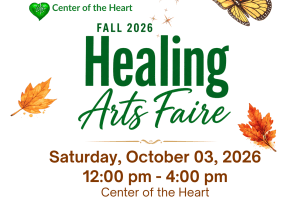
Reclaim Your Radiance Fall 2026 Healing Arts Faire
Sat, Oct 03
12:00 PM
Santa Barbara
CWC Docs: “SURFILMUSIC” (2026)
Sat, Oct 03 9:00 AM
Santa Barbara
Fall Plant Sale and Master Gardener Workshop
Sat, Oct 03 7:00 PM
Santa Barbara
Clean Comedy at Carrillo Recreation Center
Sat, Nov 14 7:00 PM
Santa Barbara
Clean Comedy at Carrillo Recreation Center
Sat, Dec 05 7:00 PM
Santa Barbara
Clean Comedy at Carrillo Recreation Center
Thu, Oct 01 11:00 AM
Santa Barbara
In Studio: Julie Anderson Mathias
Thu, Oct 01 7:30 PM
Santa Barbara
Robert Plant with Saving Grace and Suzi Dian
Fri, Oct 02 5:30 PM
Santa Barbara
Pet Blessing at Trinity Episcopal Church
Fri, Oct 02 8:00 PM
Santa Ynez
Comedian Ron White Performs at Chumash Casino Resort
Sat, Oct 03 9:00 AM
Goleta
Out of the Darkness Suicide Awareness Walk
Sat, Oct 03 10:00 AM
Santa Ynez
Chumash Intertribal Powwow Returns
Sat, Oct 03 10:00 AM
54th Santa Barbara Old -Time Fiddlers’ Festival
Sat, Oct 03 11:00 AM
Santa Barbara
OktoBEERfest at Dutch Garden Restaurant!
Sat, Oct 03 12:00 PM
Santa Barbara
Reclaim Your Radiance Fall 2026 Healing Arts Faire
Sat, Oct 03 12:00 PM
Santa Barbara


You must be logged in to post a comment.