

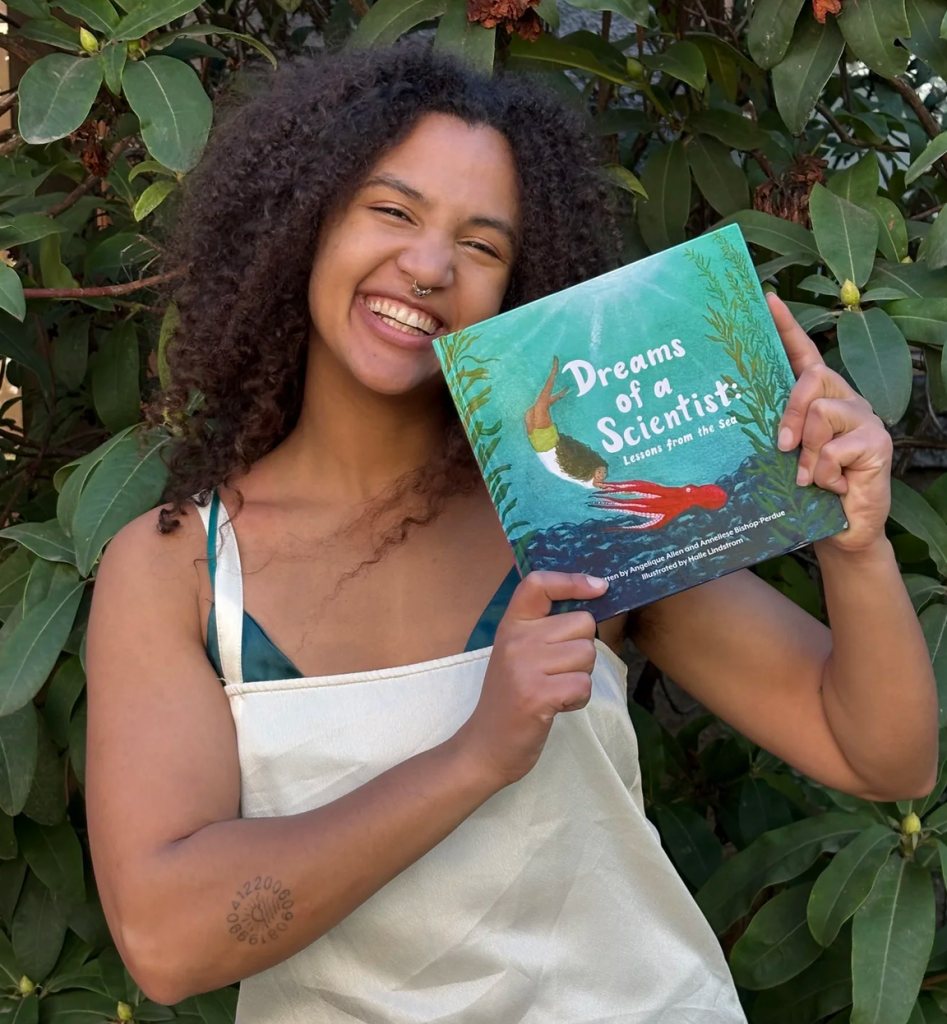
Angelique Allen, a doctoral student in the Institute of Neuroscience at University of Oregon, is as comfortable in a lab coat as she is creatively penning stories. In her studies, she’s adding to our understanding of how octopuses perceive the world around them.
If this seems like a heady subject, it is. In part, that’s why Allen has also worked to create easier access points to the cutting edge science she advances. She and colleagues created “Dreams of a Scientist,” both as a children’s book and a community of scientists whose mission it is to make science easier to reach through storytelling and art.
Allen brings her science-for-the-people mission to Santa Barbara this September 12 and 13 during the Santa Barbara Sea Glass & Ocean Arts Festival at Earl Warren Showgrounds. She says it’s a perfect fit. The audience of ocean lovers and artists will hear Allen’s latest discoveries in the field of octopus neuroscience and how her creative side hustle challenges the pigeonholed perspective that we operate strictly as right- or left-brained, scientist or artist.
Read on for Allen’s POV on mixing art and science, and visit santabarbaraseaglassandoceanartsfestival.com for full festival details and to buy tickets.
How did you get involved in the Santa Barbara Sea Glass & Ocean Arts Festival?
I am always on the lookout for unique places and ways to share marine scientists’ stories. At Dreams of a Scientist, we aim to help integrate science into local communities and everyday life, so when I heard about the Santa Barbara Sea Glass & Ocean Arts Festival I knew this would be an amazing way to share science with a group that already feels connected to the ocean. I was so excited about the idea of sharing how science and art can connect us to the ocean.
This festival is focused on ocean art; how does this intersect with your work through Dreams of a Scientist?
Dreams of a Scientist was born because three scientists (Halle Lindstrom, Anneliese Bishop-Perdue, and myself) wanted to connect people to the ocean and the scientists working to better understand it. We had seen time and time again how traditional scientific approaches of writing papers full of jargon and giving presentations full of acronyms prevents non-scientists from connecting with scientific discoveries. So we turned to art! Just like the festival, we create ocean art with the hope that by sharing stories and showing people the miracles of the ocean, we can inspire people to learn, connect with, and protect our oceans!
You study octopuses, and specifically how they think about what they see. Please unpack that. What’s an experiment or discovery you’ve recently made in this area?
Yes! I am getting my PhD in neuroscience at the University of Oregon, where I study how the octopus brain creates an image of the world around it, or their visual processing. I study the brain because I want to get a better idea of what octopuses and other cephalopods perceive, and to do this we have to go beyond just what information enters the eye! To study the brain, I look at brain activity in real time while presenting the octopus little movies. If you have ever had to go into those large white tubes in the doctors office for a brain scan, you may have gotten an FMRI, which is similar to what I give the octopuses.
What topics will you cover at the festival?
I am super excited to talk about both of my passions: our children’s book, Dreams of a Scientist, and my work in the lab. For the book, we turned a creative project into a community of people bound by their love of the ocean. In the lab, I will share what we’re learning about the octopus brain and how being immersed in studying animal perception has inspired and evolved my worldview and connection to the ocean.
Sea Glass Festival attendees are hooked on the hunt. They walk the coast looking for inspiration from the ocean. How does this activity overlap with the work of a marine biologist and your interactions with the ocean?
Sea Glass Festival attendees and scientists have a lot in common! In order to fully understand how something as complex as the brain or the ocean works, you have to look at it from all angles. You have to compare and contrast high tide and low tide, you need to flip over every rock, and you need to listen to that little voice that says, “But what if there is something really cool just a little further down the beach.” You need to look closely, but you can’t lose the big picture. And most importantly, you have to trust your experience and your gut.
Related Posts
Premier Events
Fri, Oct 23
2:00 PM
Santa Barbara
Music & Meditation: Clarinetist Nancy Mathison & Pianist Antonio Artese
Wed, Oct 21
6:30 PM
Santa Barbara
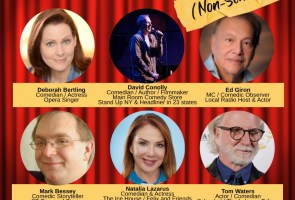
Teflon Comedy/Non-Schtick – Evening of Comedy
Thu, Oct 22
5:30 PM
Santa Barbara
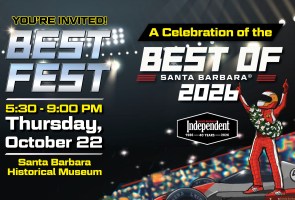
Best Fest: A Celebration of the Best of Santa Barbara® Readers’ Poll 2026
Thu, Oct 22
6:00 PM
Santa Barbara
Chaucer’s Books Author Talk & Signing- Daniel M. Jaffe “Russian Silhouette: A Memoir of Activism and Identity”
Fri, Oct 23
5:30 PM
Solvang
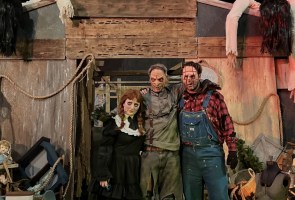
Solvang Haunted House and Street Fair
Fri, Oct 23
7:00 PM
Santa Barbara
This & That Performs at Roy
Fri, Oct 23
7:00 PM
Santa Barbara
Beth Amine’s 20th Anniversary Wildcat Dance Variety Show
Fri, Oct 23
9:00 PM
Santa Barbara
Casa de la Raza Fundraiser: Brasscals! with DJ Darla Bea
Sat, Oct 24
10:30 AM
Santa Barbara
Picnic in the Cemetery: A Live Historical Event
Sat, Oct 24
11:00 AM
Goleta
2nd Annual Charger Cup to Benefit DP High Golfers
Sat, Oct 24
12:00 PM
Santa Barbara
Makers Hive Market
Fri, Oct 23 2:00 PM
Santa Barbara
Music & Meditation: Clarinetist Nancy Mathison & Pianist Antonio Artese
Wed, Oct 21 6:30 PM
Santa Barbara
Teflon Comedy/Non-Schtick – Evening of Comedy
Thu, Oct 22 5:30 PM
Santa Barbara
Best Fest: A Celebration of the Best of Santa Barbara® Readers’ Poll 2026
Thu, Oct 22 6:00 PM
Santa Barbara
Chaucer’s Books Author Talk & Signing- Daniel M. Jaffe “Russian Silhouette: A Memoir of Activism and Identity”
Fri, Oct 23 5:30 PM
Solvang
Solvang Haunted House and Street Fair
Fri, Oct 23 7:00 PM
Santa Barbara
This & That Performs at Roy
Fri, Oct 23 7:00 PM
Santa Barbara
Beth Amine’s 20th Anniversary Wildcat Dance Variety Show
Fri, Oct 23 9:00 PM
Santa Barbara
Casa de la Raza Fundraiser: Brasscals! with DJ Darla Bea
Sat, Oct 24 10:30 AM
Santa Barbara
Picnic in the Cemetery: A Live Historical Event
Sat, Oct 24 11:00 AM
Goleta
2nd Annual Charger Cup to Benefit DP High Golfers
Sat, Oct 24 12:00 PM
Santa Barbara


You must be logged in to post a comment.