

The Commercial Fishermen of Santa Barbara (CFSB) say many young people lack the support to grow into fully fledged fisherfolk, even within the region’s established coastal economy.
“For years, our fleet has worked out of a harbor with no room to grow — no place to store gear, no space to train the next generation of fishermen,” said Kim Selkoe, PhD, executive director of CFSB.
With a $507,500 grant from the California State Coastal Conservancy, the group can begin to turn that tide.
The CFSB will use the grant to launch the Ocean Collective, a partnership with Santa Barbara City College (SBCC) dedicated to nurturing the region’s budding ocean workforce and expanding access to training.
Selkoe herself is not a fisherman. But she knows her stuff about Santa Barbara’s waters. She began her career as a marine biologist, working for years at UC Santa Barbara and studying marine ecosystems, such as coral reefs and kelp forests. She began educating the community about sustainable seafood as a hobby 20 years ago.
In 2016, she took on the role of executive director of CFSB, setting aside her research to “engage with the fishing community,” she said. For eight years, Selkoe ran Get Hooked Seafood, which linked small-boat fishermen with community members interested in sustainable seafood.
During that time, she found that Santa Barbara Harbor had little space for commercial fishing gear storage and no place for fishermen to repair their nets. Only a small percentage of boat slips were designated for commercial vessels, she found. It has only become “harder and harder to find affordable places near the harbor.”
“And we need workshop space to be able to teach how to build gear and repair gear, and there is no space anywhere in the harbor for that,” she said.
The need is great, and Santa Barbara’s blue economy is huge. It brings in an estimated $7.7 billion per year, according to Selkoe, and employs around 44,000 workers in industries such as fishing, tourism, and aquaculture. In the harbor alone, more than 100 small fishing boats bring in around $30 million annually, according to CFSB’s website.
CFSB and SBCC formally established the partnership in 2023. The idea was to take a piece of undeveloped land owned by SBCC and turn it into an incubator for young people interested in ocean jobs, while filling those gaps in access and training along Santa Barbara’s waterfront.
In 2025, Uplift Central Coast awarded SBCC a grant to begin the planning process. With funding from the conservancy, they can now implement an Ocean Careers Initiative and Ocean Collective facility on SBCC’s campus, the school said.
SBCC matched the conservancy’s grant with $50,000 of its own Strong Workforce state funding to complete the planning process.
“This funding turns more than a decade of planning into a real facility,” Selkoe said.
It also opens opportunities for a new generation and makeup of fishermen. Typically, a “fisherman” may conjure the image of an older white man, wrinkled and calloused from years chasing the day’s catch under the sun and sea spray. They pass down their talents to their sons, who pass them down to their sons, and so on.
“It is very white-male-dominated, so, if we want to diversify fisheries, then we need to create training programs to coach people who didn’t grow up with a dad who’s a commercial fisherman,” Selkoe said.
Additionally, fewer and fewer younger people, even in established fishing families, are choosing to pursue seafood as a career.
Every year, the average age of fishermen is rising because younger generations aren’t replacing them, Selkoe said. But that is not because of a lack of growth or interest in the industry.
Employers in the blue economy need skill sets they aren’t getting from their current applicant pools, Selkoe said. That’s not just fishing — there’s plenty of job opportunities in other sectors, such as sustainable aquaculture and captaining boats, she noted.
“And there are a lot of people who are fascinated by working on the ocean and really want to get into it,” she continued. So, what is the problem? Mainly, lack of access to training and entry points.
Conflicts over ocean space make entering the industry even more daunting, as the state considers expanding its Marine Protected Areas — zones of ocean protected against most human activity — and the Trump administration seeks to increase aquaculture opportunities but also open up the coast to new offshore drilling leases.
Even space conflicts between fisheries exist — this is not new, Selkoe said. The Ocean Collective, she noted, is intended to be an umbrella organization to find solutions and common ground, at least between fishermen and conservationists.
She said there are opportunities for synergies within Santa Barbara’s strong working waterfront, such as using fishing boats for research and development for burgeoning “blue tech.” And if new MPAs are added, fishing fleets will need to adapt, which studies on how fish move around these protected zones can help.
“Some of our problems are still persistent, even when you don’t allow fishing,” Selkoe continued. She mentioned urchin barrens, kelp die-offs, and increasing ocean temperatures.
“The Ocean Collective and CFSB are already working on new methods for kelp restoration that employ the fishing fleet, so it’s a win-win for conservation and for fishing livelihoods,” she said.
“The programming that we’re going to be developing with City College is tailored to the specific skill sets that employers are asking for,” she added.
Situated near the harbor and the Channel, the SBCC campus will host academic programming, including Associate Degrees and career technical certificates, supplemented by mentorship and internship opportunities with maritime professionals, the school said in a press release.
The program will focus on tribal youth and underrepresented groups, and it will prepare students for careers in fishing, shellfish and abalone farming, vessel maintenance, habitat restoration, and other blue-economy opportunities.
SBCC said the Ocean Collective’s maritime facilities will be developed on a 16,300-square-feet area of undeveloped land on the east side of Loma Alta Street, between SBCC’s Marine Diving Tech building and the campus footbridge. Design group RRM created the site plan and will guide it through state permitting, including Coastal Commission approval.
The new facility, it added, will address those “long-standing shoreside infrastructure shortages” mentioned by Selkoe by providing trailered boat parking, gear storage, and a fabrication workshop area that can be used by both the maritime community and SBCC classes. SBCC said the site will be “screened with landscaping to blend the facility into its coastal setting.”
“This is what’s possible when a college, a city, and an industry commit to solving a problem together,” said Dr. Erika Endrijonas, Superintendent/President of Santa Barbara City College. “SBCC is proud to match this funding and to be building a facility that will serve our students and the region’s maritime economy for decades.”
Coastal Conservancy funding comes from the Safe Drinking Water, Wildfire Prevention, Drought Preparedness, and Clean Air Bond Act of 2024 (a k a “2024 Climate Bond” or “Proposition 4”).
With that funding secured, CFSB, SBCC, and their partners, the City of Santa Barbara and the Economic Development Collaborative, will move forward on public rollout, pursue additional philanthropic and government support, and finalize project-specific agreements to advance coastal economic resilience, SBCC said.
Related Posts
Premier Events
Fri, Oct 23
2:00 PM
Santa Barbara
Music & Meditation: Clarinetist Nancy Mathison & Pianist Antonio Artese

Mon, Oct 19
7:00 PM
Santa Barbara
PFLAG Santa Barbara October Meeting: “Schools and Inclusive Practices – What creates a safe and inclusive school?”

Tue, Oct 20
7:00 PM
Santa Barbara
Get Out the Vote Night @ SOHO, Music Performance by Loyal Defense Workers

Wed, Oct 21
6:30 PM
Santa Barbara
Teflon Comedy/Non-Schtick – Evening of Comedy

Thu, Oct 22
5:30 PM
Santa Barbara
Best Fest: A Celebration of the Best of Santa Barbara® Readers’ Poll 2026
Thu, Oct 22
6:00 PM
Santa Barbara
Chaucer’s Books Author Talk & Signing- Daniel M. Jaffe “Russian Silhouette: A Memoir of Activism and Identity”

Fri, Oct 23
5:30 PM
Solvang
Solvang Haunted House and Street Fair
Fri, Oct 23
7:00 PM
Santa Barbara
Beth Amine’s 20th Anniversary Wildcat Dance Variety Show

Fri, Oct 23
9:00 PM
Santa Barbara
Casa de la Raza Fundraiser: Brasscals! with DJ Darla Bea
Sat, Oct 24
10:30 AM
Santa Barbara
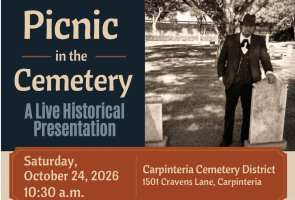
Picnic in the Cemetery: A Live Historical Event
Fri, Oct 23 2:00 PM
Santa Barbara
Music & Meditation: Clarinetist Nancy Mathison & Pianist Antonio Artese

Mon, Oct 19 7:00 PM
Santa Barbara
PFLAG Santa Barbara October Meeting: “Schools and Inclusive Practices – What creates a safe and inclusive school?”
Tue, Oct 20 7:00 PM
Santa Barbara
Get Out the Vote Night @ SOHO, Music Performance by Loyal Defense Workers
Wed, Oct 21 6:30 PM
Santa Barbara
Teflon Comedy/Non-Schtick – Evening of Comedy
Thu, Oct 22 5:30 PM
Santa Barbara
Best Fest: A Celebration of the Best of Santa Barbara® Readers’ Poll 2026
Thu, Oct 22 6:00 PM
Santa Barbara
Chaucer’s Books Author Talk & Signing- Daniel M. Jaffe “Russian Silhouette: A Memoir of Activism and Identity”
Fri, Oct 23 5:30 PM
Solvang
Solvang Haunted House and Street Fair
Fri, Oct 23 7:00 PM
Santa Barbara
Beth Amine’s 20th Anniversary Wildcat Dance Variety Show
Fri, Oct 23 9:00 PM
Santa Barbara
Casa de la Raza Fundraiser: Brasscals! with DJ Darla Bea
Sat, Oct 24 10:30 AM
Santa Barbara

